
Before we get started today, a plug for another event: Come on out and join the A City That Works crew to talk housing (and anything else) with Alderwoman Leni Manaa-Hoppenworth (48th) on Wednesday, June 3rd. We’ll be at Pasteur starting at 5:30. Register here to let us know you’re coming.
We all get sucked into the noise or controversy of the moment. But we think it’s pretty important to try to take the long view. So, last year we published our first scoreboard, looking at a set of key outcomes for Chicago – both relative to the prior year, and in comparison to our big city peers (New York, LA, Houston and Phoenix).
Now it’s time for a refresh. We’ve pulled the same metrics (with some minor adjustments). They tell a nuanced story about how the city is doing. Let’s dive in.
Population: Chicago’s population grew again in 2025, up by .02% and nearing our recent pre-Covid high. That’s an important psychological marker. It also has real implications for our broader financial health: 80% of our pension obligations goes to pay benefits that have already been accrued by city workers, so more people spreads the overall financial burden, and reduces the tax hikes or service cuts required to balance our books.
But it’s worth noting that we’re still growing more slowly than our peers. Notably, Houston added almost twice as many residents in the last year as Chicago did.
Economic growth: Unfortunately, most of the municipal-level economic data only runs back to 2024, and covers the region as opposed to the City proper. It’s also unfortunate that the picture is rather mediocre. Chicago remains a large, diversified economy, but in 2024 GDP grew at a rather weak 1.43%, far slower than our peer city average. On a per capita basis things look a little better – Chicago’s 3.85% growth was only slightly behind the 4.6% average of other cities.
There are some nice bits of good news when looking at more vulnerable residents. Chicago’s unemployment and poverty rates are both a bit lower than the average for our peers. It’s particularly encouraging to see the share of residents living below the federal poverty line fall by two tenths of a percentage point.
Public Finance: Here we remain on quite rockier footing. Start with our municipal bond ratings. Our peers typically enjoy ratings in the AA to AA+ range, signifying a very low risk of default. Most of their ratings are unchanged in the past year, with only one seeing any downgrades (S&P lowered Los Angeles from AA to AA-). Chicago remains quite low in contrast, with ratings ranging from Baa3 at Moody’s to A- at Fitch as of 2025 year-end. We also saw a downgrade last year, with S&P lowering the city’s rating from BBB+ to BBB in January 2025.
This remains genuinely costly to the city. At present, A-rated municipal bonds have interest rates that are 50-60bps higher than AAA-rated ones, and given our BBB ratings, Chicago’s securities bear an even higher interest rate. With a Baa3 rating at Moody’s, we also remain just one notch away from junk rating, which would likely cause a significantly higher rate as well (according to Goldman Sachs, as of March 2026 spreads on high yield municipal bonds were around 190bps higher than those on investment grade bonds).
And our underlying fundamentals remain quite weaker than peers as well. While our pension funding rate improved slightly year over year, it remains at an abysmal 26.2% funded as of 2024 year-end, compared to over 80% for our peers. Our total long-term debt and pension liabilities remain quite high as well, at nearly $24,000 per Chicagoan. That’s more than twice the average of our peers, and about 40% higher than our nearest peer city. The reality is that by any reasonable metric, our public finance burdens remain very bad compared to other big cities.
Public Safety: In 2025, the best news came on public safety. 167 fewer Chicagoans were murdered in 2025 than 2024. In aggregate, the homicide rate per 100,000 residents fell 30% – with similar improvements in non-fatal shootings and robberies. That’s a jaw-dropping improvement, and it significantly outpaced the 18% decline among our big city peers (notably, the prior year murders slowed in Chicago at a slower rate than our peers).
167 lives should be enough – but the benefits go much further than that. In 2025, parents could feel a little safer letting their kids play outside. It was less dangerous to come home at the end of a late-night shift. And the case to build homes or businesses in long-disinvested neighborhoods got a little bit better. When violence recedes, it becomes much easier to address so many of our other challenges.
Of course, the bad news is that we’re still an outlier. Chicago’s homicide rate is double that of our big city peers – and more than times the rate of New York. We still have a lot of work to do, and unfortunately the trend hasn’t continued so far this year – through May 16, homicides are up 5%.
Transportation: Transit ridership continued to recover in 2025, with trips rising by 9% on a per-capita basis. That’s solid progress, even if we’re still likely to return to pre-Covid ridership levels anytime soon. It’s worth noting that this is one of a number of metrics where Chicago really doesn’t look anything like any of the individual cities in our peer set. The average New Yorker rides the MTA once per day (350 trips/year). The average Angeleno uses transit at about 2/3rds the rate of Chicagoans (which is better than you’d expect) – and ridership in Houston and Phoenix is negligible.
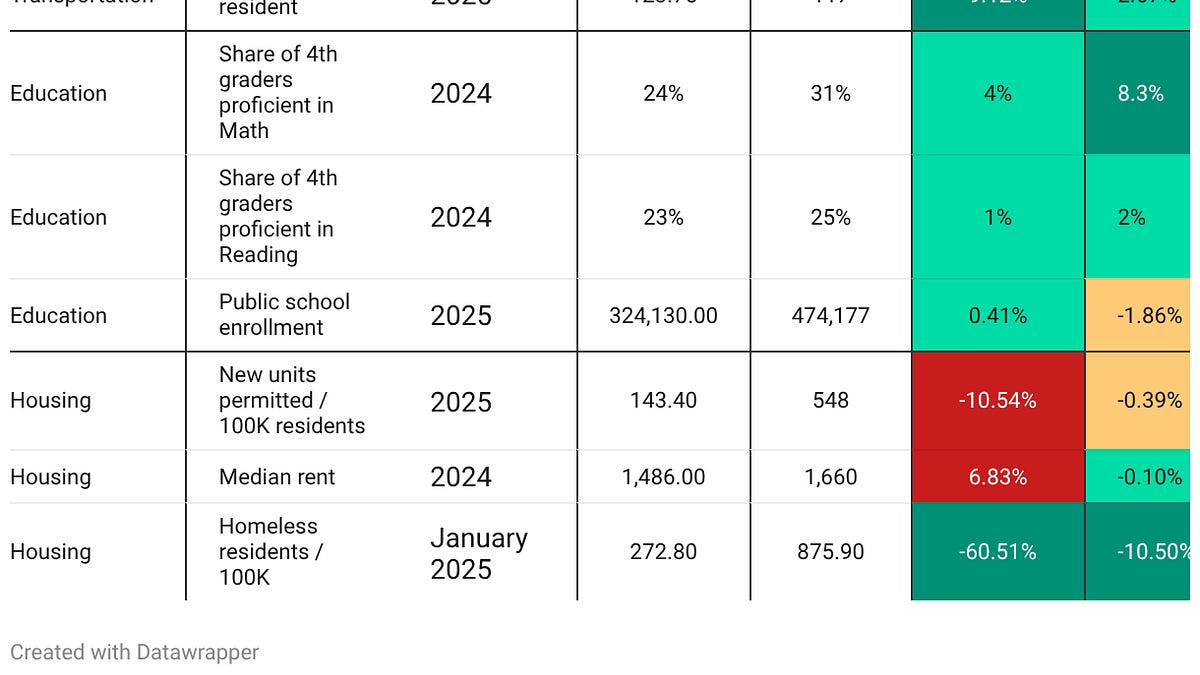
Education: Here’s where things get ugly again. The National Assessment of Educational Progress only provides district-level data every few years. So this time around, we’re comparing Chicago (and peer districts) based on 4th grade reading scores in 2022 and 2024.
In 2024, just 24% of Chicago 4th graders meet the bar for proficiency in math, and just 23% met national reading proficiency standards. Those numbers are significantly worse than our peers. And while they represent an improvement from Covid-era lows (albeit not a statistically significant one), Chicago Public Schools fourth graders made half as much progress as our peer school districts did over that period. Notably, this isn’t just an affect of a proficiency cutoff – the average scaled scores for Chicago 4th graders in math and reading are also worst among our peer schools.
Of course, lots of things go into student achievement. But it’s worth noting that this is a pretty fair peer group to compare CPS to – as you can tell above, Chicago’s per capita income and poverty rates closely track the other districts in this sample. But our schools are performing far worse – and the gap is growing.
Housing: This one hurts too. In 2024, median rents grew 7% in Chicago, while staying flat across our peer group. We can expect more pain in the future. In 2025, we built roughly a fourth as many new housing units (per capita) as the rest of our peer set. We were dead last among our peers in 2024, and then watched our new construction rate fall even further this past year. That means we’ll continue to see our historic affordability advantage erode – and more families struggle to make rent.
There is one really positive story to note, however. We continue to have far lower rates of homelessness than most of our peer cities (likely due to a combination of lower-rents, and a point-in-time count that’s conducted in the middle of winter). And the number of homeless residents dropped dramatically – driven largely by the fact that the surge of new arrivals occupying City shelters as of the 2024 has subsided. The fact that those folks are not (largely) showing up on the streets or continuing to cycle through the shelter system is really good news for everyone.
A challenging outlook for 2026
You can total up these numbers, and come to a variety of conclusions. It’s good that our population is growing, and it’s great that the city got so much safer last year. But the outlook on many of the variables that will shape Chicago’s future (including finances, education, and housing) look decidedly mixed.
In 2024, we concluded this column by noting that Chicago has a lot of work to do in 2025. That remains true in 2026. As the financial pressures on the City continue to grow, we’ll need to make even harder decisions this time around.
At least it’s not an election year.
Thanks to Athan Chiampas for help with data compilation and analysis.