
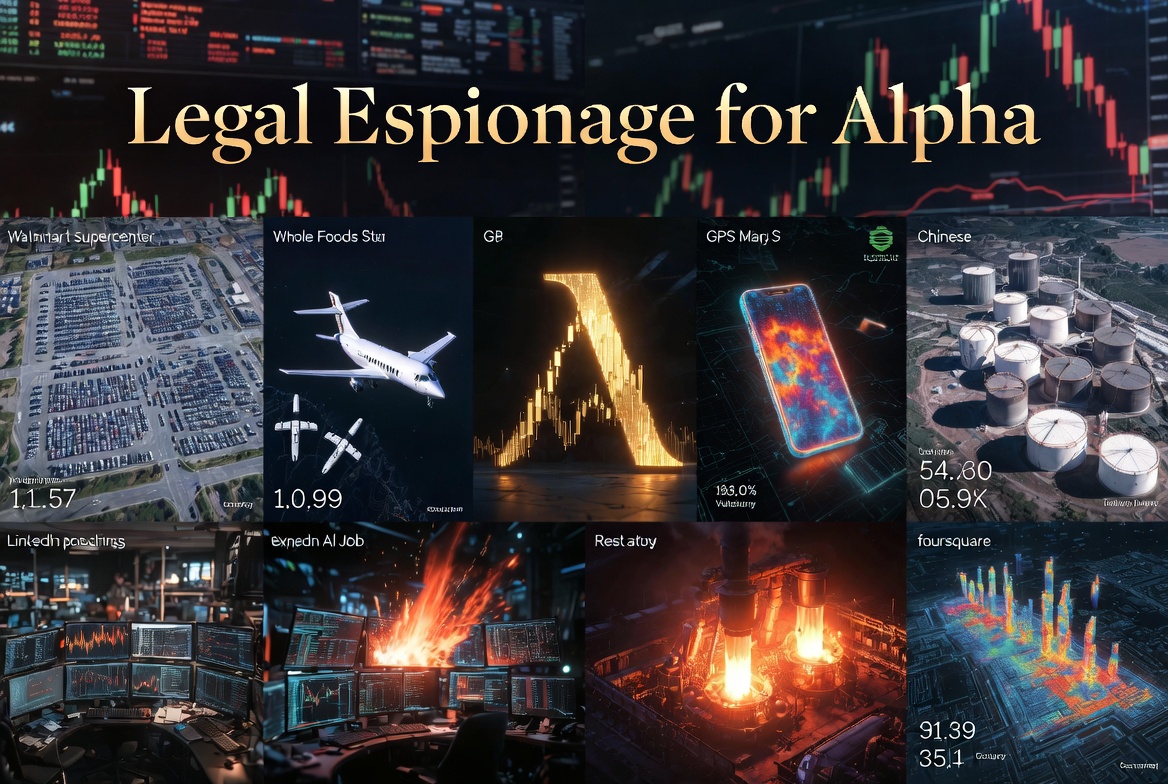
In the relentless pursuit of alpha — the excess returns that separate elite hedge funds from the market average — traditional research often falls short. Charts, earnings models, and public filings are widely available. The real edge increasingly comes from alternative data (alt-data): publicly accessible or commercially licensed information gathered through sophisticated observation, satellite imagery, geolocation tracking, and open-source intelligence (OSINT).
Leading funds don’t just read financial statements. They watch parking lots from space, track corporate jets in real time, monitor smartphone movements, analyze job postings, and measure industrial heat signatures. These methods are legal when using commercial datasets, public flight tracking, or aggregated anonymized data. Here are striking real-world examples of how funds have turned unconventional signals into profitable trades.
1. Satellite Eyes on Walmart Parking Lots
UBS and Point72 partnered with RS Metrics to monitor parking occupancy at over 100 key Walmart supercenters via high-resolution satellite imagery.

This alt-data delivered 4–5% excess returns (alpha) in the narrow three-day window around earnings releases.
The strategy proved so effective that academic studies later confirmed satellite parking-lot data as a reliable predictor of same-store sales growth for major retailers.
2. Corporate Jet Tracking Reveals Secret M&A Talks

The funds accumulated a combined $1.46 billion position in Actelion shares. When J&J announced the $30 billion acquisition, Actelion shares surged nearly 20% in a single day, delivering massive profits for the event-driven bets.
3. A Gulfstream V Leads to Warren Buffett
Macro funds, including Tudor Investment, used platforms like Quandl to track the flight path of Occidental Petroleum’s private Gulfstream V. The jet made an unexpected landing in Omaha — home of Berkshire Hathaway — despite Occidental having no offices there.
This anomaly strongly suggested secret talks with Warren Buffett. Funds positioned ahead of the announcement. Just 48 hours later, Buffett revealed a $10 billion investment to help finance Occidental’s acquisition of Anadarko Petroleum. The trade paid off handsomely.
4. Smartphone GPS Data Exposes Amazon’s Whole Foods Impact

Crucially, it revealed customer defection: 24% from Walmart and 16% from Kroger. Funds aggressively shorted traditional grocers. Shares of competitor Sprouts Farmers Market dropped 8% shortly after the insights became actionable.
5. Foursquare Check-ins Expose Chipotle’s Crisis Failure
Hedge funds analyzed aggregated check-in and movement data from the Foursquare app around Chipotle locations during the 2015 E. coli outbreak. The data showed that a coupon campaign failed to restore traffic — actual visits fell ~30%.
When Chipotle later reported comparable sales plunging a record 29.7%, the funds were already positioned with large short positions and profited from the subsequent stock collapse.
6. Satellite Shadow Analysis for Global Oil Inventories

This real-time visibility into physical supply and demand allowed profitable positioning in oil futures long before the broader market reacted.
7. LinkedIn Job Postings Signal Hidden AI Strategy

The funds built long-term positions and captured significant gains as the company’s valuation rose with the market’s eventual recognition of its AI transformation (+22% in one documented case).
8. Infrared and Thermal Satellite Data for Metals Production

This provided precise capacity utilization data (e.g., 95% global loading for copper, nickel, and steel) 2–4 weeks before official statistics. The funds executed profitable trades in London Metal Exchange (LME) futures.
Also read:
The New Arms Race for Alpha

Providers sell everything from satellite imagery and credit-card aggregates to app usage, web scraping, and now AI-powered analysis.
Funds that master these signals can generate genuine alpha in an increasingly efficient market.
However, success requires significant capital — subscriptions to premium alt-data feeds are expensive — and sophisticated infrastructure to process noisy signals into actionable trades.
While these methods rely on legal, commercially available, or publicly observable data, regulators (especially the SEC) scrutinize whether any information crosses into material non-public territory.
The line between clever OSINT and illegal insider trading remains strictly enforced.
Retail investors and traditional analysts are largely left watching from the sidelines as the most sophisticated players deploy “legal espionage” at scale. In today’s markets, alpha often doesn’t come from reading the lines on a chart — it comes from watching what happens between the lines, from space, from the sky, and from millions of smartphones.
The hunt for alpha has never been more high-tech — or more fascinating.