
SpaceX deleted one of the most revealing data points from its S-1 before filing: its first two Colossus II clusters were built at $2.7 million per megawatt, roughly a fourfold improvement on the industry benchmark, according to an earlier draft of the S-1 reviewed by PitchBook.
Paired with the $1.25 billion-a-month compute contract with Anthropic, disclosed elsewhere in the filing, the economics imply SpaceX recoups its AI infrastructure capex in under a month. Even at double the disclosed cost, payback is 2.2 months.
Read the research: SpaceX S-1 Dissection: Starlink Prints, AI Burns
Anthropic, a direct Grok competitor, is paying SpaceX $15 billion a year for access to its compute infrastructure through May 2029. That nearly matches the combined revenue of the company’s Space and Connectivity businesses in 2025.
If Grok were the moat, Anthropic would be the last company renting the servers that train it. The deal validates the compute infrastructure as a standalone commercial asset, independent of the AI models running on it. And it does so by monetizing dormant capacity.

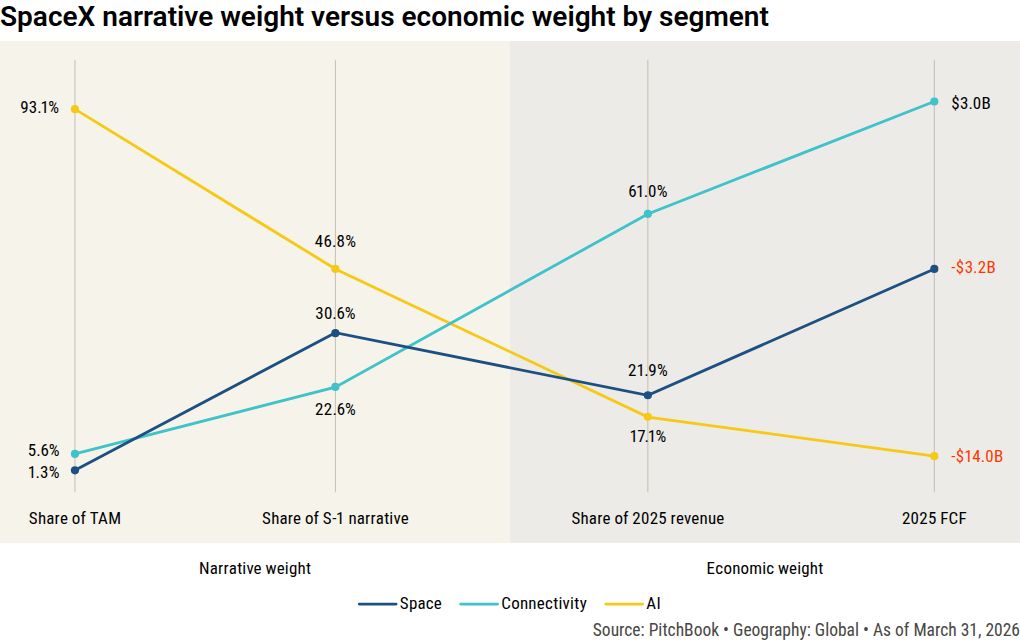
SpaceX is asking public market investors to value it primarily as an AI company. We analyzed term frequency across the nearly 300-page document: AI-related terms account for 47% of segment-specific language, seven of 12 growth strategies relate to AI, and 93% of the company’s stated $28.5 trillion total addressable market is attributed to AI.
The economic reality underneath that narrative is different. The AI segment generated 6.7% of revenue excluding legacy X advertising and posted a $14 billion free cash flow loss in 2025. Starlink’s connectivity business delivered 61% of revenue, virtually all of the free cash flow, and a 63% EBITDA margin.
The Anthropic deal and the infrastructure economics behind it are the strongest evidence that the AI thesis has commercial substance, but the gap between narrative weight and economic weight remains wide.
The listing will reveal which version of SpaceX investors are buying: the AI company the filing describes, or Starlink with a profitable infrastructure side business.
This article originally appeared on PitchBook News