
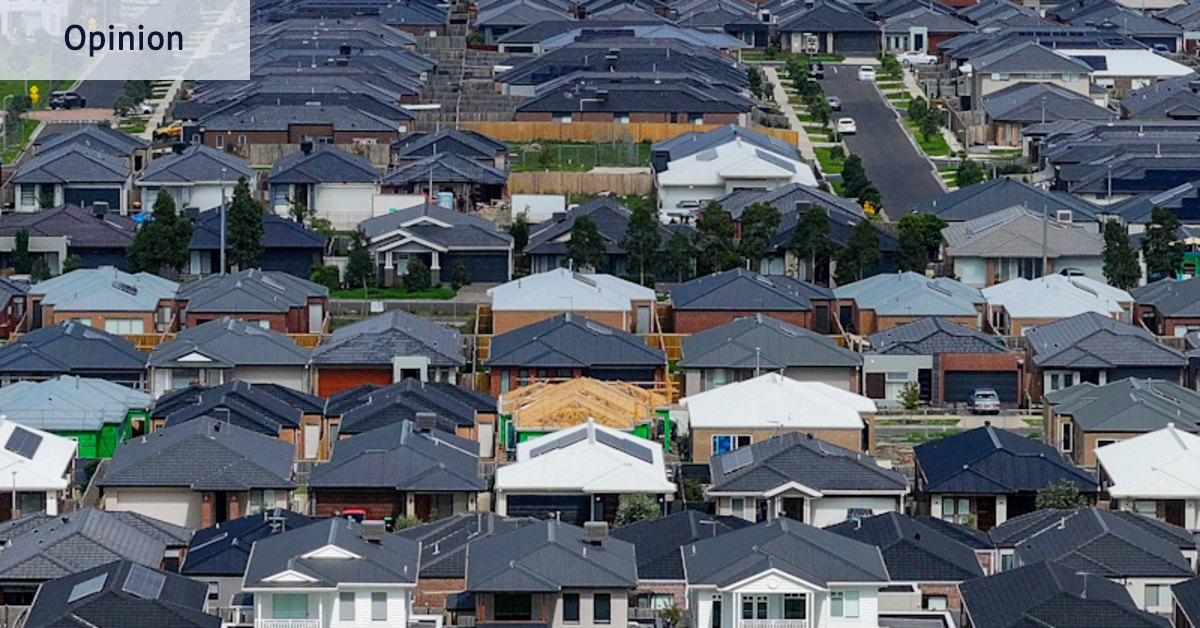
When consumers feel richer, they’re also more likely to loosen the purse strings, according to conventional economic wisdom. And for most of the last three decades, the biggest source of household wealth – real estate – has been heading in one direction: up.
So, what happens to household spending when people’s biggest asset starts losing value, instead of rising? And how much does it really matter for the wider economy?
With property prices now falling in Sydney and Melbourne, this is an issue that could affect a wide range of businesses, and I’m not just talking about real estate agents. Housing touches a huge range of sectors in one way or another, from construction to banking to retail.
But before getting too swept up in housing gloom, it is important to draw a distinction between the property market and the wider economy: they’re not the same thing.
What happens to house prices from month to month gets huge amounts of attention, and it does matter, but the value of housing assets is a very different thing from the economy’s performance.
It’s easy enough to understand why housing gets so much attention: it’s the biggest source of Australian household wealth, and its value has surged.
Research firm Cotality estimates that the value of residential real estate hit $12.6 trillion in March. That’s roughly two-thirds of the total household sector’s net wealth of $18.8 trillion, according to the Australian Bureau of Statistics.
As Treasurer Jim Chalmers told us on budget night, house prices are up more than 400 per cent since 1999 – and the government wants to slow things down. So far, Labor’s changes to rein in investor tax concessions are having their desired effect, as are higher interest rates.
Prices have started falling in Sydney and Melbourne, and major banks expect that decline has further to run. Most banks are talking about price falls of less than 10 per cent, and some believe a long-running housing “super cycle” is over.
So, how much would a fall in house prices matter for the wider economy?
Perhaps the most direct impact would be on construction, which employs about 9 per cent of the workforce.
When prices are falling, there’s less incentive for developers to invest in new projects that will require more workers. Residential construction work had been moving higher until the latest quarter, when it slowed, and the sector is also grappling with cost inflation. But against this, other parts of construction are booming, such as data centres, and the building groups are still talking about skills shortages, not major job losses.
AMP deputy chief economist Diana Mousina points out housing also has flow-on effects for all sorts of other sectors, such as banking, legal work, removalists, and retail, through all the furniture people tend to buy when they purchase a home.
Mousina says you can estimate these indirect and direct impacts of housing through economic measures called input-output tables, which attempt to show all these interconnections between industries. On this measure, she says housing accounts for 13 per cent of the economy, which is close to non-residential construction and larger than mining.
So, there’s no question that a lot of industries are exposed to housing weakness. But if our banks are right and the falls are somewhere in the 5 to 10 per cent range, a bit of softness for these various housing-linked industries won’t be enough to drag down the whole economy.
Another way housing slumps can flow into the wider economy is via the banking system, if it leads to a big jump in problem loans. But once again, the huge surge in prices over the decades makes this unlikely.
There is a group of borrowers who bought recently at risk of “negative equity” – where their loan is worth more than their house – and these loans can be a risk to banks if the borrower gets into strife. But loans at risk of negative equity are a small fraction of banks’ mortgage portfolios. Westpac, for example, said just 0.5 per cent of its portfolio was in negative equity in the latest half. Banks can handle the current weakness in housing, in other words.
Finally, house price moves can affect the economy through “wealth effects”. This is a theory that says when people’s wealth goes up, they feel wealthier and therefore more open to spending.
A Reserve Bank study in 2019 found higher house prices in the past decade had indeed supported more spending, and the types of spending that responded most to higher wealth were on things such as cars or furniture, as well as recreation.
Logically, the same thing should happen in reverse when prices fall. And that’s exactly what some analysts are expecting, saying companies such as JB Hi-Fi or Harvey Norman may cop weaker sales as prices fall.
But predicting wealth effects is far from an exact science. Confidence can be fickle, and good luck disentangling the impact of falling house prices from, say, what’s happening to wage growth, inflation, or employment. For the vast majority, income is a far more important influence on spending than paper wealth.
So the bottom line is: swings in house prices can indeed have a real economic impact, but the sorts of decline being predicted for Australia’s market are hardly extraordinary.
History (and logic) suggests that prices in Sydney and Melbourne may well fall for a while before they start to become more affordable for the first home buyers keen to get into the market, who will then support prices. Some also think the Reserve Bank will start cutting interest rates next year, which could also support the market.
Falling prices also need to be kept in perspective. The sorts of declines that economists are forecasting are pretty modest when seen against the huge run-up in asset prices in the preceding decades. AMP’s Mousina points says national home prices are up more than 50 per cent since the COVID-19 pandemic.
If prices now decline by 5 per cent or a bit more, as many are predicting, it would be a blow to the unlucky homeowners who bought recently, but it wouldn’t be enough to cause a serious economic slowdown.
The Business Briefing newsletter delivers major stories, exclusive coverage and expert opinion. Sign up to get it every weekday morning.
 Clancy Yeates is deputy business editor. He has covered banking and financial services, and was previously national business correspondent in the Canberra bureau.Connect via X or email.