
Elon Musk has fired the starting gun on the world’s biggest stock market float as his rocket firm SpaceX targets a valuation of $1.75 trillion (£1.3 trillion).
The initial public offering (IPO), which could take place as soon as June 12, will instantly make SpaceX one of the world’s most valuable listed companies.
That is despite its latest annual losses of £3.7billion on revenues of £13.9billion, outlined in a shareholder prospectus yesterday, taking the total losses to date to £30.8billion.
In the first three months of this year alone it added a further £3.2billion in losses, an eightfold increase on the same period in 2024.
Yet it is still expected to attract a frenzy of interest as investors put their faith in Musk’s extraordinary ambition – after his previous record in driving the success of electric car maker Tesla.
The plans rely on SpaceX’s aim of reaching a market value of £21 trillion – though much of that relies on technology that has not yet been built.

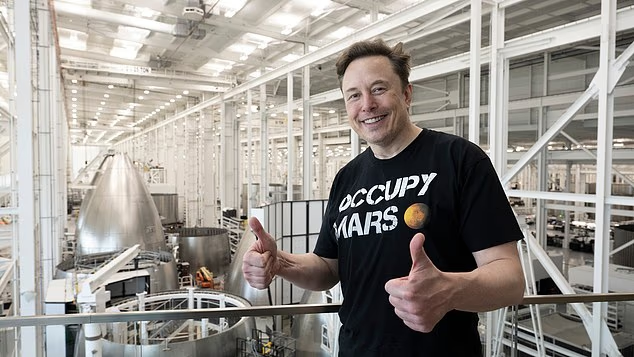
Star man: Elon Mus k, already the world’s richest man with a net worth of more than $800bn (£600bn), could see his wealth soar when SpaceX makes its debut in New York next month
Its ambitions range from setting up vast AI data centres in space, to creating a permanent human colony on Mars.
Reports suggest that the initial public offering will raise around £56billion.
And it will spark a lucrative payday for Wall Street bankers, with Goldman Sachs the leading institution among a host of New York’s heavyweight firms participating in the float.
The formal announcement of the long-awaited IPO also puts Musk ahead of rivals Sam Altman, boss of ChatGPT maker OpenAI, and Dario Amodei, who heads Anthropic, also a leading artificial intelligence (AI) firm.
Both men have also been gearing up to take their companies on to the public markets.
Reports this week suggested OpenAI was preparing to file for an IPO within days or weeks, which could value the operation at £740billion.
Launched in 2002, SpaceX has come to dominate the global market in satellite launches.
It has contracts worth millions of dollars with the US military and space agency Nasa.
And it includes Starlink, whose network of 10,000 satellites provides internet connections to 10m people across the globe and is a vital tool for Ukraine in its battle to repulse Vladimir Putin’s Russia.
SpaceX has also recently acquired two other struggling Musk operations: social media platform X (formerly Twitter) and artificial intelligence business xAI.
Only the Starlink part of the business currently makes money, generating £3.3billion in operating income last year, doubling the total compared to 2024.
SpaceX’s space division made a £490million loss while its AI unit recorded a loss of £4.7billion, which was four times that of the year before.
Musk will retain a tight grip on the company, with a shareholder structure that will leave him with 85 per cent of voting rights.
Susannah Streeter, chief investment strategist at Wealth Club, said: ‘Investors interested in the IPO still need to tread carefully, with the risk that gravity could pull valuations back down to earth.
SpaceX’s financials underline both the scale of the opportunity and the risks attached.
‘Revenues are climbing rapidly, but losses remain substantial
following the integration of xAI into the core space operations, as the company pours cash into expansion, infrastructure and innovation.’
DIY INVESTING PLATFORMS

AJ Bell
AJ Bell
Easy investing and ready-made portfolios

Hargreaves Lansdown
Hargreaves Lansdown
Free fund dealing and investment ideas

interactive investor
interactive investor
Flat-fee investing from £4.99 per month

Freetrade
Freetrade
Investing Isa now free on basic plan

Trading 212
Trading 212
Free share dealing and no account fee
Affiliate links: If you take out a product This is Money may earn a commission. These deals are chosen by our editorial team, as we think they are worth highlighting. This does not affect our editorial independence.