
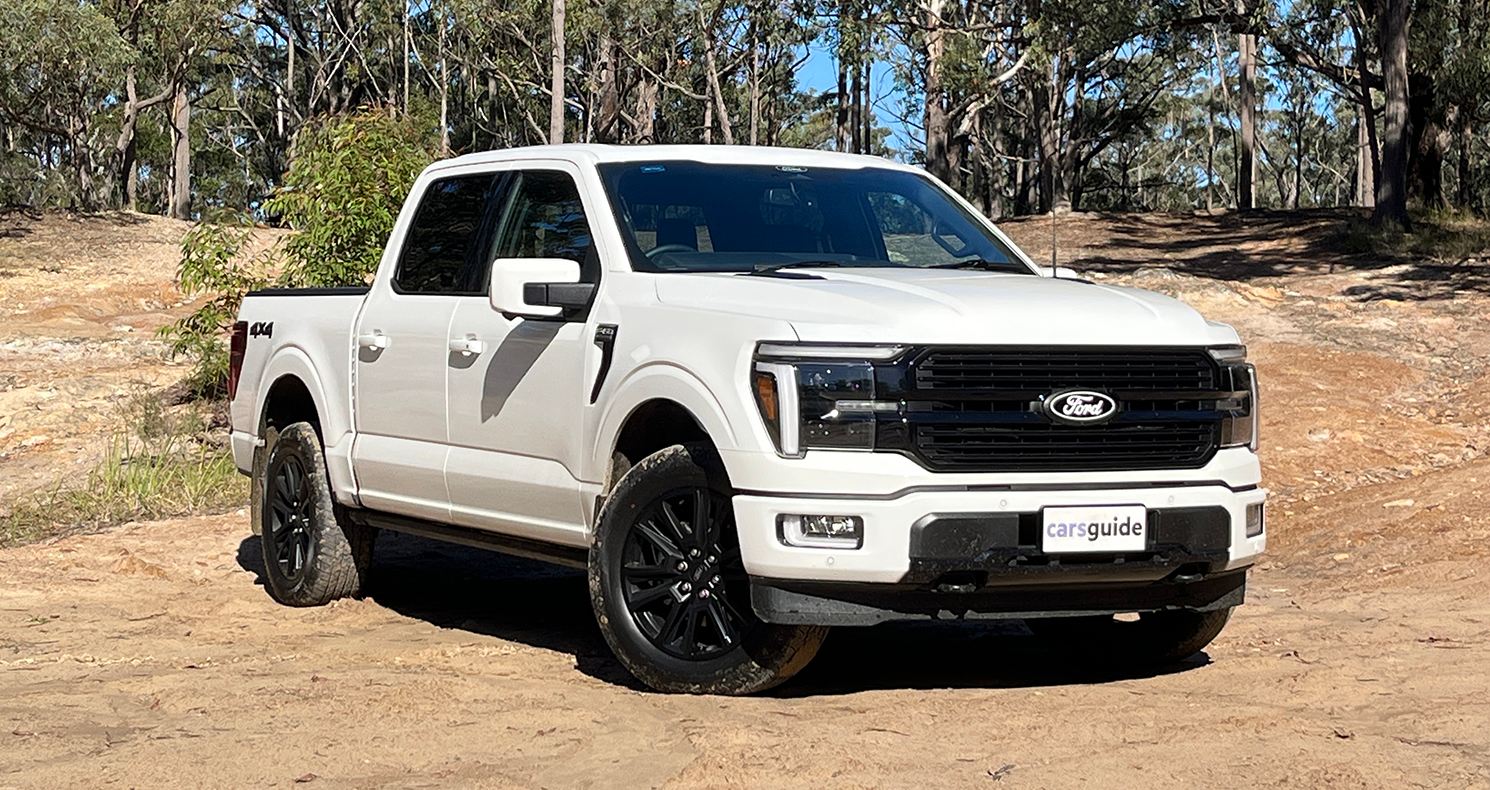
The Ford F-150 Platinum – the new top-shelf variant in the company’s F Series truck range – has arrived in Australia as part of the a refreshed line-up.
This full-sized dual-cab ute has a 3.5L twin-turbo V6 petrol engine, myriad drive modes and 4500kg towing capacity and, as such, is regarded as a rival for the likes of the Ram 1500, Chevrolet Silverado and Toyota Tundra.
But with a price-tag tickling $164,000 before on-road costs and at a smidge under six metres long, is this big rig simply too big and too expensive?
We’re testing the short wheelbase (SWB) version this time, so let’s get into it.
Ford F150 2026: Platinum Swb (4X4)
| Engine Type | Twin Turbo V6, 3.5L |
|---|---|
| Fuel Type | Unleaded Petrol |
| Fuel Efficiency | 13.4L/100km (combined) |
| Seating | 5 |
| Price From | $163,950 |
Price and features – Does it represent good value for the price? What features does it come with?
7 / 10
The new Ford F-150 Platinum SWB and long-wheelbase (LWB) body styles are priced from $163,950 (excluding on-road costs), making this top-spec F truck the most expensive yet.
In fact, it comes in at pricier than rivals Ram 1500 and Chevrolet Silverado, but not as much of a hit to the bank account as the Toyota Tundra is.
Also, the “new” F-150s now on offer in Australia are actually the model year 2024 versions of this vehicle.
Standard features onboard the Platinum include a 12.0-inch LCD portrait touchscreen, 12.0-inch digital instrument cluster, a 14-speaker Bang & Olufsen audio system, folding gear shifter, fold-out centre console, leather upholstery, 12-way power-adjustable heated and ventilated front seats (with memory and massage functions), and heated outboard rear seats.

2026 Ford F-150 Platinum short wheelbase
It also gets power side steps, 20-inch alloy wheels, LED headlights and tail-lights, panoramic glass sunroof, spray-in bed-liner and a powered tailgate with a manual swing-door section.
Exterior paint choices include Agate Black, Iconic Silver, Rapid Red, Carbonised Grey, Star White, and Antimatter Blue.
This F-150 matches its rivals, such as the Ram 1500, Chevrolet Silverado, and even the more expensive Toyota Tundra, in terms of standard features.
Design – Is there anything interesting about its design?
7 / 10
The Ford F-150 Platinum SWB is 5908mm long (with a 3697mm wheelbase), 2089mm wide (excluding mirrors) and 1995mm high. It has a listed kerb weight of 2611kg.
It’s a chunky but stretched US-style ute with ample presence, but manages to look like it’s not trying too hard.
It doesn’t hurt this ute’s cause that its appearance now encompasses model year 2024 updates from the US, which include a facelifted exterior with a new front bumper, grille and headlights, as well as a new rear bumper, tail-lights, and gloss-black alloy wheels.
The wheel-and-tyre package (20-inch alloys and 275/60R20 Hankook Dynapro AT2 all-terrains) suit its style, but aren’t particularly great for off-roading – more about that later.
Inside, it’s a cool and practical space with leather-accented seats – those are underdone in terms of feeling posh – and there’s an overall roominess that’s difficult not to like.
In terms of design, this F-150 holds its own, inside and out, against the likes of the Ram, Silverado, and Tundra.

2026 Ford F-150 Platinum short wheelbase

Explore the 2026 Ford F150 Range
Practicality – How practical is its space and tech inside?
7 / 10
All in all, the Ford F-150 Platinum’s cabin is a highly practical space.
The 12-way power-adjustable, heated and ventilated front seats (with a handy massage function and memory) recline to a fully flat position and the fold-down centre console work table is a nice touch as is the auto shifter, which stows away flush at the push of a nearby button.
Even though I prefer a vertically oriented screen nowadays, the F-150’s horizontal 12.0-inch LCD touchscreen is easy to use and offers clear, crisp colours so my old codger eyes can cope with the vast array of information and controls depicted onscreen.
The rest of the cabin is as roomy and as practical as can be expected in a dual-cab ute of this size. There are storage spaces and cupholders aplenty, as well as smart device charging points front and rear.
The 60/40 split rear seat even has a shallow lockable under-seat storage.
This F-150’s tub is 1700mm long, 1650mm wide, 543mm deep and measures 1285mm between the wheel arches so it will fit an Aussie pallet or a truckload of your camping equipment.


The tub has a tri-fold hard tonneau cover and the load space has a 12-volt outlet, load box lights, a durable-looking spray-in tub liner, as well as fixed tie-down points at each corner and four sidewall-mounted tie-down points as part of Ford’s BoxLink tie-down system.
The powered tailgate can be opened the usual boring drop-down way or you can use the ‘Pro Access Swing Door’ of the tailgate to open a side-hinged section as you would a door.
Bonus points for the raised ruler markings on the tailgate’s inner wall and the two G-clamp fitting positions at each side of the tailgate’s top edge.


The F-150 has a keyless entry system with a keypad on the exterior of the front passenger door. Punch in your permanent access code and – bingo – you’re in.
As practical as any of its rivals, the F-150 stays in the race here.
Under the bonnet – What are the key stats for its engine and transmission?
7 / 10
The Ford F-150 Platinum has a 3.5-litre twin-turbo V6 engine producing 298kW at 6000rpm and 678Nm at 3100rpm, and that’s matched to a 10-speed torque converter automatic transmission.
The base-spec XLT gets part-time 4WD but the Lariat and Platinum grades get Ford’s more advanced full-time 4WD system. This setup has selectable two-wheel drive (2H), four-wheel drive high-range (4H), four-wheel drive low-range (4L) and four-wheel drive automatic (4A = 4Auto) that sends drive to the front and rear axles as needed, and which can be safely used on high-traction surfaces, such as bitumen.

2026 Ford F-150 Platinum short wheelbase
The Platinum has a variety of selectable drive modes – including Normal, Eco, Sport, Tow/Haul, Slippery, and Off-Road – and an electronic locking rear diff.
This is a proven engine-and-auto pairing and is more than a match for any of the F-150’s rivals’ powertrains.
Driving – What’s it like to drive?
7 / 10
From the get-go, this short-wheelbase F-150 is a smooth driving ute on road.
And the V6 offers a welcome low-level rumble as a soundtrack to your driving experience. Nice.
It’s a big vehicle with a steel ladder-frame chassis and a lengthy wheelbase, but it suits our conditions, especially with Aussie-tuned steering, impressive on-road ride and handling and its new continuously controlled adaptive dampers setup works in conjunction with the Terrain Management System and is claimed “to enhance vehicle control on every surface”, according to Ford Australia.
This system does iron out much of the jarring sharpness often felt in test vehicles along chopped-up back-country roads on the way to my unofficial 4WD proving ground.
F-150s are imported to Australia from the USA as left-hand-drive vehicles and reengineered to right-hand drive by Melbourne-based RMA Automotive, at the company’s production facility in Melbourne.
The utes undergo a comprehensive transformation – including changes to steering, driver displays, air-con, as well as software upgrades, to name but a few – aimed at making them capable of excelling in Aussie conditions.
And it does excel.
This F-150 is well controlled with a planted feel on sealed surfaces, the steering has a nice weight to it in all conditions, acceleration is smooth, and the 10-speed auto delivers clever management of this big ute.
It’s very quiet and comfortable in the cabin. You can just barely register the low-level rumble of the twin-turbocharged V6 as you truck along stretches of highway and rural back roads.

2026 Ford F-150 Platinum short wheelbase
On-road, the F-150 is a near-perfect open-road touring vehicle. The bonus is, as a Platinum driver, you have access to a suite of driver-assist tech which includes modes aimed at making the task of 4WDing (Off-Road) and towing (Tow/Haul) safer, more controlled and, consequently, more enjoyable than it otherwise may be.
Much better suited to towing and hauling than 4WDing, the F-150 still makes a good fist of it, but it does have off-road limitations.
It has to be driven with consideration, and you have to understand and appreciate the off-road parameters in which this F-150 performs best. If you drive anything more severe than light-to-medium-duty off-roading, then you risk damage.
Otherwise, visibility is great, the driving position is commanding, steering at low speeds is well-weighted and precise, and throttle response is impressive.
Again, this is a big ute so it has off-road angles you’d expect for a vehicle this large: the approach angle is listed as 24.5 degrees, departure angle is 25.3 and ramp-over is 20 degrees.
Ground clearance is listed as 239mm and wading depth is 700mm. Bash plates do offer the front differential, transfer case and fuel tank some protection though.
The tyres – Hankook Dynapro AT2 all-terrains (275/60R20) – aren’t well suited to 4WDing, but more aggressive all-terrain tyres on an 18-inch rim and an aftermarket suspension lift would go some of the way to help sort out the F-150’s off-road issues with its less-than-ideal showroom-standard rubber, only adequate ground clearance and off-road angles.
For such a big ute, payload is an underwhelming 704kg. For reference, the Ram 1500 (878kg) and Chevrolet Silverado (757kg) offer more, and even mainstream dual-cab utes, such as the Ford Ranger – 966kg (kerb weight)/1010kg (min kerb weight) – offer better payloads.
If you’re looking for a decent towing platform, it’s likely an F Series is already on your shopping list. This F-150’s maximum unbraked towing capacity is 750kg and 4500kg (braked), Gross Vehicle Mass is 3315kg and Gross Combined Mass is 7365kg.
This F-150 remains on par with rivals in the 4WD stakes.
Efficiency – What is its fuel consumption? What is its driving range?
7 / 10
Official fuel consumption is listed as 13.4L/100km (combined).
On test I recorded 14.1L/100km, but that figure included a solid half-day of off-roading.
Based on my on-test figures, a full tank (136 litres) of unleaded petrol in this F-150 will get you a driving range of about 965km.
For a big ute, it exhibits reasonable fuel usage.

2026 Ford F-150 Platinum short wheelbase
Warranty & Safety Rating
Basic Warranty:
5 years/unlimited km warranty
ANCAP Safety Rating:
–

Safety – What safety equipment is fitted? What is its safety rating?
7 / 10
The Ford F-150 has not been fully tested by ANCAP, but the safety watchdog did award it a Platinum collision avoidance score of 81 per cent in 2025. This rating applies only to Lariat and Platinum grades, not the XLT.
Standard safety gear includes six airbags, front and rear parking sensors, blind-spot monitoring, rear cross-traffic alert, lane-keep assist, traffic sign recognition, a surround-view camera, auto emergency braking (AEB), adaptive cruise control and trailer sway control.
There are top-tether child-seat attachment points in the rear seat but no ISOFIX points.
In safety terms, the F-150 has a stack of gear onboard which keeps it competitive against rivals.
Ownership – What warranty is offered? What are its service intervals? What are its running costs?
7 / 10
The F-150 has a five-year/unlimited-kilometre warranty and that’s pretty much standard for vehicles in the Aussie market.
Servicing is scheduled for every 12 months or 15,000km, whichever occurs soonest and the F-150’s 12 months of free roadside assistance is extended when those schedules are followed.
Ford’s five-year pre-paid service package for this vehicle costs $1968, working at an average cost of $393.60 per service.

2026 Ford F-150 Platinum short wheelbase
Ford Australia has about 180 dealerships.
In ownership terms, the F-150 remains competitive against its full-sized rivals.
Verdict
The Ford F-150 Platinum SWB is good but not great.
It has plenty of standard features onboard and some handy touches, it’s nice to drive on-road, and is adequately capable off-road but it lacks the overall plushness its price-tag promises.
The F-150’s smaller sibling, the Ranger Super Duty, does all of this F Truck’s jobs better, has more general appeal and all-round driveability, and it costs much less than the F-150.
Yet I can still see the appeal of the Ford F-150 Platinum SWB. As a potential purchase, it might make a lot more sense to you than me.
Pricing Guides

$106,950
Price is based on the Manufacturer’s Suggested Retail Price for the lowest priced Ford F150 2026 variant.
Disclaimer: The pricing information shown in the editorial content (Review Prices) is to be used as
a guide only and is based on information provided to
Carsguide Autotrader Media Solutions Pty Ltd (Carsguide) both by third party sources and the car
manufacturer at the time of publication. The Review Prices were correct at the time of publication.
Carsguide does not warrant or represent that the information is accurate, reliable, complete,
current or suitable for any particular purpose. You should not use or rely upon this information
without conducting an independent assessment and valuation of the vehicle.