
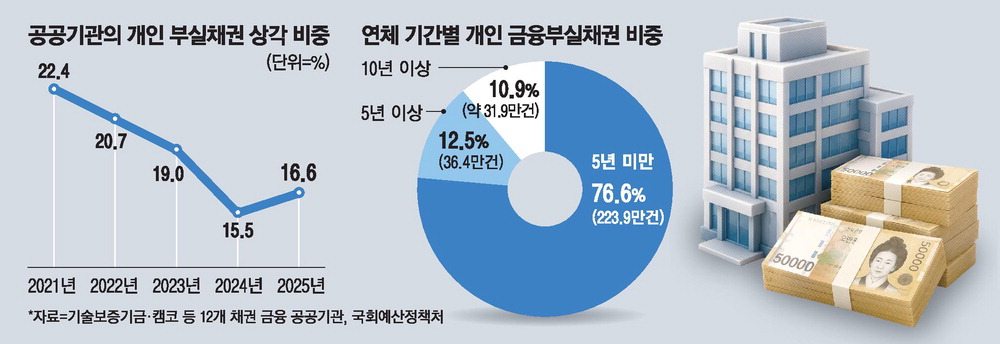

It was found that the proportion of removing debts from the books that financial public institutions cannot receive has decreased compared to the past. Critics point out that public institutions are not keeping pace with the Lee Jae Myung government’s policy of actively dealing with losses on bad debts that have virtually disappeared from the possibility of collection.
According to a report released by the National Assembly Budget Office on the 26th, the proportion of individual bad debts (dismissed) among public institutions such as the Korea Technology Guarantee Fund, Korea Trade Insurance Corporation, Small Business Market Promotion Corporation, Korea Institute of Public Finance, Korea Asset Management Corporation (KAMCO), Korea Credit Guarantee Fund, Korea Housing City Guarantee Corporation, Small and Medium Venture Business Corporation, regional credit guarantee foundation, Korea Housing Finance Corporation, Korea Scholarship Foundation and Labor Welfare Corporation fell from 23.3% in 2018 to 16.6% in 2025.
Amortization is the process of dropping non-recoverable bonds from books to losses. Amortization itself does not eliminate the debtor’s debt, but if bonds that are difficult to recover are not amortized and sorted out in a timely manner, the collection period will only be prolonged without being able to move on to follow-up arrangements such as the sale of Camco or debt adjustment. The debtor is exposed to long-term dunning while the debt is alive. In particular, the public sector is emerging as a “blind spot” for inclusive financial measures as the proportion of amortization by public institutions has decreased, even though the government has been ordering timely clearing of bad debts.
The Financial Services Commission has already announced its plan to expand amortization by specifying standards for managing bad debts by public institutions that are biased toward maintaining formal bonds through measures to improve the bad debt management system of financial public institutions in 2017. In February this year, the authorities also promised to prevent long-term collection by improving the practice of indiscriminate extension of the extinctive prescription for bad debts. However, as the portion of amortization by public institutions is on the decline, the structure in which the debt that has not been received remains on the books for a long time seems to be fixed.
Individual bad debts of these public institutions increased by more than 16 trillion won from 28.114 trillion won in 2018 to 44.4478 trillion won in 2025. The number of debtors surged to 2.5 million from about 1.78 million. Among them, non-performing loans that have been overdue for more than five years reached 683,000 cases and 11.9 trillion won as of the end of 2025, accounting for 23.4% of the total number of non-performing loans. In particular, there were 319,000 bonds that were overdue for more than 10 years, reaching 6.1669 trillion won. This means that there are so many delinquents who have been suffering from debt dunning in public institutions for more than a decade.
It is pointed out that public institutions are embracing bonds that are difficult to recover at a time when private financial companies’ “predatory” collection is under fire. Financial authorities have launched a full investigation into long-term overdue bonds held by private liquidity companies (SPCs). At a Cabinet meeting on the 20th, President Lee Jae Myung called for a forward-looking settlement of non-performing loans, saying, “If it is badly received, it will be money, but the social side effects or damage is greater.”
In this regard, the Ministry of Finance suggested, “The Financial Services Commission should consider effective measures to adjust and organize personal financial insolvency bonds, such as shortening the period of amortization of non-performing loans by public institutions and expanding the institution of the Camco agreement to quickly clean up non-recoverable personal financial insolvency bonds.”
[Reporter Gong Junho]