

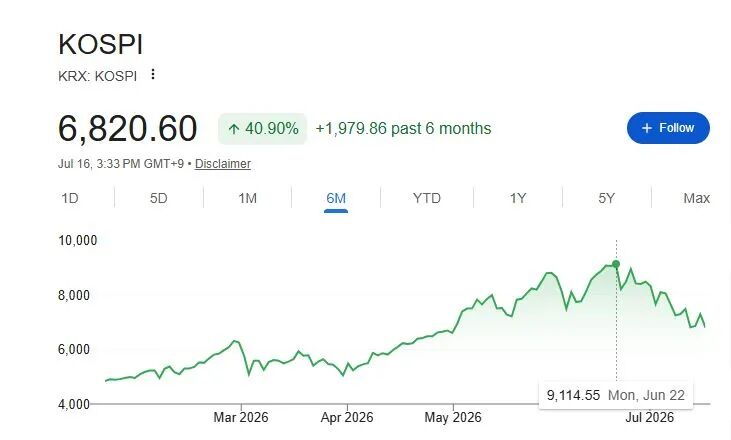
In 2026, the South Korean stock market experienced an extreme reversal from a “mad bull” to a “bear market rout.” The KOSPI index surged wildly at the start of the year, then plummeted sharply after hitting an all-time high in June, and by July 16, it had fallen 25% from its June peak.
A large number of retail investors chased high returns using margin trading and leveraged ETFs, only to face forced liquidations during the sharp downturn. In just two and a half months, the total value of forced liquidations reached 2.3 trillion won. Office workers who lost their wedding home down payments, college students who went from “sudden wealth to total wipeout,” and investors losing sleep every night… The wealth of countless ordinary people evaporated rapidly amid the extreme surges and crashes.
As market volatility intensified, the South Korean president urgently ordered the formulation of supplementary countermeasures, and regulators halted the listing of new single-stock leveraged ETF products.
On July 16, the South Korean stock market plummeted again, with the benchmark composite stock index (KOSPI) closing down 6.37%, breaking below the psychological threshold of 7000 points. Just the day before, the index had surged 6.24%.
Amid the violent ups and downs, investors are paying a painful price.
“If stock prices don’t recover, I might have to postpone my wedding,” said a 39-year-old South Korean office worker who invested 80 million won (about 360,000 yuan) in wedding home down payment funds into the stock market. Now facing a floating loss of nearly a quarter of his investment, he can only helplessly accept the reality.
During this year’s roller-coaster ride in South Korean stocks, a large number of retail investors used margin trading and leveraged ETFs to amplify returns, but also amplified risks. When the market reversed downward, their wealth evaporated rapidly, and even triggered forced liquidations.
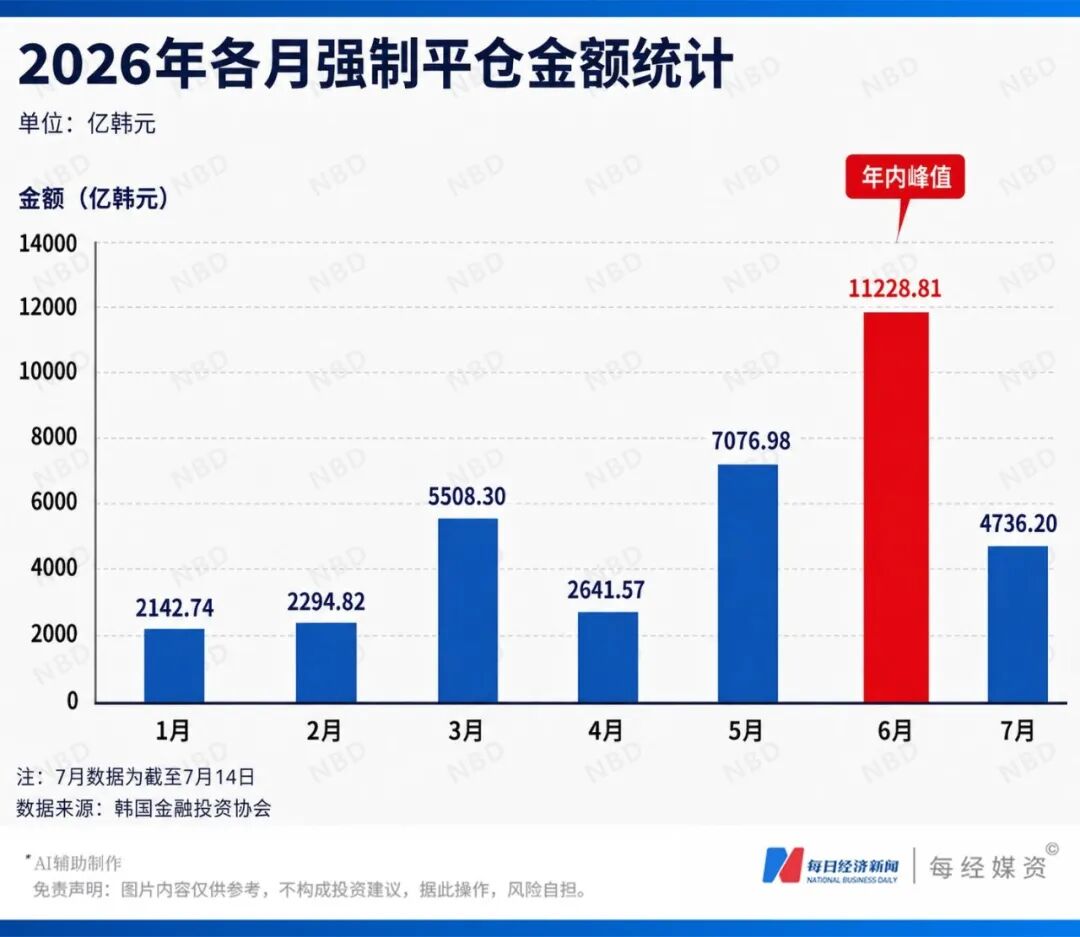
Statistics from reporters at National Business Daily (hereafter referred to as NBD) show that the scale of forced liquidations in the South Korean stock market has surged sharply since May, with the total amount from May to July 14 reaching 2.3 trillion won (about 10.4 billion yuan).
On July 16, the South Korean Financial Services Commission announced measures targeting single-stock leveraged ETFs, banning the listing of new single-stock leveraged products. A market-triggered, regulator-driven deleveraging process is now underway.
36 Trading Halts and 7 Circuit Breakers in South Korean Stocks: Retail Investors’ Leveraged Wealth Evaporates Rapidly
“Those who made money hit the jackpot, those who lost money got wiped out, (the losing investors) are all ready to jump off the rooftop,” Mr. Fan, a student studying in South Korea, described the recent South Korean stock market to NBD reporters, though he himself has already liquidated all his Samsung Electronics shares.
The South Korean stock market was the world’s most outstanding performing market this year. The KOSPI index surged wildly from the start of the year, hitting an all-time high on June 22, with a cumulative increase of as much as 116%.
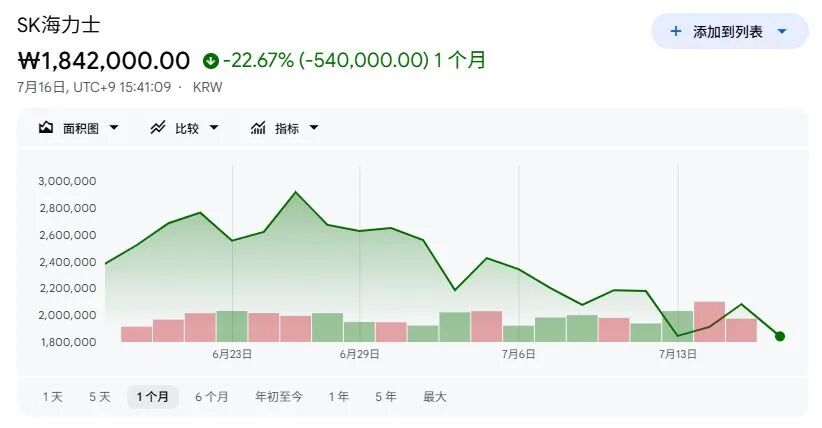
But after that, the KOSPI index took a sharp downturn. On Monday (July 13), South Korean memory chip giant SK Hynix plummeted 15.37%, marking the largest single-day drop since its listing; Samsung Electronics fell 10.70%. The KOSPI index crashed 8.95%, falling below the 7000-point mark.
Just two days later on the 15th, the KOSPI index opened sharply higher and quickly reclaimed the 7000-point integer threshold, rising more than 7% at one point during the session, and closing up 6.24% that day.
On July 16, the KOSPI index closed down 6.37% at 6820.6 points, falling back into a technical bear market, down 25% from its June high. SK Hynix fell more than 11%, and Samsung Electronics fell nearly 9%. Extreme volatility has become the norm.
Data shows that since the start of this year, the South Korean stock exchange has launched 36 temporary trading halts, and triggered 7 market-wide circuit breakers, exceeding half of the total historical number (a total of 13 times since the mechanism was established in 2000). Meanwhile, the KOSPI volatility index (KSVKOSPI) has risen 281.8% since last December, remaining at a historically high level.
In such a market environment, ordinary investors have become the most directly affected group bearing the pressure.
According to South Korean media reports, a 39-year-old professional invested about 80 million won (about 360,000 yuan) in home purchase funds into semiconductor stocks and leveraged ETFs in June, and now has a floating loss of about 18 million won (about 80,000 yuan). He admitted that if stock prices do not recover, his wedding date might be forced to be postponed.
Mr. Han, a 31-year-old office worker in Mapo-gu, Seoul, bought 15 million won (about 68,000 yuan) of SK Hynix 2x leveraged products in early July. After he entered the market, stock prices fell rapidly, and one-third of his principal evaporated instantly. Mr. Han said, “The loss is twice as large as the drop in SK Hynix’s share price. The huge shock has kept me losing sleep every night.”
Lee Seung-ho, a 24-year-old South Korean college student, experienced a typical cycle of “going from sudden wealth to total wipeout”: he used margin trading to leverage his principal of 10 million to 20 million won up to 300 million won (about 1.36 million yuan), but almost all of the gains were erased during the market correction. “The more fiercely it rose, the more miserably it fell. Everyone only saw the doubling of returns, but ignored that losses would also be amplified,” he said.
Wu Qicong, assistant researcher at the Chongyang Institute for Financial Studies, Renmin University of China, told NBD reporters that there are three driving forces behind South Korea’s leveraged trading boom:
First, wealth anxiety. High housing prices, high education and elderly care costs make young people more inclined to achieve asset appreciation through high-risk investments;
Second, policy guidance. The government encouraged capital to flow back into the stock market, and allowed the issuance of single-stock leveraged products;
Third, financial facilitation. Mobile trading and credit margin financing have lowered the threshold for taking on leverage.
“Essentially, this is the result of the combination of anxiety, policies and financial innovation,” Wu Qicong said.
Margin Trading Balance Plunges 17.7 Billion Yuan, Forced Liquidations Hit 2.3 Trillion Won in Two and a Half Months
Goldman Sachs pointed out that this round of decline has been significantly amplified, the main reason being that newly listed single-stock leveraged ETFs have undergone rapid deleveraging, triggering a self-reinforcing chain of liquidations that are clearly disconnected from fundamental drivers.
NBD reporters made exclusive calculations based on data from the South Korean Financial Investment Association:
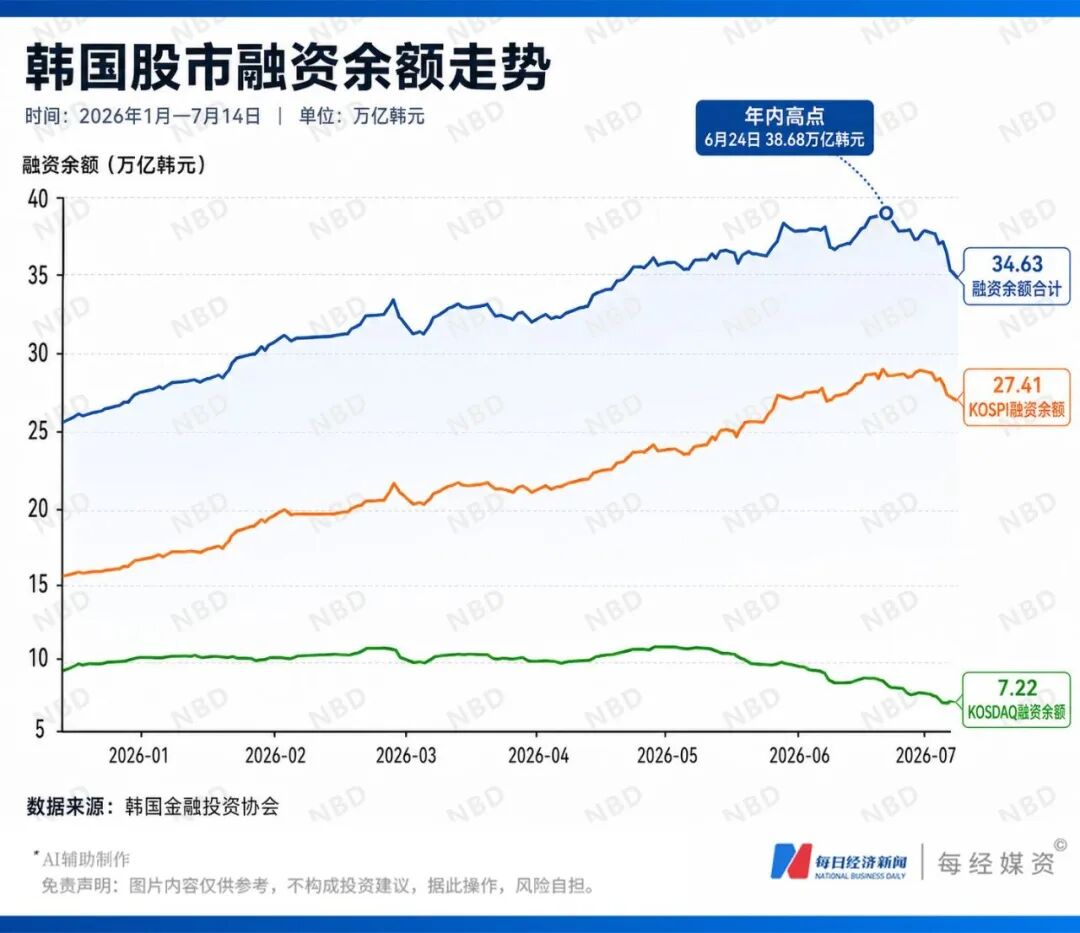
● The margin trading balance in the South Korean stock market rose from 27.4 trillion won (about 124.6 billion yuan) in early January to a peak of 38.6 trillion won (about 175.5 billion yuan) on June 24, then fell back rapidly. As of July 14, it dropped to 34.7 trillion won, a decrease of 3.9 trillion won (about 17.7 billion yuan) from the peak.
● From the highest point of the South Korean stock market on June 22 to July 14, the total amount in South Korean investors’ margin accounts has decreased by 20.9 trillion won (about 95.7 billion yuan).
Li Haoyang, analyst at China Merchants Securities, pointed out that South Korea’s minimum initial margin requirement is only 40% (lower than 50% in the US and 100% in China), with a maximum leverage of 2.5x, giving investors low tolerance for volatility. “When the decline reaches a certain threshold, investors will face margin call requirements; otherwise their positions will be force-liquidated, a process that further increases downward pressure on the underlying assets purchased with margin.”
From a time perspective, the scale of forced liquidations has surged sharply since May: 550.8 billion won in March, rising to 707.7 billion won in May, reaching 1.12 trillion won in June, and hitting 473.6 billion won by July 14. The total amount of forced liquidations from May to July 14 has reached 2.3 trillion won (about 10.4 billion yuan).
Meanwhile, due to the high concentration of the KOSPI index, the 16 single-stock leveraged ETFs for Samsung Electronics and SK Hynix launched on May 27 have become important amplifiers of volatility.
Li Yujie, head of Hong Kong Stocks and Overseas Strategy Research at Huatai Securities Research Institute, explained to NBD reporters that such products require daily rebalancing operations of “adding positions when rising, reducing positions when falling”, which pushes up market rallies during surges and accelerates selling pressure during downturns.
Data shows that from their listing to July 15, the asset size of the 16 aforementioned leveraged ETFs reached about 12.4 trillion won. South Korean retail investors are the largest buyers, with a cumulative net purchase of about 13.67 trillion won (about 62.1 billion yuan), while institutions have been consistently selling.
But this week, there has also been a situation where South Korean retail investors became net sellers. Taking the KODEX SK Hynix leveraged ETF as an example, retail investors have made a net purchase of 4.73 trillion won since its listing. Even as SK Hynix’s share price has fallen 28.62% from its June 25 high, retail investors still made a net purchase of 1.55 trillion won. It was not until the past two trading days (14th and 15th) that they turned to net selling, offloading a total of 474.4 billion won in two days.
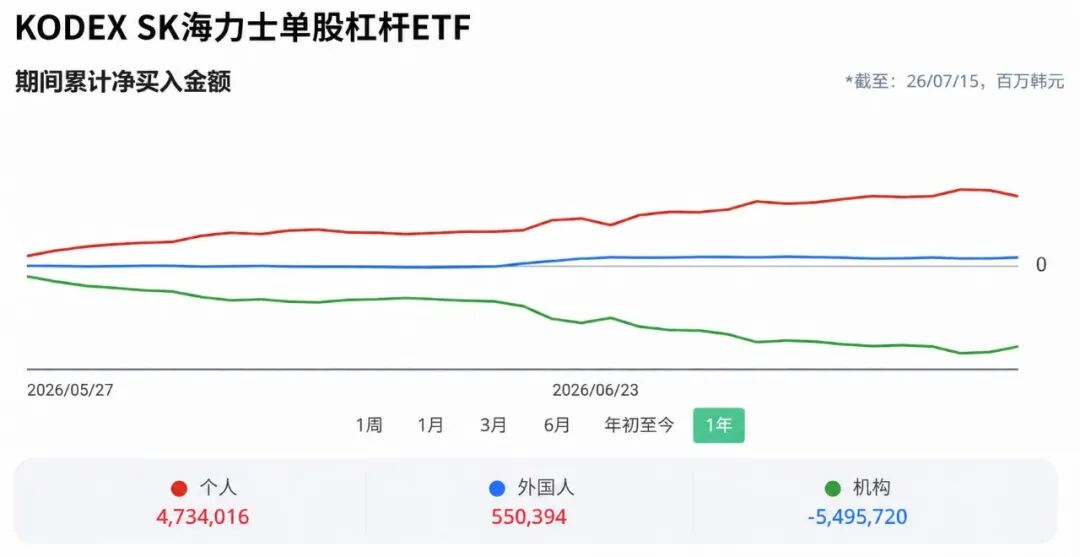
Li Yujie pointed out that as of July 15, the absolute size of leveraged ETFs has fallen by more than 50% from its June 25 peak, which means that the actual position adjustment amount corresponding to the rebalancing mechanism has also decreased accordingly, objectively making the impact on the market smaller than during the peak period.
But Li Yujie also emphasized that the recent decline in the total size of leveraged ETFs mainly comes from the shrinkage of leveraged ETF net value caused by the fall in underlying stock prices, while the expansion speed of product shares has only slowed down, with no significant drop in share counts. This means that the structural foundation of leverage may still exist, and no clear signs of contraction have been observed.
Wu Qicong told NBD reporters that “The current deleveraging is still strongly passive. Only when the margin trading balance falls, the amount of forced liquidations continues to decline, and investor account funds stabilize, can we say the market is truly close to completing risk clearing.”
Li Yujie also believes that “deleveraging is more likely to be an ongoing process that requires continuous tracking, rather than a state that has already been completed.”
South Korean President Personally Named the Issue, Regulators Halt Listing of New Single-Stock Leveraged ETF Products
As market volatility intensified, regulators began to intervene clearly.
On July 15, South Korean President Lee Jae-myung, while receiving a work report, directly named the Samsung Electronics and SK Hynix single-stock leveraged ETFs, demanding that relevant departments “formulate supplementary countermeasures quickly and properly.” Lee Chan-jin, head of the Financial Supervisory Service, responded on the spot that he would take responsibility.
On July 16, the South Korean Financial Services Commission announced measures targeting single-stock leveraged ETFs, banning the listing of new single-stock leveraged products in South Korea. South Korea has strengthened margin requirements for single-stock leveraged trading, raising the minimum margin from 10 million won to 30 million won, and only recognizing cash as eligible margin. At the same time, each single-stock leveraged trade is limited to a maximum of 20 shares per purchase.
Li Yujie pointed out to NBD reporters that based on historical experience, South Korean regulators are more inclined to adopt gradual adjustment methods focused on stabilizing market expectations, rather than drastically tightening policies or forcing market clearing in the short term. For example, the 2023 regulation of Contracts for Difference (CFD) trading was completed by gradually increasing margin requirements, with a transition period of several months; the regulatory tightening on Equity Linked Securities (ELS) also took 1 to 2 years. “If the process continues at this gradual pace, the impact on the market is expected to be relatively limited.”
Li Yujie believes that in the longer term, leverage is more of a structural factor affecting short-term volatility, rather than a core variable that determines the central level of stock prices. “As leverage levels gradually ease and regulatory uncertainties are gradually resolved, market attention will most likely return to the semiconductor industry fundamentals represented by leading South Korean stock companies, which is the more fundamental driving force determining the medium and long-term trend of South Korean stocks.”
Wu Qicong warned that if the South Korean stock market continues deleveraging, risks may spill over to SK Hynix’s ADRs, and spread to global memory chip companies such as Micron Technology and Western Digital. However, South Korean market volatility alone is not enough to trigger a global stock market crash. “Only when South Korea’s deleveraging coincides with a downward revision of global AI investment expectations, concentrated fund redemptions, and exchange rate pressure, can local risks escalate into systemic risks.”
(Disclaimer: The content and data in this article are for reference only, and do not constitute investment advice. Please verify before using. Operate at your own risk.)