
KUWAIT: During H1 2026, the GCC Bonds and Sukuk market raised $102.7 billion through 161 primary issuances, representing an increase of 6.5 percent from $96.4 billion raised during H1 2025. The number of issuances declined by 32.1 percent from 237 in H1 2025, lifting the average issuance size from $406.8 million to approximately $637.8 million in H1 2026. Saudi Arabian entities were the leading issuers in the GCC during H1 2026, raising $49.3 billion through 58 issuances and accounting for 48.0 percent of total primary issuance value.
The UAE followed with $25.5 billion through 58 issuances, representing 24.8 percent of the market, while Qatar ranked third with $12.4 billion. In terms of market performance, GCC fixed income indices recovered during Q2, with both the Bloomberg GCC Agg Index and the S&P MENA Bond & Sukuk Index returning 0.39 percent year-to-date by the end of H1 2026. Credit conditions also improved during Q2 2026, as GCC 5-year sovereign CDS spreads tightened across all markets from March levels following the earlier risk-off move. On a year-to-date basis, spreads remained above December 2025 levels for most GCC sovereigns, led by Bahrain, Dubai and Abu Dhabi, while Oman and Saudi Arabia ended H1 2026 tighter than at the start of the year.
GCC bonds, Sukuk market
GCC Bonds and Sukuk primary issuances amounted to $102.7 billion during H1 2026, which represents an increase of 6.5 percent from $ 96.4 billion raised during H1 2025. The total number of primary issuances during H1 2026 was 161 issuances compared to 237 issuances during H1 2025, representing a decrease of 32.1 percent. The combination of higher issuance value and fewer deals indicates that average deal size increased from $406.8 million in H1 2025 to approximately $637.8 million in H1 2026.

The rise in average issuance size highlights the market’s ability to absorb larger benchmark transactions, despite a more selective investor backdrop. While the number of deals declined, stronger issuance value suggests that high-quality and well-established borrowers continued to access funding successfully, supported by demand for sizeable, liquid transactions. This indicates that the GCC primary market remained resilient, with larger issuers using favorable windows to secure funding and set pricing references for the broader market.
Geographical Allocation
Saudi Arabian entities were the leading issuers in the GCC during H1 2026, raising a total of $49.3 billion through 58 issuances (H1 2025: $48.6 billion through 74 issuances), representing 48.0 percent of the total value of primary GCC Bonds and Sukuk issuances. The UAE came in second in terms of value raised, with $25.5 billion through 58 issuances so far this year (H1 2025: $27.3 billion through 76 issuances), representing 24.8 percent of the total value of primary GCC Bonds and Sukuk issuances.
Qatar-based entities were the third largest issuers in terms of value within the GCC during H1 2026 with $12.4 billion (H1 2025: $9.4 billion), recording a 32 percent increase from H1 2025. Kuwaiti entities raised $ 8.7 billion during H1 2026 through 14 issuances (H1 2025: $3.8 billion), representing 8.4 percent of the market. Bahraini entities raised $4.0 billion through 5 issuances (H1 2025: $6.0 billion), representing 3.9 percent of the market while Omani entities raised a total of $1.8 billion (H1 2025: $1.4 billion) through 6 issuances, representing 1.8 percent of the market.
Finally, there were two issuances from The Arab Energy Fund, a supranational (“SNAT”) entity headquartered in Riyadh, that totaled $1.0 billion. At a high level, issuance during H1 2026 remained concentrated in Saudi Arabia and the UAE, which together accounted for around 72.8 percent of total GCC Bonds and Sukuk primary issuance value. Saudi Arabia led the market with $49.3 billion raised through 58 issuances, while the UAE followed with $25.5 billion through 58 issuances. This reflects the depth of both markets and the continued role of large sovereign, quasi-sovereign and established corporate borrowers in setting regional pricing benchmarks.
Other GCC markets also contributed to issuance activity during H1 2026, with Qatar ranking third at $12.4 billion, followed by Kuwait at $8.7 billion, Bahrain at $4.0 billion and Oman at $1.8 billion. While issuance outside Saudi Arabia and the UAE remained smaller in absolute terms, activity across Qatar, Kuwait and Oman improved compared to H1 2025, highlighting broader regional participation and the ability of issuers across the GCC to access funding during market windows.
Sovereign vs corporate
The financial sector raised a total of $41.7 billion during H1 2026, accounting for 40.6 percent of total GCC primary issuance value through 104 issuances. Government entities followed with $36.0 billion, representing 35.1 percent of total issuance value. The energy sector ranked third, raising $13.7 billion through 11 issuances and accounting for 13.4 percent of the market. Overall issuance in H1 2026 remained concentrated in government and financial borrowers, which together accounted for the majority of primary-market activity.
This underscores the continued importance of GCC debt markets as both a benchmark funding channel for sovereign and quasi-sovereign issuers and a core source of capital markets funding for regional banks and financial institutions. Energy issuance represented a smaller but meaningful share of the market during H1 2026. Activity in the sector remained driven by the timing of larger benchmark transactions, reflecting the more episodic nature of funding from energy-related issuers and the importance of favorable market windows for sizeable deals. Despite periods of market volatility during H1 2026, investor demand remained focused on larger, well-established issuers. In this context, the sector mix helped support overall market depth, with government and high-quality financial issuance anchoring activity, while select corporate and energy issuers accessed the market during windows of improved sentiment.
Maturity Profile
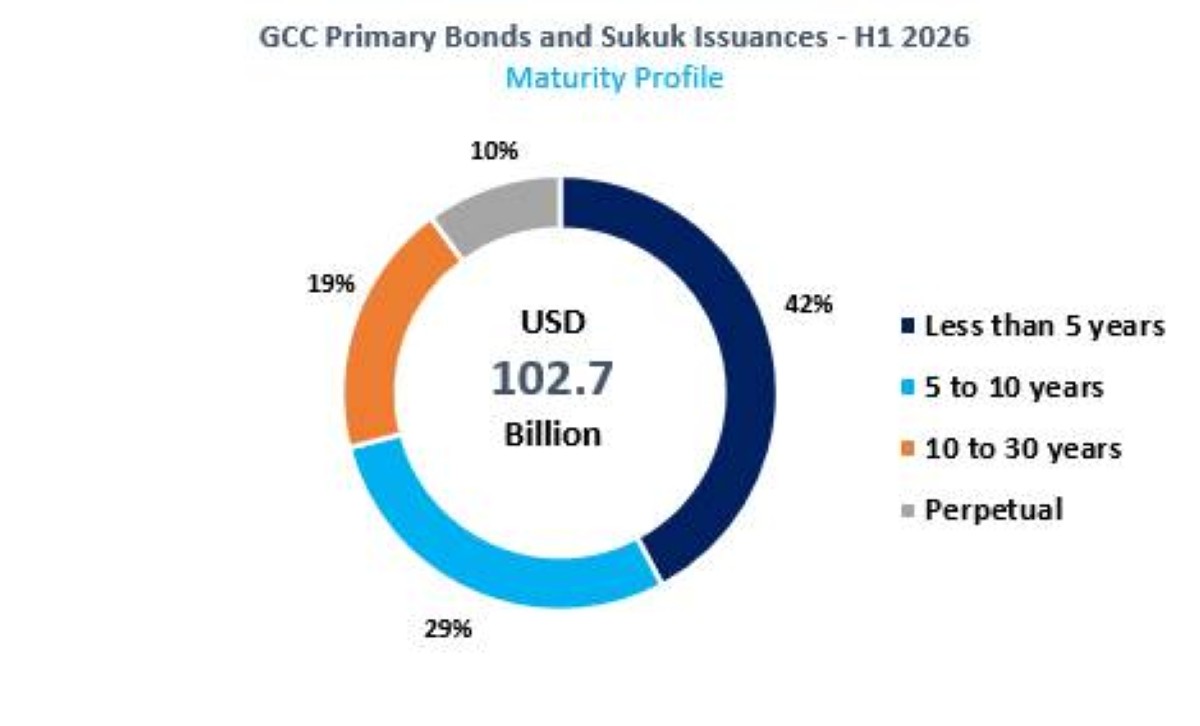
During the first half of 2026, primary issuances with less than (“LT”) 5-year tenors represented 42.2 percent of the GCC debt capital markets with total value that amounted to $43.4 billion through 97 issuances. Primary issuances with 5-10 year tenors came in second, representing 28.7 percent of the GCC debt capital markets with total value that amounted to $29.5 billion through 32 issuances. Issuances with 10-30 year tenors raised a total $19.5 billion through 11 issuances in H1 2026 representing 19.0 percent of GCC primary issuances. Additionally, perpetual primary issuances raised a total value of $10.4 billion through 21 issuances, while there was no bond issued with a maturity greater than 30 years.
Based on issuances in H1 2026, the GCC market is expected to witness elevated levels of redemptions and potential refinancing in 2031 and in 2036 compared to other years as issuances amounting to $54.7 billion are expected to mature during said years (53.3 percent of bonds issued in H1 2026). During H1 2026, primary issuances ranged in issue size from $4million to $4.3 billion.
Issuances with issue size of $1 billion or greater raised the largest amount, totaling $63.6 billion through 35 issuances inH1 2026 and representing 61.9 percent of the total amount issued in the GCC. The highest number of issuances was under $100 million issue size, where there were 43 issuances that raised a total amount of $1.3 billion during H1 2026. This indicates that while smaller transactions remained frequent, overall issuance value was heavily driven by large benchmark deals, reflecting stronger investor appetite for liquid, sizeable instruments from established issuers.
Currency Profile
US Dollar-denominated issuances led the GCC Bonds and Sukuk market in H1 2026, raising a total of $83.4 billion through 100 issuances, representing a substantial 81.2 percent of the total value raised in primary issuances in the GCC. The second largest issue currency was the Saudi Riyal (SAR), where SAR denominated issuances raised a total of $7.5 billion through 10 issuances, followed by the Kuwaiti Dinar with $ 5.7 billion through 12 issuances, with 11 of those issuances coming from the recent issuances of the Central Bank of Kuwait.
Credit Rating
In terms of value, a total of 75.1 percent of GCC Conventional and Sukuk bonds were rated in H1 2026 by either one of the following rating agencies: Standard & Poor’s, Moody’s, Fitch and/or Capital Intelligence, as compared to 69.9 percent during the same period last year. Issuances rated within the Investment Grade accounted for 69.8 percent of the total issuances in H1 2026. The increase in the share of rated issuance value from 69.9 percent in H1 2025 to 75.1 percent in H1 2026 points to stronger transparency across the GCC primary market. A higher rated share is constructive for investor participation, particularly among institutional accounts that rely on external ratings for portfolio eligibility, risk budgeting and relative-value assessment. It also suggests that more issuers were willing to access markets through formats that support broader investor distribution.
With investment-grade issuances accounting for 69.8 percent of total issuance value in H1 2026, the market remained supported by higher-quality credits. This is important in a period where investors continued to be selective, as stronger-rated sovereign, quasi-sovereign and financial issuers are generally better positioned to attract demand, achieve tighter pricing and place larger benchmark transactions across regional and international investor bases. Overall, the rating profile of H1 2026 issuances highlights the depth of demand for quality GCC credit, while also reinforcing the importance of ratings as a key reference point for pricing and market access. The continued dominance of rated and investment-grade instruments should help support secondary-market liquidity and investor confidence, particularly for larger $-denominated benchmark issues.
Listing exchange
London was again the most preferred listing exchange during H1 2026 for GCC primary issuances, totaling $68.9 billion through 52 listings. The second most popular listing exchange in H1 2026 was Euronext Dublin, with $3.8 billion through 13 listings. Meanwhile, there were 41 issuances that were not listed on any exchange, with a value of $10.7 billion. The continued preference for London reflects its role as the main international listing venue for GCC debt issuers, particularly for larger $-denominated benchmark transactions targeting global investors. The concentration of listings on established international exchanges also highlights issuers’ focus on visibility, investor familiarity and access to deep global liquidity pools. Over time, broader listing activity across recognized venues could further support market transparency, improve secondary-market accessibility and strengthen the GCC debt capital market ecosystem.
After a volatile start to 2026, global and regional fixed income markets recovered during the second quarter, supported by improved investor sentiment and positive returns across most indices. For H1 2026, the Bloomberg Emerging Market Index delivered the strongest performance, rising 2.03 percent, followed by the Bloomberg Global Agg Index at 1.15 percent. GCC fixed income markets also moved back into positive territory, with both the Bloomberg GCC Agg Index and the S&P MENA Bond & Sukuk Index returning 0.39 percent year-to-date. The S&P US Treasury Bond Index gained 0.53 percent, while the FTSE World Government Bond Index was the only major index in the comparison to remain negative, declining 0.38 percent. Overall, the H1 performance highlights a recovery from the March sell-off, with credit and emerging-market bonds benefiting from stronger risk appetite while government bond performance remained more mixed.
Credit Default Swaps (CDS)
After widening sharply during Q1 2026, GCC 5-year sovereign CDS spreads tightened across all markets during Q2 2026, reflecting improved investor sentiment and a partial reversal of the risk-off move seen earlier in the year. Qatar recorded the largest quarterly tightening, with spreads declining by 45.74 percent from March 2026 levels, followed by Abu Dhabi (-37.24 percent), Dubai (-32.13 percent), Saudi Arabia (-29.92 percent), Oman (-29.21 percent), Kuwait (-23.09 percent) and Bahrain (-21.32 percent).
On a year-to-date basis, however, CDS spreads remained above December 2025 levels for most GCC sovereigns. Bahrain recorded the largest YTD widening at 31.73 percent, followed by Dubai at 31.05 percent and Abu Dhabi at 18.96 percent. Qatar and Kuwait recorded more modest increases of 6.95 percent and 6.25 percent, respectively, while Oman (-3.59 percent) and Saudi Arabia (-10.71 percent) ended H1 2026 tighter than at the start of the year. Abu Dhabi and Qatar continued to hold the highest sovereign credit ratings in the GCC, followed by Kuwait and Saudi Arabia, while Bahrain remained the lowest-rated sovereign among the group.