
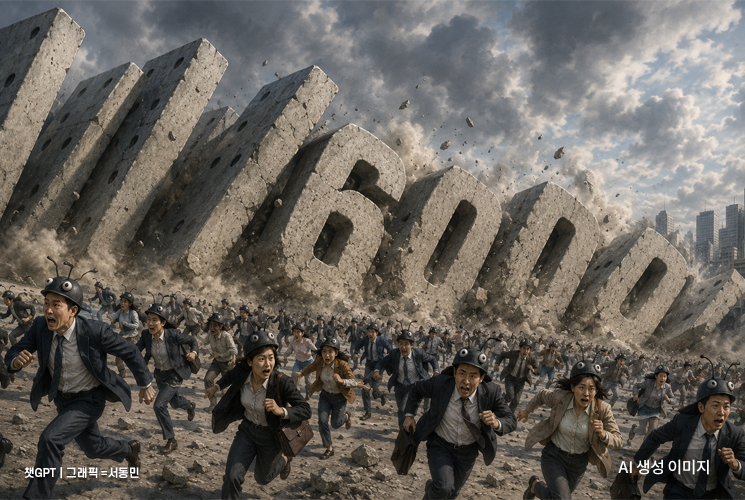
KB Securities: “Face Reality, But Do Not Lose Optimism”
KB Securities commented on the sharp decline in the stock market during the last week of July, stating, “It is too early to conclude that the bull market has ended.” The recommendation is to view the current reality objectively, while not abandoning optimism altogether. As alternatives during this correction phase, the firm suggested banks, insurance, and cosmetics sectors that have shown defensive strength or continued strong performance.
Min-kyu Kim, a researcher at KB Securities, said, “At the peak of every bubble, there has always been a structural rise in interest rates to a level unseen for years,” adding, “If this is truly the end of the current rally, it would be the first time a bull market ended without breaking the previous interest rate high.” He cautioned against adopting the logic of “this time it’s different” during rallies, and noted that the same applies to downturns. According to Kim, concluding that the bull market has ended, even though the interest rate has not surged past its previous high, could be another version of the “this time it’s different” mentality.
![Too Early to Call an End to the Bull Market... "Focus on Banks, Insurance, and Cosmetics" [Click-e-Stock]](https://www.asiae.co.kr/news/img_view.htm?img=2026072913455562625_1785300355.png)
Kim cited the “Stockdale Paradox.” This refers to the case of James Stockdale, an American who survived as a prisoner of war during the Vietnam War by maintaining optimism even in the midst of despair. The message is that, the more difficult the situation, the more one must face reality while holding onto hope.
He said, “Despite the recent market correction, we are paying attention to banks, insurance, and cosmetics stocks that have shown defensive characteristics or ongoing earnings improvement,” adding, “Sectors such as consumer staples, hotels and leisure, and trading companies, which are less sensitive to market swings and where dividends can help support share prices, can also serve as alternatives.”
However, he acknowledged that short-term conditions remain challenging. The market interest rate already reflects the hawkish hold (preference for monetary tightening) by the Federal Open Market Committee (FOMC), and there is a high likelihood that more emphasis will be placed on upside inflation risks rather than labor market conditions. The U.S. Treasury’s net borrowing and bond issuance plans, to be disclosed on August 3 and 5, were also cited as factors adding pressure.
It was the credit market that further dampened investor sentiment. While Oracle’s credit default swap (CDS) premium—insurance fees for default risk—was already in a high range, concerns intensified when Nvidia went a step further from its previous equity investments in companies like OpenAI, Corning, and IREN by guaranteeing $250 billion in rental fees for OpenAI’s data center. Kim explained, “Up to now, if a company one invests in fails, the risk was limited to the loss of equity and invested capital; but now, by taking on contingent liabilities (debts that may materialize depending on circumstances), companies are also sacrificing their own credit.”

On the 29th, the KOSPI index turned down during the session and fell below the 6,000 mark. The status of the domestic stock market was displayed on the electronic board in the dealing room at the head office of Hana Bank in Junggu, Seoul.
Doubts are also growing over whether AI investment can continue at the current pace. The combined capital expenditure of the top five big tech companies is projected to reach $776 billion in 2026 and $1 trillion in 2027, up 88.5% and 29.7% year-on-year, respectively. Starting in 2028, growth rates are expected to fall to single digits. Until now, the market has paid a premium for beneficiary stocks in anticipation that investment would continue to increase, but there are concerns that this expectation may falter if funding costs rise further.
The perspective on semiconductors has also changed. During the dot-com bubble, the peak for the KOSPI came in January 2000, but the semiconductor sector did not peak until July of that year. Even as interest rates climbed and growth stocks collapsed, semiconductors, backed by strong demand for personal computers and rising DRAM prices, managed to hold up through robust performance.
The situation is now different. Kim noted that “semiconductors have become both earnings-driven stocks and AI narrative stocks.” During the market correction in March and April, they withstood the downturn because they were still seen as earnings plays. However, starting in May and particularly during the July decline, their steeper drop compared to the KOSPI was due to their transformation into narrative-driven stocks. Kim pointed out, “Although they continue to post record-high earnings, it is now time for a new story to take the lead.”
This content was produced with the assistance of AI translation services.
© The Asia Business Daily. All rights reserved. Unauthorized AI training and use prohibited.