
Your remote designer just booked a hotel in Lisbon, a contractor in Manila needs software access, and a field rep in Houston is asking for a per diem top-up before lunch. Meanwhile, finance is still chasing receipts, waiting on reimbursements, and trying to figure out who spent what on which card. That’s the point where employee prepaid debit cards stop being a nice-to-have and start looking like operating infrastructure.
For businesses that need tighter control without slowing people down, these cards create a practical middle ground. They’re especially useful when spending needs to be fast, limited, and visible, which is why they’ve become more relevant in distributed teams and global operations. If you’re also trying to gain clear control over spending, prepaid cards are one of the cleanest tools to evaluate.
Table of Contents
The Modern Challenge of Team Spending
A fast-growing startup often discovers the same problem in three different places at once. A remote engineer needs a new monitor, a sales lead needs a travel card, and a contractor asks for a one-off software purchase. If each spend has to move through reimbursement workflows, the company ends up trading speed for control, and both sides feel the drag.
Why distributed teams expose weak expense processes
Traditional expense management works poorly when people are spread across cities, countries, and time zones. A manager may approve a purchase in one system, accounting may reconcile it in another, and the employee may still have paid out of pocket days earlier. That gap creates friction, especially for teams that don’t sit near a corporate office or a domestic bank branch.
Employee prepaid debit cards solve that by putting spend limits directly on the card instead of after the fact. The company loads funds in advance, the employee spends within the approved amount, and the transaction data is available for review. In practice, that means fewer reimbursement tickets and less ambiguity about who controls the budget.
The commercial relevance is real. The Federal Reserve’s 2024 payments study found that business use of prepaid debit cards rose from 1% of all prepaid card payments in 2015 to 7% in 2022 by number, and from 3% to 20% by value, with the average business prepaid-card payment at $114 IBISWorld’s summary of the Federal Reserve payments study. That doesn’t mean every team should replace every card with prepaid funding. It does show that businesses are using prepaid rails for more structured, higher-value operational spend than consumer retail use.
Practical rule: use prepaid cards when the business wants to approve spend before it happens, not investigate it after it happens.
For growing companies, that distinction matters. If you have global contractors, field teams, or project-based budgets, a prepaid program can create a simpler operating rhythm than manual reimbursements and shared cards. For a deeper look at card-enabled operational controls, OneSafe’s contractor payments page is a useful reference point for teams comparing payout models.
How Employee Prepaid Debit Cards Work
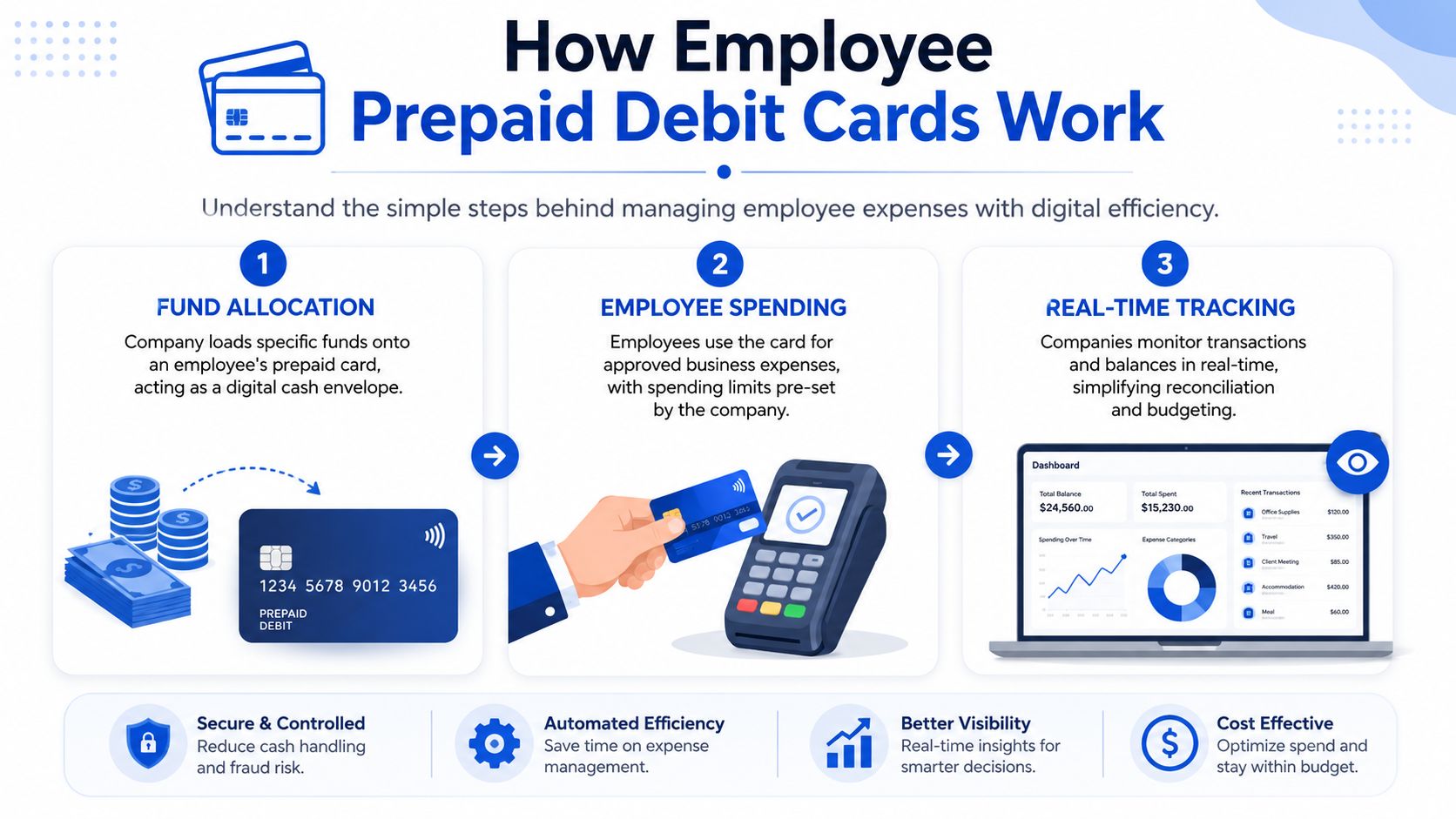
Think of a prepaid card as a digital cash envelope. The company sets aside a specific amount, loads it onto the card, and tells the employee what it can be used for. Once the balance is gone, the card stops spending until it’s reloaded.
The loading and spending flow
The mechanics are straightforward. Finance moves money from the company account to the card program, an employee uses the card for an approved purchase, and the transaction is logged back to the admin dashboard. That structure gives operators much tighter budget discipline than a general-purpose debit card tied to the whole bank balance.
This is not a credit product. The employee isn’t borrowing against a line of credit, and personal credit history doesn’t come into the equation. That makes prepaid cards useful for companies that want purchasing power without underwriting, revolving debt, or personal liability exposure.
What good card programs usually control
Most strong programs let admins shape how the card behaves before the employee ever taps it. The useful controls are the ones that reduce cleanup later, not the ones that merely look good in a demo.
- Funding limits: Keep the card balance aligned to a trip, a project, or a department budget.
- Merchant restrictions: Block categories that don’t fit the intended use.
- Card visibility: See transactions as they happen instead of waiting for month-end cleanup.
- Reload flexibility: Add funds when the project changes, not on a fixed banking schedule.
The concept is simple, but the operational effect is important. A prepaid card that’s set up well works like a controlled envelope with a card network attached to it. That makes it especially useful for distributed teams that need local autonomy without broad account access.
For teams evaluating providers, the card-operations model described on OneSafe cards is a practical example of how spend controls and transaction visibility can be built into a business card workflow.
Why the setup matters more than the card brand
A prepaid card can look modern and still be poorly managed. If the organization doesn’t define who gets a card, what it can buy, and how reloads are approved, the program will just move mess from one inbox to another. The value comes from pairing the funding model with clean policy design.
Prepaid Cards vs Corporate and Payroll Cards
The easiest way to choose the right card is to stop treating every business card as the same product. Employee prepaid debit cards, corporate credit cards, and payroll cards all solve different problems, even if they sometimes live in the same expense stack.
The decision logic
A prepaid card is funded in advance. A corporate credit card extends credit. A payroll card is mainly a wage-disbursement tool. That sounds simple, but the differences matter in day-to-day administration, liability, and employee experience.
By January 2007, PrePay Technologies had already issued its 10 millionth prepaid card, showing that payroll and incentive cards had already reached large operational scale long before today’s fintech wave Visa payroll card history. That historical point matters because it shows prepaid programs are not experimental. They’ve been part of employer payments for a long time.
Comparison of Business Card Types
| Feature | Employee Prepaid Card | Corporate Credit Card | Payroll Card |
|---|---|---|---|
| Funding model | Pre-funded company balance | Credit line from issuer | Loaded wage or compensation funds |
| Credit liability | No borrowing, no revolving balance | Company may carry debt if not paid in full | Not designed for spending on credit |
| Primary use case | Controlled employee spend | Broader travel, entertainment, and general business spend | Wage payment and compensation access |
| Administrative control | High, with funding and spend limits | Moderate to high, depending on issuer | Lower for spend control, higher for wage access |
Where the distinctions become operational
Corporate credit cards are usually better when a business wants float, rewards, or broad travel flexibility. Payroll cards are better when the core problem is wage access, especially for workers who don’t use direct deposit. Prepaid cards sit between those two, because they’re designed for controlled disbursement rather than borrowing or pure payroll delivery.
If the company needs to cap a budget before a purchase happens, prepaid cards fit. If the company needs to carry charges until a monthly bill, corporate credit cards fit better.
That’s also why payroll-card conversations often get confused. Federal law doesn’t ban them, but their practical application is about wage access and disclosure, not discretionary spend management. For expense-heavy teams, a payroll card can be the wrong tool even when it’s legally available.
Key Benefits for Modern Companies
The strongest case for employee prepaid debit cards is practical. They cut back-and-forth, reduce uncertainty, and let finance teams control spend without turning every purchase into a reimbursement ticket.
Control without slowing the business
A prepaid program lets finance set a hard budget before spending starts. That matters for travel, event budgets, office setup, and contractor purchases, where managers want a clear cap but do not want to approve every swipe manually. With the right rules, the card declines out-of-policy spend before it becomes a bookkeeping issue.
That control matters in cross-border operations as well. A regional team can receive a fixed budget for a launch, and the prepaid card keeps that spend separate from the rest of the treasury stack. For teams comparing expense workflows in the Middle East, the managing business expenses in UAE guide is a useful reference for regional cost-control thinking.
Operational efficiency for finance and employees
Reimbursements are slow because employees front cash, keep receipts, and file claims. Prepaid cards remove that sequence. The employee spends from the company-funded balance, and finance reviews a live transaction feed instead of a stack of expense reports.
That change reduces admin on both sides. Finance spends less time chasing missing documentation, and employees do not wait for repayment after an approved purchase. For teams that need to centralize contractor payouts and controlled spend in one place, OneSafe contractor payments is one example of a platform built around that operational need.
The employee experience is better too. New hires do not need to wait until after a purchase to get reimbursed, and temporary staff do not need access to a full corporate account to do their jobs. That makes prepaid cards a strong fit for onboarding, project budgets, and distributed teams that need immediate access to approved funds.
Flexibility for modern work models
The strongest use cases are usually specific. A remote hire receives a card for home-office equipment. A field marketer gets a card for venue and catering spend. A contractor uses a project-specific budget for tools or software. Each scenario benefits from controlled liquidity without broader banking exposure.
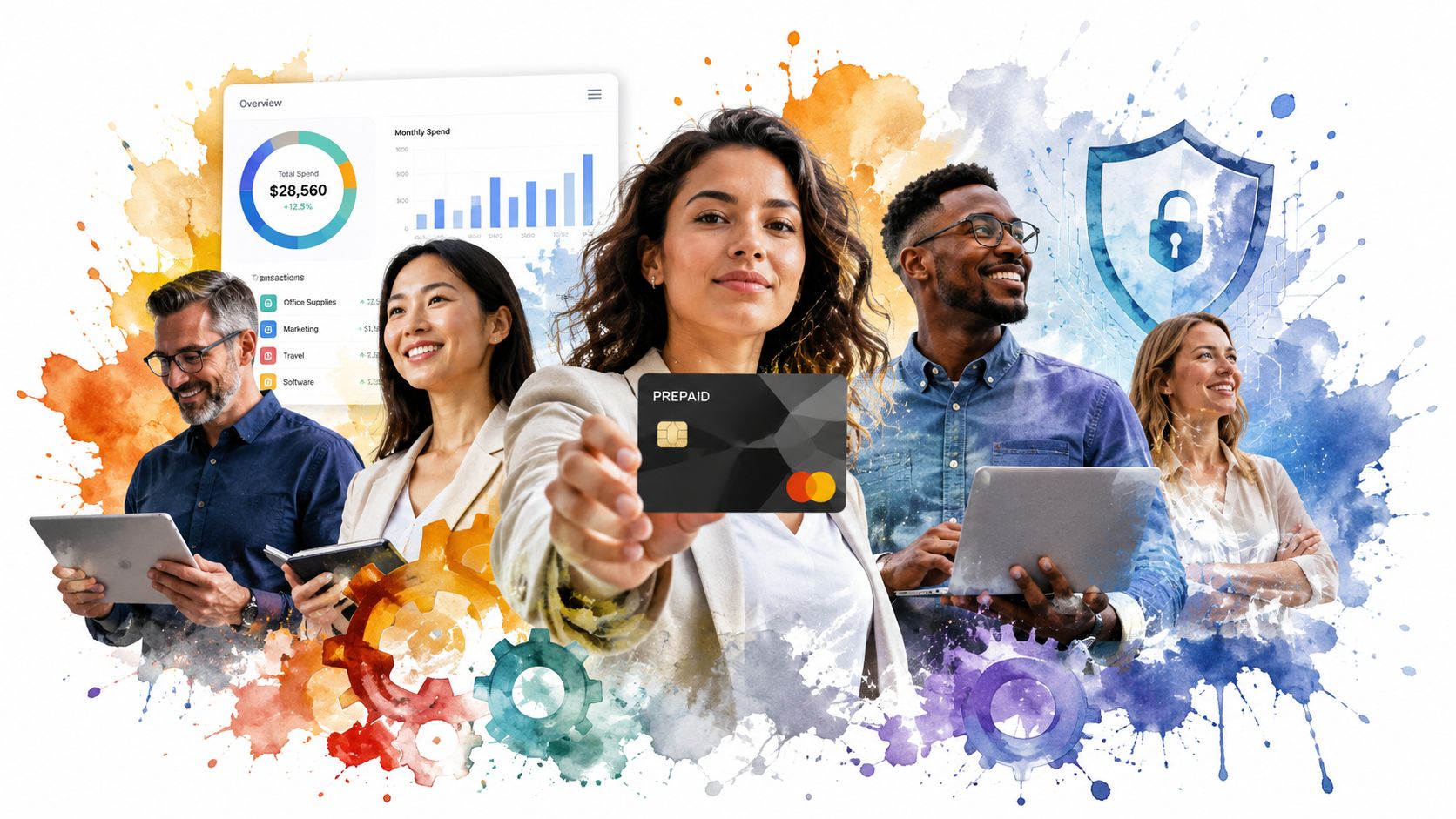
For global and crypto-native companies, that flexibility is part of the strategic value. Prepaid cards can sit between strict treasury control and local spending needs, which helps teams move faster without handing out open-ended payment access.
The bottom line is simple. Prepaid cards work best when the business wants autonomy at the edge and discipline at the center. They are not meant to replace every payment method. They are meant to remove the most painful parts of controlled spend.
Navigating Risks and Compliance
A prepaid card program can save time and still create trouble if the compliance layer is weak. The core risks are legal, financial, and operational, and they show up first in disclosures, wage access, and card security.
Federal and state wage rules still matter
Federal law requires employers to offer a real alternative payment method to payroll cards and to disclose all fees, and employees must be able to access their full wages without discount in many states paycard law overview. That means the rollout can’t be built around convenience alone. If workers are pushed into a card program without a legitimate alternative, the company can create avoidable compliance and morale problems.
Many businesses underestimate the difference between “allowed” and “usable.” A paycard can be lawful and still feel punitive if fees, ATM limitations, or access rules are unclear. The most common failure isn’t the card itself, it’s poor disclosure and poor employee guidance.
Security should be layered, not assumed
From a technical standpoint, enterprise prepaid cards can be built with strong chip and hardware protections. A sample RuPay/EMV technical specification calls for ISO/IEC 7816 compliance, EMV scheme support, secure hardware crypto coprocessors, RSA/ECC plus 3DES/AES support, Common Criteria EAL5+ hardware security, and anti side-channel protections such as SPA/DPA countermeasures technical specification. That’s a reminder that a well-designed prepaid card can support mainstream terminal acceptance and real cryptographic assurance.
Still, card technology doesn’t replace internal controls. If lost cards aren’t frozen quickly, if admin access is too broad, or if unused cards stay active after an employee leaves, the technology won’t save the policy.
Practical rule: assume every unused card becomes a risk until someone has explicitly deactivated it.
Fees and employee trust
The “free payroll card” story often falls apart once ATM, balance inquiry, or out-of-network charges are added up. Workers may not see those costs in the sales pitch, but they feel them immediately. That’s why transparent fee schedules matter as much as card features.
The right approach is to treat fee disclosure as part of the employee experience, not just a legal checkbox. If people can’t tell how to avoid charges, they’ll assume the company is offloading cost onto them. That’s bad for adoption, even when the program is compliant.
Implementing a Prepaid Card Program
A good rollout looks like an operations project, not a product launch. The goal is to make spending easier without adding a new layer of confusion for finance, managers, or employees.
Assess, select, configure, launch
Start with use cases. Travel, per diems, onboarding, contractor spend, and event budgets are all valid, but they don’t need the same card rules. If you try to solve every problem with one policy, the program gets bloated fast.
Then select a provider based on controls, reporting, fee transparency, and integration fit. A provider that issues cards quickly but can’t support spending rules or clean transaction data will create more manual work later. If the business operates globally or in digital-asset workflows, that selection step should also consider whether the platform supports cross-border payments and treasury visibility.
Build the policy before the cards go out
Configuration should define who gets a card, what they can buy, who approves reloads, and what happens if a card is lost. That policy needs to be readable by employees, not just finance. If a traveler doesn’t know whether hotel incidentals are allowed, you’ll get disputes instead of clean spend.
A useful rollout pattern is simple:
- Assess the use case: Decide whether the card is for travel, tools, subscriptions, or temporary spend.
- Select the provider: Check controls, fee structure, and integration with accounting workflows.
- Configure limits: Set merchant restrictions, balance caps, and reload rules.
- Launch with training: Show employees how to use the card, save receipts, and report lost cards.
Don’t skip the employee side
Training is where many programs often falter. Employees need to know that the card is not a personal debit card, that limits are intentional, and that receipts still matter. If they understand the boundaries, they’re far more likely to use the card properly.
For companies that need one system for both fiat and digital workflows, OneSafe’s web3 capabilities are relevant because they connect business accounts and card controls with crypto-aware operational flows. That matters if your spend program has to serve both a conventional operations team and a digital-native treasury function.
The Future of Spending in Global and Web3 Companies
Global and web3 companies run into payment friction faster than domestic businesses do. They hire across borders, pay contributors in different currencies, and often need to move between fiat and crypto without losing visibility or control. Traditional banking can handle parts of that stack, but not always in one clean workflow.
Why traditional banking leaves gaps
The hard part isn’t just making a payment. It’s coordinating the payment, the accounting record, the team access, and the treasury position at the same time. A company with international contractors might need one wallet for operational spend, another for vendor payments, and a third for conversion timing. That fragmentation slows decisions and creates reconciliation work.
Employee prepaid debit cards fit into that world because they provide controlled spend without handing out broad account access. They’re especially useful when the company wants local spending autonomy but still needs a central policy layer. In web3 environments, that combination matters because teams often mix fiat operations with digital asset workflows.
Where a unified platform becomes useful
OneSafe is an example of a platform that combines multi-currency business accounts, corporate cards with spend limits, policy-based approvals, and crypto-compatible workflows in a single interface. For teams paying global contributors or managing treasury across fiat and digital assets, that kind of structure reduces context switching and makes spend governance easier to apply consistently.
That matters for crypto-native companies that can’t rely on one bank rail for everything. If a treasury team needs to settle invoices, issue cards, and manage conversion timing without juggling disconnected tools, the operational value is in the workflow, not just the payment instrument.
What to look for as the stack evolves
The next generation of card programs will be judged less by plastic and more by control. Businesses will want real-time visibility, configurable permissions, clearer fee structures, and a better link between spend and accounting. The companies that win here will be the ones that treat cards as part of treasury infrastructure, not a side perk.
Frequently Asked Questions
Are employee prepaid debit cards the same as payroll cards
No. Payroll cards are primarily used to deliver wages, while prepaid debit cards are usually used for controlled business spend. The key difference is the operational purpose, wage access versus discretionary but policy-bound spending.
What happens to funds if an employee leaves
Unused funds should be recoverable or removable through the program administrator, depending on the provider’s setup. The important part is having a written offboarding step so inactive cards don’t keep holding balances or stay open longer than necessary.
Do prepaid cards affect an employee’s credit
No, not in the way a credit card does. They’re funded in advance, so there’s no borrowing against a revolving line and no personal credit decision in the normal card use flow.
Can a DAO use prepaid cards for operational tasks
Yes, if the treasury setup supports clear approvals, limited budgets, and good recordkeeping. DAOs usually need a stronger policy layer than traditional companies because the approval path can involve multiple stakeholders and on-chain or off-chain workflows.
What should finance ask before choosing a provider
Ask how funding works, what controls are available, how fees are disclosed, how quickly cards can be frozen, and how the transaction data exports into accounting. If the answers are vague, the card program will probably create more manual work than it removes.
If you’re evaluating prepaid cards as part of a broader spend strategy, OneSafe can help you bring cards, accounts, and cross-border payments into one operating layer. Visit OneSafe if you want a practical way to manage employee spend, contractor payouts, and global treasury without stitching together separate systems.