
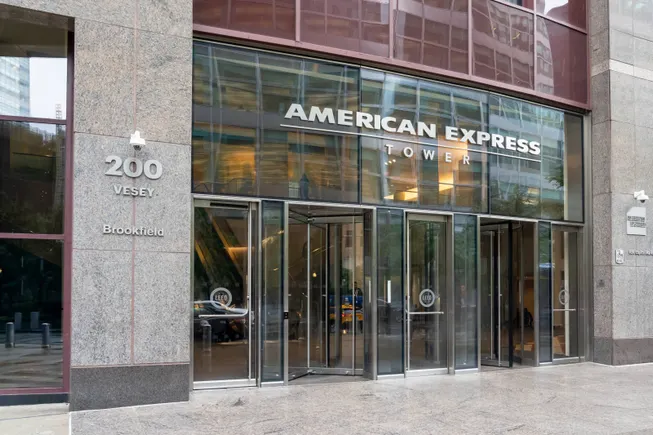
Keeping fraud at bay is tied to two factors for American Express: its closed network structure and its use of artificial intelligence, the company contends.
Amex this year once again charted the lowest fraud rate among major U.S. card networks, according to the industry research publication Nilson Report.
While Amex does not publicly release its exact fraud rate, the card issuer touted its low fraud track record over the past 19 years in a July 21 press release, citing Nilson’s February issue.
The low fraud rate reflects the New York company being an early adopter of cutting edge fraud detection technologies, such as artificial intelligence and machine learning, said Amber Gupta, Amex’s executive vice president for global decision science.
“As issuer and acquirer, we can see fraud attacks from different angles and our data feeds directly back into our fraud detection models, which helps us create the best possible outcome,” Gupta said in an interview this month.
Visa did not respond to an interview request. The San Francisco-based card network, the largest in the U.S., tracks fraud closely and has invested billions of dollars in combatting it, including acquiring the company Biocatch this month for $2.4 billion.
Visa’s annual 2026 Global eCommerce payments and Fraud report, produced in cooperation with the Merchant Risk Council, said “fraud rates are down across the board, reversing a multi-year trend of increasing incidence.”
In addition, the Visa report notes “significant declines” in first-party misuse, card testing, and triangulation schemes. The decline in first-party misuse, a.k.a. friendly fraud, is “notable” as it increased the previous two years, the report said. Friendly fraud occurs when a cardholder disputes a legitimate transaction.
A spokesperson for Mastercard, which does not disclose its fraud rate, said the company’s safety net application has prevented $77.4 billion in fraud since its 2014 launch.
One key to Amex’s fraud detection capabilities is its access to cardholder and merchant data, which enables it to see anomalies at both ends of the transaction. “Being able to see cardholder and merchant data gives Amex a structural advantage because it puts cardholder and merchant data into fraud detection models,” Jim Mortensen, strategic advisor, Fraud and AML for Datos Insights and a former Amex executive said in an interview this month. “Having this type of closed-loop system provides greater insights when it comes to spotting out-of-pattern transactions. It’s a significant structural advantage.”
Because of Amex’s network structure, comparing its fraud rates to Visa’s and Mastercard’s is not an apples-to-apples comparison, according to Tony DeSanctis, senior director for Cornerstone Advisors.
“Amex being a card issuer and acquirer muddies the water when comparing its fraud rate to Visa and Mastercard,” DeSanctis said in an interview this month. “There are a lot of players on the Visa and Mastercard networks, card issuers, acquirers and processors, which create the potential for more points of failure. Amex is on its network by itself.”
Being the acquirer and primary issuer on its network means Amex does not have to aggregate the fraud prevention performance of thousands of different card issuers, which use a variety of fraud controls and have different risk appetites.
Amex’s breadth of data is another factor in its low fraud rate. The card network has invested in AI and machine-learning technology to stay ahead of criminals which are adopting both technologies to perpetrate fraud.
An Amex AI pilot launched earlier this year streamlines investigation into transactions disputed by cardholders. The app analyzes historical transaction data, such as suspect transactions exhibiting the same characteristics, and makes that information immediately available to customer service representatives. Since introducing the app, the number of cases involving a disputed transaction that have been resolved immediately has more than doubled, Amex said in the July release.
Another fraud fighting technology in Amex’s toolbox is machine learning, which is used to spot emerging fraud trends. Fraud detection models need to be “proactive” and learn as they go, Gupta said.
Early detection is critical as more transactions are processed real-time.
A report from the research firm Gartner last month, Hype Cycle for Fraud and Financial Crime report, said 53% of financial institutions surveyed increased their fraud prevention budgets by 5% or more the past year, while 70% of banks continue to see rising fraud losses.
“Preempting fraud and detecting suspicious activity early reduces losses,” the July report said. The report is gated for Gartner clients.
Although Visa and Mastercard offer integrated fraud detection services, many bank card issuers on those networks also use third-party fraud detection solutions, which can lead to varying results. “Amex being a closed-loop network means all transactions receive the same level of scrutiny,” DeSanctis said.
Nevertheless, Amex’s real advantage lies in its ability to see cardholder and merchant data. About 70% of Amex’s ability to detect fraud comes from its closed-loop environment, while 10% can be attributed to its technology and 20% to the makeup of its cardholders, DeSanctis said.
“Amex cardholders tend to be more affluent and less likely to engage in friendly fraud,” DeSanctis added.
While Visa and Mastercard can reduce fraud through implementation of AI, tokenization and other technologies, they lack the data sharing capabilities of Amex and therefore cannot replicate its fraud fighting model. “AmEx’s lower reported fraud rate likely reflects both strong fraud-management capabilities and structural portfolio advantages,” Meng Liu, principal analyst at Forrester said by email this month.
Nevertheless, Liu cautions that comparing Amex’s fraud rate directly to Visa’s and Mastercard’s “risks conflating different business models, portfolios, and responsibilities.”