
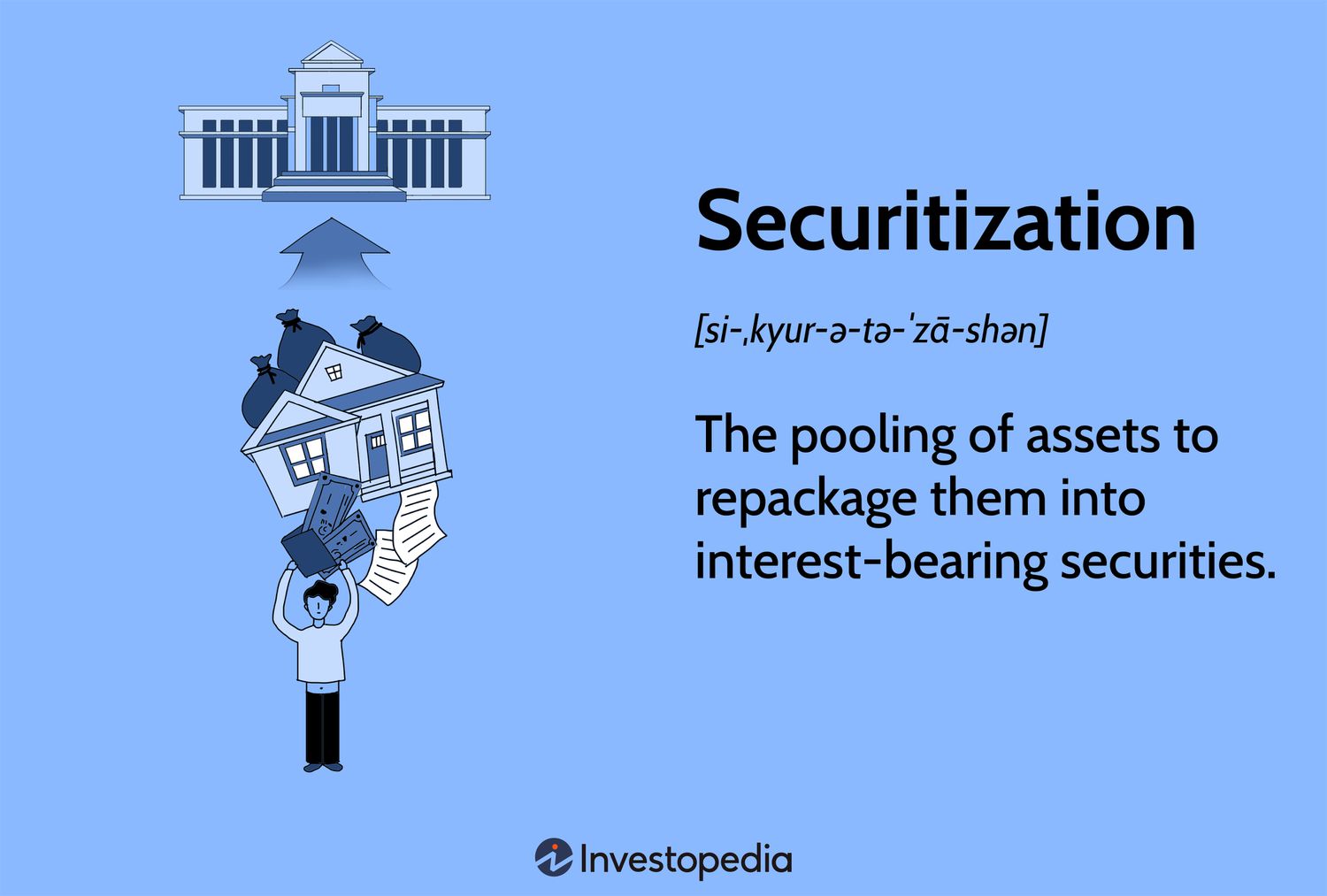
Securitization transforms non-liquid assets into tradeable securities, providing investors with principal and interest returns from diverse assets like mortgage loans and consumer debt. This process of financial integration empowers issuers and offers investors a structured avenue for income generation.
We’ll take up the nuts and bolts of how securitization works, exploring its mechanics through a step-by-step example. We’ll examine the potential benefits securitization offers to both lenders and investors, such as improved liquidity, risk diversification, and more efficient capital allocation. Meanwhile, we’ll grapple with the significant risks and downsides of securitization, including reduced transparency, misaligned incentives, and the potential for systemic instability.
Key Takeaways
- Securitization transforms non-tradable assets into tradeable securities, providing investors with income from interest and principal payments.
- Mortgage-backed securities and asset-backed securities are two common forms of securitization using different asset types as collateral.
- Securitization improves liquidity and capital allocation, though it carries risks such as reduced transparency and potential for systemic instability.
- The process involves several steps, including asset pooling, creating a special purpose vehicle (SPV), and tranching based on risk levels.
- The 2007-2008 financial crisis highlighted the risks of securitization, as complex structures like CDOs contributed to widespread financial instability.
Investopedia / Xiaojie Liu
Understanding the Securitization Process
In securitization, the company or the originator that holds the assets determines which assets to remove from its balance sheets. A bank might do this with mortgages and personal loans it no longer wants to service or raise capital for additional loans.
This gathered group of assets is now considered a reference portfolio. The originator then sells the portfolio to an issuer who creates tradable securities with a stake in the assets in the portfolio. Investors buy the new securities for a specific rate of return and effectively take the position of the lender.
Securitization lets lenders remove assets from their balance sheets to issue more loans. Investors profit as they earn a rate of return based on the associated principal and interest payments made on the underlying loans and obligations by the debtors or borrowers.
Important
Securitization frees up capital for originators and promotes liquidity in the marketplace.
Steps to Securitization: A Step-by-Step Guide
Securitization is a complex process that involves several steps:
- Asset origination: The lender begins the process by issuing loans to borrowers, which could include business lines of credit, mortgages, or other types of credit.
- Create asset pools: Loans with similar characteristics are selected to form collateral for issuing securities.
- Create the special purpose vehicle (SPV): A separate legal entity, the SPV, is established to handle the securitization process.
- Transfer the assets: Loans are sold to the SPV to remove them from the lender’s balance sheet.
- Tranching: The SPV divides the loans into tranches based on risk and return to appeal to various investors.
- Credit enhancement: Strategies are employed to make securities attractive, like over-collateralization or third-party guarantees.
- Rating: Credit rating agencies assess the tranches for creditworthiness.
- Marketing and sale: Securities are marketed and sold, focusing on investor risk appetites.
- Distribute cash flows: Loan repayments are collected and distributed according to security terms.
- Monitoring and reporting: Continuous monitoring of loans is essential, with regular performance reports provided to investors.
Different Forms of Securitization
Securitization comes in different types, each with unique structures. The most common types include pass-through securitization, pay-through debt instruments, and collateralized debt obligations (CDOs).
Tranches
The new securitized financial instrument may be divided into different sections called tranches. The tranches consist of individual assets grouped by loan type, maturity date, interest rate, and remaining principal. Each tranche carries different degrees of risk and offers different yields.
Pass-Through Securitization
Pass-through is the simplest form of securitization. In this structure, the cash flows from the underlying pool of assets are transferred to investors. The SPV issues securities, known as pass-through (or flow-through) certificates, which represent an undivided interest in the pool of assets (i.e., there are no tranches). As borrowers make payments on the underlying loans, the cash flows are collected by the servicer and distributed to the investors pro rata.
MBS issued by government-sponsored enterprises (GSEs) like Fannie Mae and Freddie Mac are examples of pass-through securitization.
Pay-Through Debt Instruments
Pay-through instruments, also known as collateralized mortgage obligations (CMOs) or real estate mortgage investment conduits, are a more complex form of securitization. For these, the cash flows from the underlying pool of assets are used to pay interest and principal on the securities issued by the SPV, but the securities themselves are structured as debt obligations.
The securities are divided into tranches with different maturities, risk profiles, and payment priorities. The cash flows from the underlying assets are allocated to the tranches based on a preset structure, with the senior tranches receiving payments before the junior tranches.
Fast Fact
Asset-backed securities (ABS) are a general term for securitization backed by a pool of nonmortgage assets, such as auto loans, credit card receivables, student loans, or equipment leases. The cash flows from these assets are used to pay interest and principal on the securities issued by the SPV. Like other types of securitization, ABS can be structured with different tranches, each with its own risk and return profile.
Collateralized Debt Obligations (CDOs)
Collateralized debt obligations (CDOs) are a type of securitization that involves pooling together a diverse range of debt obligations, such as corporate bonds, loans, or even other securitized products like MBS or ABS. The pool of assets is then divided into tranches, each with its own risk and return characteristics.
CDO-squared and CDO-cubed build on CDOs and CDO-squared assets. These played a significant role in the 2007 to 2008 global financial crisis. Many of these securities were backed by subprime mortgages and experienced significant losses when the housing market collapsed. The complexity and lack of transparency in these structures made it difficult for investors to understand the true risks involved, leading to a loss of confidence in the securitized product market.
| Securitization By Type | |||
|---|---|---|---|
| Securitized Products/Acronym | Underlying Assets | Description | Risk |
| Asset-Backed Securities (ABS) | The most general category for various consumer and commercial loans (auto loans, credit card debt, student loans, etc.) | Diversified pool of assets, cash flow from loan repayments passed through to investors | Depends on underlying assets and structure |
| Collateralized Bond Obligations (CBOs) | Corporate bonds | Like CDOs but backed by corporate bonds | Generally higher risk than MBS |
| Collateralized Debt Obligations (CDOs) | Various debt instruments (bonds, loans, MBS, ABS, etc.) | Complex structures with multiple tranches offering different risk-return profiles | Higher risk because of complexity and leverage |
| CDO-Squared | Tranches of other CDOs | Highly complex and leveraged structure | Very high risk |
| CDO-Cubed | Tranches of CDO-squared securities | Highly complex and leveraged structure | Very high risk |
| Collateralized Loan Obligations (CLOs) | Leveraged bank loans | Similar to CDOs but backed by leveraged loans | Higher risk due to leveraged nature of underlying loans |
| Commercial Mortgage-Backed Securities (CMBS) | Commercial mortgage loans | Backed by income-producing commercial properties | Generally higher risk than RMBS |
| Mortgage-Backed Securities (MBS) | Residential or commercial mortgage loans; agency-backed (U.S. government guaranteed) or private MBS | Pooled mortgages, cash flows from principal and interest payments passed through to investors | Depends on underlying mortgages and structure; agency-backed MBS are low-risk |
| Residential Mortgage-Backed Securities (RMBS) | Residential mortgage loans | Backed by loans on single-family homes and condominiums | Depends on underlying mortgages and issuer |
Pros and Cons of Securitization
Advantages
-
Turns illiquid assets into liquid ones
-
Frees up capital for the originator
-
Provides income for investors
-
Small investors can participate
Disadvantages
-
Investor assumes creditor role
-
Risk of default on underlying loans
-
Lack of transparency regarding assets
-
Early repayment damages investor’s returns
Securitization offers liquidity by letting retail investors buy shares they couldn’t access otherwise. An MBS investor can buy portions of mortgages and receive regular returns from interest and principal payments.
Many loan-based securities, unlike other investments, are backed by collateral. In addition, as the originator moves debt into the securitized portfolio, it reduces the liability on its balance sheet, allowing it to underwrite further loans.
Although the securities may be backed by tangible assets, there is a risk of default. Moreover, early repayments will cut the returns the investor receives on the underlying notes. There may also be a lack of transparency about the underlying assets. Misrepresented MBS infamously played a toxic and precipitating role in the financial crisis of 2007 to 2008.
Securitization in Action: A Real-World Example
The investment company Fidelity offers MBS that give investors a monthly distribution of principal and interest payments made by homeowners. For this example, Fidelity offers an MBS issued by various GSEs or agencies:
- Government National Mortgage Association (Ginnie Mae): Ginnie Mae does not purchase, package, or sell mortgages but does guarantee their principal and interest payments.
- Federal National Mortgage Association (Fannie Mae): Fannie Mae purchases mortgages from lenders, then packages them into bonds and resells them to investors.
- Federal Home Loan Mortgage Corporation (Freddie Mac): Freddie Mac purchases mortgages from lenders, then packages them into bonds and resells them to investors.
When an investor purchases these securities, they are essentially buying a share in a pool of mortgages. As homeowners make their monthly mortgage payments (principal and interest), the cash is collected by the GSEs or agency and distributed to MBS investor pro rata.
Investors in MBS benefit from the regular cash flows from the underlying mortgages, as well as the potential for capital appreciation if interest rates fall (as the value of fixed-income securities generally rises when interest rates decline). However, they also face prepayment risk, which is the risk that homeowners may refinance or pay off their mortgages earlier than expected, altering the cash flow profile of the MBS.
Investing in these MBS exposes investors to the risks and returns of the underlying mortgages. These MBS are backed by the full faith and credit of the U.S. government, making them among the safest fixed-income investments. These are called agency MBS, as opposed to non-agency (private) MBS, which make up but a small part of the market.
Which Agencies Regulate Securitization?
How Are Investors Paid by Investing in Mortgage Based Securities?
Two types of MBS included pass-throughs and collateralized mortgage obligations (CMO).
Pass-throughs are structured as trusts in which mortgage payments are collected and passed to investors with stated maturities of 5, 15, or 30 years. CMOs consist of pools of securities known as tranches with varying credit ratings that determine the rates that are returned to investors.
What Is the Difference Between an MBS and an ABS?
Mortgage-backed securities are bonds backed by home loans issued to consumers. Asset-backed securities are bonds backed by auto loans, mobile home loans, credit card loans, and student loans.
The Bottom Line
Securitization transforms illiquid assets, such as mortgages and consumer loans, into marketable financial instruments, providing liquidity and investment opportunities. Investors gain by receiving interest and principal payments from these assets, with mortgage-backed securities (MBS) and asset-backed securities (ABS) being prominent examples. However, securitization carries risks, including potential default and reduced transparency, evident during the 2007-2008 financial crisis. Therefore, investors should carefully consider their risk tolerance and seek advice from financial professionals when dealing with these complex products.