(Bloomberg) — To see how Asian hedge funds got blindsided by the Iran war, look no further than Trivest Advisors Ltd.
Most Read from Bloomberg
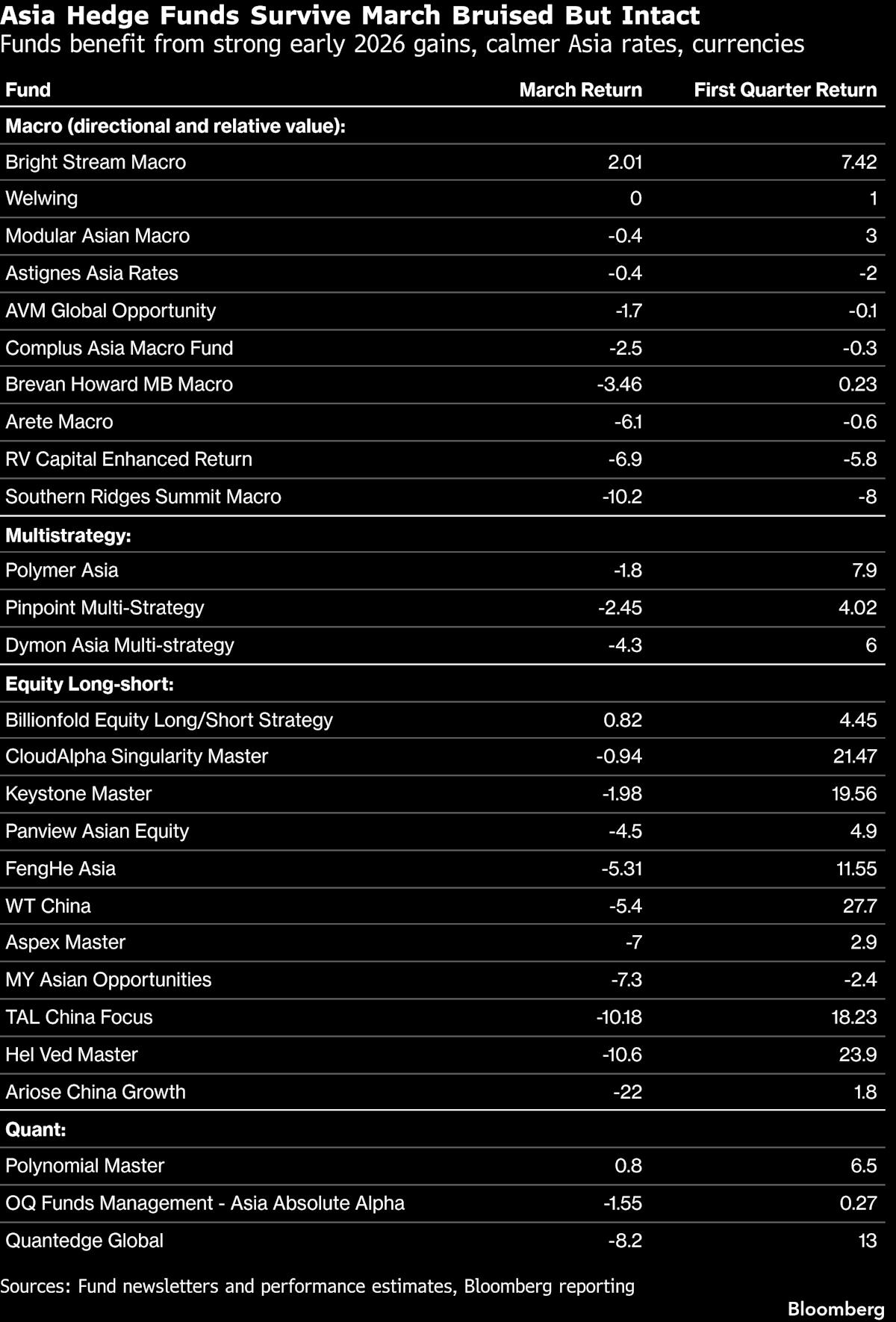
Through its almost 16 years of existence, the firm’s $5.4 billion TAL China Focus Fund has weathered the country’s stock market routs, geopolitical spats and handling of the pandemic — only to have its worst ever monthly loss in March, slumping 10.2%.
March “is likely to go down in history as one of the most challenging months for investors,” Trivest said in an update to clients. “Global markets have gone through an awfully painful pattern where risk-on and risk-off trades turned very wrong within hours as news of war escalation or ceasefire negotiations changed constantly.”
It wasn’t alone. Mohit Khurana’s $1.65 billion Southern Ridges Summit Macro Fund also tumbled 10.2%, the most since its October 2022 inception, it told investors. That was more than twice its August 2024 loss, the only other month in which it declined more than 1.5%. Hermes Li’s more than $14.5 billion Aspex hedge fund retreated 7% in March, said people with knowledge of the matter.
To varying degrees, most funds managed out of Asia were in the red in March, as the US-Israeli war against Iran escalated. The median stock hedge funds trading across the region or focusing on specific geographies lost anywhere from 4.5% to 6.2% during the month, while the median macro funds tapping broad trends across asset classes slid 6.9%, UBS Group AG prime brokers said in a note.
But the picture wasn’t all bad. For the most part, funds in Asia held up better than global peers during the month and the first quarter, having stayed out of the worst-hit wagers on European rates, with stronger performances in the first two months of the year as a cushion.
And with the ceasefire, Asian stock-picking hedge funds tracked by Goldman Sachs Group Inc. have already rebounded 8.9% this month through April 9, the bank said in a note. That erased much of the March fall and gave them on average a 15% return this year. The MSCI Asia Pacific Index of shares slid 13.4% in March, but has since recouped most of those losses, even as investors grapple with ongoing confusion over the state of the conflict.
March saw popular rates, currencies, equities and commodities wagers upended after the war disrupted oil and gas supplies and stoked fears of inflation and an economic slowdown. Stock investors shifted toward energy and utility companies, as the prospects of tighter financial conditions clouded the outlook for previously red-hot technology bets.
Southern Ridges went into the month with wagers on a dollar decline, steeper yield curves and stock rallies, Khurana wrote. He expected productivity growth from corporate spending on artificial intelligence, higher fiscal deficits and a move toward “a less unipolar world.” US President Donald Trump’s willingness to go to war wasn’t on his radar.
“Stagflation was not part of our expectations and given the historical reluctance of Trump to engage in long-term conflicts, there did not feel like a need to hedge that outcome,” he added. “I could not have been more wrong.”
Others fared better. Brevan Howard Asset Management’s $6.5 billion MB Macro strategy, led by Singapore-based Minal Bathwal, capped its loss under 3.5%. Global liquid fixed-income relative-value firm Welwing Capital, founded in Hong Kong in 2019 and overseeing just shy of $5 billion, finished March flat, according to people with knowledge of its performance.
Astignes Capital Asia Pte’s flagship macro fund slipped 0.4%, as did the just under $2 billion macro hedge fund of Modular Asset Management, said people with knowledge of the matter. Yip Ka-hay’s $108 million Bright Stream Macro joined the small rank of peers who made money amid the rout, gaining 2%.
Yip positioned for the Indonesian rupiah to decline against the dollar, on concerns about the Southeast Asian nation’s 2.9% fiscal deficit even before the Iran war. Government plans — such as free school meals — could take it across the 3% constitutional limit, denting investor confidence.
Macro traders had widely bet on the Australian dollar to appreciate against the greenback and the New Zealand dollar since the fourth quarter, on the commodity-exporting country’s strong economic growth and high interest rates. Seeing danger of overcrowding in the consensus trade, Yip bought put options on the Australian currency against call options on the dollar as a hedge, a move that paid off during the March turmoil.
At Trivest, most of the China fund’s losses came from tech industry investments, as concerns mounted about AI-related valuations and disruptions.
It responded by trimming positions across the board. By now, while the Middle East situation remains fluid, some of the fund’s core holdings have declined so much that it’s looking to raise positions again, it said.
Billionfold Asset Management’s $927 million South Korea equity long-short strategy eked out a 0.8% gain in March, one of the rare stock hedge funds that avoided losses, according to a fund document seen by Bloomberg News. Millennium Management gave the Seoul-based firm an initial $250 million last year, the global hedge fund giant’s first allocation to an external manager in South Korea.
Representatives for Southern Ridges, Brevan Howard, Welwing, Billionfold and Modular declined to comment. Aspex, Trivest and Astignes representatives didn’t reply to emails seeking comment.
Most Read from Bloomberg Businessweek
©2026 Bloomberg L.P.