
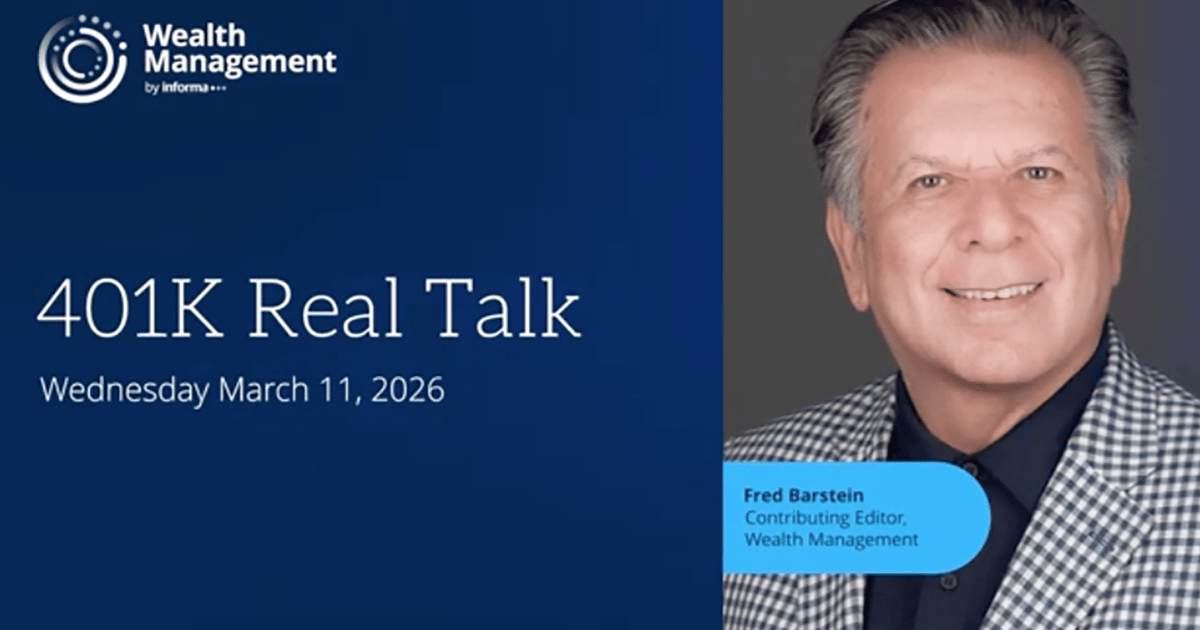
Welcome to this week’s edition of 401(k) Real Talk, where Fred Barstein, contributing editor for Wealth Management’s RPA channel, reviews all of last week’s industry news and selects the five most important/interesting stories.
Worth Reading:
Read the full raw transcript below:
Greetings & a warm welcome to this week’s edition of 401k Real Talk. This is Fred Barstein contributing editor at WealthManagement’s RPA omnichannel and CEO at TRAU, TPSU & 401kTV – I review all of this week’s stories and select the most important and interesting ones providing open honest and candid discussion you will not get anyway else. So let’s get real!
FIRST STORY
AS EBSA Director Daniel Aronowitz testified before a House Subcommittee, his department announced their priorities emphasizing loyalty over prudence and not regulating by enforcement. Instead, Aronowitz said his department will focus on fairness, notice and clarity.
Much of his Congressional testimony concentrated on what he called “meritless” ERISA litigation with a bill pending that would severely limit lawsuits. Aronowitz did indicate a renewed focus on healthcare plans with new laws, regulations and lawsuits likely to force plan sponsors to treat their health plan like their DC plan with an emphasis on costs, fiduciary liability and prudent due diligence.
It’s worth noting that Aronowitz had previously led Encore Fiduciary which insures plans against lawsuits and that the DOL and EBSA have experienced a more than 20% reduction in staff which will limit enforcement creating a gap especially if the ERISA Litigation Reform Act passes.
Next story:
The debate about the impact of AI on advice and the wealth industry continues with market valuations of wealth management stocks dropping $100 bn in February after Altruist launched an AI powered tax planning tool. Investors believed that AI could be more than just a productivity tool potentially causing massive disruption.
A McKinsey report suggests that AI will not dramatically affect the high-net-worth market instead enabling cost relief and capacity expansion, but it would affect the dynamics for standardized, lower touch models and younger investors.
All of which could have a major impact on the DC market accelerating the convergence of wealth and retirement with AI democratizing advice.
NEXT STORY
In an independent blog, Nevin Adams succinctly highlights problems facing retirees that rely on DC plans with no clear solution in sight.
The problem is that people are afraid to spend and cannot model for issues like inflation, healthcare costs and longevity because DC plans focus on account balances while DB plans highlight payouts.
The obvious solution is lifetime income but adoption is still single digits with just 7% of plans considering TDFs with lifetime income options compared to 14% looking at private investments according to a recent Callan study.
TDFs would never have exploded without automatic enrollment but Adams question imbedding lifetime income into a TDF because it is too blunt an instrument. But how customized were DB plan payouts?
Partial allocation with some flexibility makes sense to Adams but he also notes that there needs to be more clarity about these options.
Meanwhile a Pru/Global Aging Institute whitepaper claims that costs would be 20% lower if benefits were paid as lifetime income v. lump sum recommending institutional pricing, flexibility and access to advice.
Next story:
Amazing column about the DOL proposed rule about alternative investment selection by Matthew Eickman, Managing Partner at the Fiduciary Law Center. He has quickly become the leading ERISA expert for the RPA industry because of his legal background + more than a decade of experience as a practicing advisor at Prime Capital.
Eickman not only explains the rule in plain English but also highlights the opportunities for RPAs in what he calls the most wide-sweeping change in the prudent standards for the selection of all DIAs since 1979.
FINALLY
While CITs continue to dominate the RPA DC market with more assets in CIT TDFs than mutual funds, there are lingering issues about these options which most people are overlooking and is causing massive confusion among plan sponsors.
Read my recent WealthManagement.com/RPA column about the issues with CITs which plan fiduciaries must consider even if costs are substantially lower.
FINISH
So those were the most important stories from the past week. I listed a few others I thought were worth reading covering:
The potential advisor conflicts of interest with managed accounts
ICI reports CITs require massive operational changes
Callan surveys highlights 2025 plan sponsor activity with three quarters taking action on their TDF
Pru & Global Aging Institute report 20% lower costs when benefits are paid as lifetime income and
Cerulli reports institutional investors are looking beyond returns when evaluating asset managers
Please let me know if I missed anything or if you would like to comment. Otherwise I look forward to speaking to you next week on 401k Real Talk.