
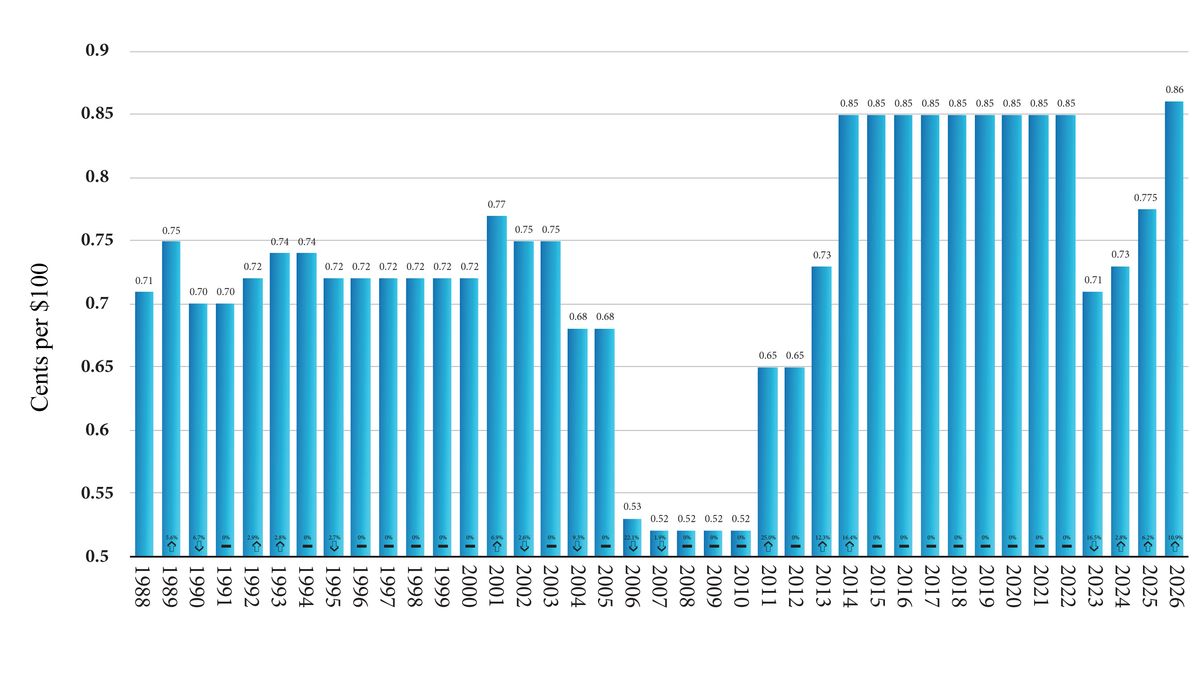
Isle of Wight’s tax rate would stay at 85 cents for the next nine years. The supervisors lowered it 16.5% in fiscal year 2023-24 to 71 cents per $100 to adjust for the impact of the 2023 reassessment, which saw the value of single-family homes rise an average 34% since 2019. It was the second double-digit percent decrease Isle of Wight saw in 20 years, the other a 22.1% decrease from 68 cents per $100 to 53 cents in 2006, also to offset an increase in valuations due to reassessment. Another reassessment is ongoing with new valuations set to take effect in 2027.
This year’s proposed real estate tax increase, according to County Administrator Don Robertson, would give an additional $1.6 million to IWCS beyond the $3 million included in his originally proposed $117.7 million budget, increase salaries for public safety employees and offset the impact of tax exemptions for disabled veterans. The 86-cent proposal followed a standing-room-only public hearing on April 23 on a then-proposed 5.8% increase to 82 cents that saw more than 120 attendees and over 50 speakers, mostly parents and teachers, lobby for 3½ hours to increase school funding to implement a consultant’s recommendation for higher pay scales.
Robertson, at an April 30 budget work session, said the revised budget with the added funding for school and public safety raises totals $119 million and would need at least an 85-cent real estate tax rate, or 9.6% increase, to cover what would otherwise be a $2.1 million revenue gap.
Several speakers at the hearing, and Vice Chairwoman Renee Rountree, suggested dipping into the county’s cash reserves to fund the raises while maintaining a lower tax rate. The county’s unassigned fund balance, which Robertson has likened to a savings account and others have dubbed a “rainy day fund,” stood at $29.4 million as of 2024, or 25.9% of budgeted expenses, up from the 15% required by county policy.
Rountree also recently pushed for the county’s Economic Development Authority to return $1.4 million the supervisors transferred to the EDA in 2024 for moving Smithfield’s farmers market to the now-scrapped Grange at 10Main development at Route 10 and Main Street. Using that funding, which Robertson said he doesn’t recommend, would reduce the required increase to 83 cents, or 7%.
But that option “puts you at a deficit of 2 cents when we start the process next year because that’s one-time money, so when you start budget conversations next year, you’re already going to start out having to make up that $1.4 million,” Robertson said.
A new public hearing on the advertised 86-cent rate is set for May 14 at 6 p.m.