
Most of us have one. A piece that lives in the family — not in a locker exactly, but not casually worn either. Somewhere between the two. Maybe it was your grandmother’s. Maybe it was bought for a wedding and never quite made it back into the box after. Maybe you can’t fully explain why it feels different from everything else you own, only that it does.
That piece, more often than not, is platinum.
There’s something about platinum that resists being casual about. It’s not intimidating — it’s just permanent. The kind of thing you don’t misplace. The kind of thing that, when you eventually pass it on, the person receiving it already understands its weight without being told.
What’s interesting is that this quality, the one that once made platinum feel almost too serious, is exactly what’s making it feel right again. Except now it’s not being chosen for the occasion. It’s being chosen for the person.
From Metros To Smaller Cities, Something Is Shifting In How India Buys Jewellery
Pallavi Sharma, Deputy Country Manager – India & Middle East at Platinum Guild International, has been sitting with this shift for a while. “For younger Indian consumers today, luxury is less about overt display and more about personal identity,” she says. “They engage with trends, but interpret them in ways that feel authentic to their own lives, choices and values. This is not limited to a small, metropolitan idea of contemporary culture — with greater access, aspiration and awareness, this mindset now extends across India, from metros to smaller cities and towns, where young consumers are shaping culture as much as responding to it.”
That last part is worth pausing on. The conversation about considered, intentional luxury isn’t happening only in South Mumbai living rooms anymore. It’s happening in Jaipur, Lucknow, Pune — in cities where a younger generation has grown up with enough access to know that the most interesting choice is rarely the loudest one.
/elle-india/media/post_attachments/30e96bff-068.jpg "publive-image")
“In a country with a deep and enduring relationship with jewellery, we see that the younger consumer is increasingly choosing their jewels not just as adornment, but as an expression of self-image and meaning,” Sharma adds. “That is where platinum resonates so strongly — it signals discernment. A rare, meaningful, and deeply personal choice.”
Which brings you to the question of what that actually looks like in practice. Because wearable and meaningful used to feel like opposing forces in Indian jewellery. You had your everyday pieces and you had your serious pieces, and rarely did the two overlap. What’s shifting is that the younger buyer doesn’t want to make that distinction anymore. They want the thing that means something to also be the thing she reaches for on a Wednesday. That’s a bigger shift than it sounds.
Three Labels, Each Saying Something Different About Who You Are
PGI has been building toward this through three labels that feel distinct but are rooted in the same essential idea.
On Platinum Evara, Sharma says: “The focus is on self-expression, self-worth, and celebrating one’s own journey — something that resonates strongly with young women today.” The pieces are designed for frequent wear — not saved for, not locked away, but actually lived in across work, travel, and the kind of occasions that don’t require a name. Which, in a culture where women’s jewellery has historically been defined almost entirely by what she wears for others — for the wedding, for the family photograph — is actually a meaningful recalibration.
/elle-india/media/post_attachments/9228ba3f-57c.jpg "publive-image")
On Men of Platinum, she describes it as reflecting “a quieter, value-led masculinity” — jewellery that becomes “a natural expression of character, confidence, and individuality.” Indian men and jewellery has always been a complicated sentence. What Men of Platinum does is uncomplicate it through design that doesn’t ask you to perform anything. The MS Dhoni association makes sense here in the most unforced way possible — Dhoni is not a man who explains himself. The jewellery doesn’t either.
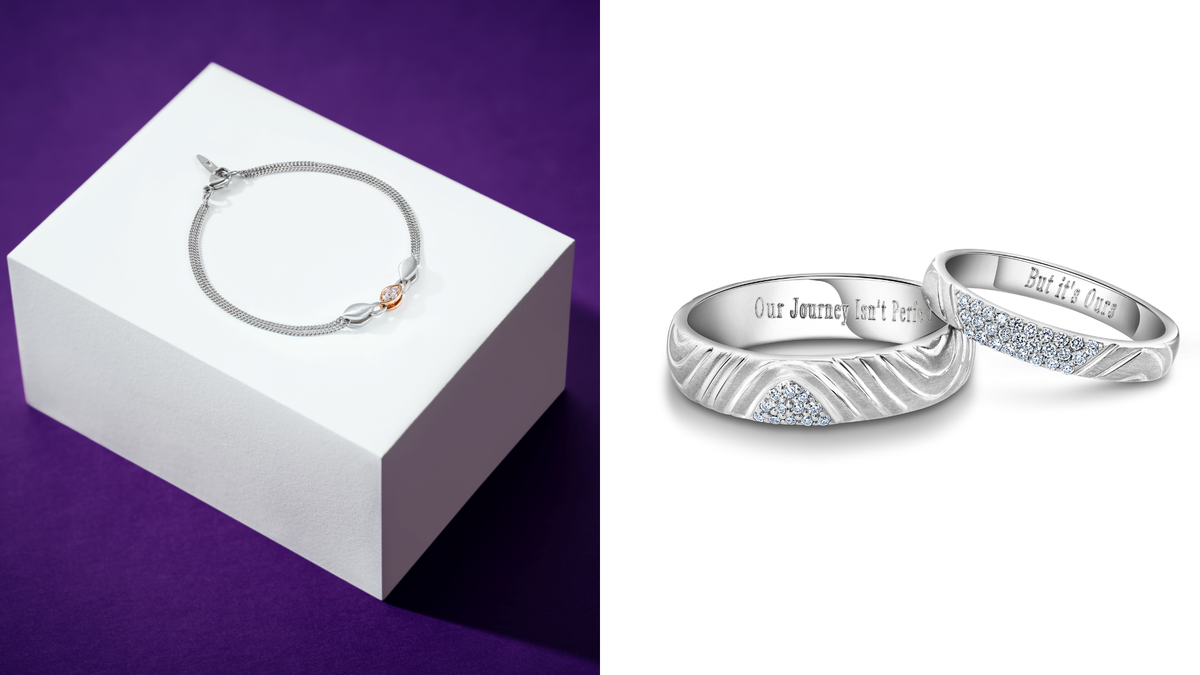
And on Platinum Love Bands: “Couple jewellery is no longer limited to ceremony,” Sharma says. “It is about celebrating a relationship in which both partners can fully be themselves.” The bands can be engraved with names, dates, initials, private milestones — details that mean nothing to anyone outside the relationship and everything to the two people inside it. Less grand gesture, more private language. Which is honestly a more accurate portrait of what love looks like day to day.
/elle-india/media/post_attachments/5e235c04-2d9.jpg "publive-image")
On the global red carpet this season, platinum showed up in ways that felt less like trend and more like consensus. At the Oscars, Teyana Taylor wore a Tiffany & Co. platinum diamond necklace featuring a centre stone of over 18 carats, while Mikey Madison chose a clean platinum-set pendant — precise, no excess. Zoe Saldana wore a Cartier High Jewellery necklace crafted in platinum with rubies and diamonds. At the Golden Globes, Miley Cyrus wore a Tiffany & Co. platinum pendant with an unenhanced emerald of over 15 carats.
None of it felt showy. That was kind of the point. When the people who have access to literally anything reach for platinum, they’re making a choice — and the choice is consistently the same. Refined over flashy. Rare over abundant. The piece that will still be worth talking about long after the night is over.
A Piece Bought Today Should Still Mean Something Forty Years From Now
India’s relationship with jewellery has always been emotional before it’s been anything else. It marks things — beginnings, losses, the quiet moments that don’t have ceremonies but matter just as much. And it travels across generations in a way that almost nothing else does.
/elle-india/media/post_attachments/29a73830-c19.png "publive-image")
Sharma puts it simply: “Platinum is often chosen to mark deeply personal moments and values — love, self-belief, achievement, identity. Younger consumers are not just asking ‘is this beautiful?’ They are also asking ‘does this reflect who I am, and will it continue to matter to me over time?’ Platinum’s rarity, purity and durability allow it to answer both questions.”
Its 95% purity — assured when bought from a certified retailer — isn’t just a product specification. It’s the reason a platinum piece bought today could mean as much to someone forty years from now as it does to the person wearing it tonight. That’s not a small thing to be able to offer someone.
Which brings you back to where you started. That piece in the family. The one that doesn’t need explaining. The one that already knows what it means.
Some things are just built to last.