
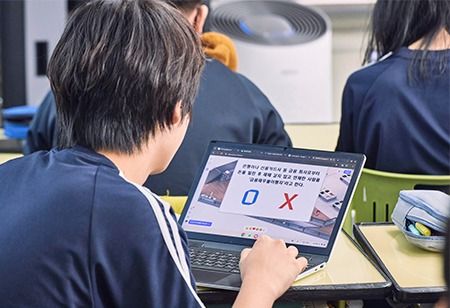
As South Korea quietly rewrites the rules around youth finance, a larger transformation is unfolding— Korea’s financial authorities lowers the age threshold for payment card usage. This amendment is reshaping how an entire generation learns to spend, save, and understand money.
Financial authorities are lowering the age barrier to payment access as digital transactions increasingly define everyday life in South Korea. This change is subtle in policy but will have a profound impact: financial responsibility is now arriving much earlier.
And for companies operating at the center of Korea’s payment ecosystem, this shift presents both an opportunity and a challenge. Among them, Hyundai Card is emerging as a notable force—not merely as a credit card provider, but as an educator helping young consumers navigate a rapidly evolving financial world.
Korea’s Financial Reality Is Changing — Earlier Access, Bigger Responsibility
For decades, payment cards in South Korea were considered tools reserved largely for adults. Teenagers often relied on their parents’ cards, while younger children had little direct exposure to structured financial systems. That framework is now changing.
Recent regulatory reforms by Korean financial authorities have significantly lowered the age threshold for card-based financial access. Children aged 12 and above can now use credit cards issued in their own name, provided a parent applies and consents. Meanwhile, the minimum age for debit card issuance has dropped from 12 to just 7 years old.
The move reflects broader shifts in Korean consumer behavior. Cash is steadily disappearing from daily life, replaced by card and mobile payments that dominate even small transactions. Financial authorities recognized an emerging mismatch between reality and regulation: while young people were already participating in digital spending, the legal and educational structures around them had not fully caught up.
Historically, many children simply used payment methods registered under their parents’ names, creating ambiguities around responsibility and spending accountability. By formalizing younger users’ entry into the system, regulators are attempting to create safer, clearer financial boundaries for the country’s next generation of consumers.
Yet easier access also raises an important question: if children are entering financial systems earlier, are they truly equipped to understand them?
Why Financial Literacy Is Becoming Urgent
The rise of youth spending power has made financial education less of an option and more of a necessity.
Understanding how payment systems work—what balances mean, why spending limits exist, how overspending happens, and how financial fraud can be avoided—is increasingly becoming essential knowledge rather than adult-only expertise.
More importantly, experts suggest that early financial decision-making often shapes long-term behavioral patterns. The ability to evaluate when, how, and how much to spend may influence not only future spending discipline, but also credit habits and financial resilience later in life.
This is precisely where Hyundai Card has chosen to deepen its role.
Hyundai Card’s Decade-Long Bet on Financial Education
While many companies are only beginning to discuss youth financial literacy, Hyundai Card has quietly invested in it for over a decade.
A cornerstone of its efforts is the “One Company, One School Financial Education” initiative—a nationwide sister-school program that connects financial institutions with elementary, middle, and high schools to deliver practical financial education.
Since joining the initiative in 2015, Hyundai Card has steadily expanded its presence, building educational content around the financial realities students are most likely to encounter at different stages of life.
The objective is straightforward but ambitious: help young people develop responsible financial habits before poor ones take root.
The company’s commitment has not gone unnoticed.
In February, Hyundai Card received the highest distinction available to financial firms at the 2025 One Company, One School Financial Education Best Practice Awards, hosted by Korea’s Financial Supervisory Service (FSS). The company earned the prestigious FSS Governor Award, standing out as the only firm in Korea’s specialized credit finance sector to receive the honor.
More significantly, the recognition marked Hyundai Card’s third consecutive win between 2023 and 2025—further solidifying its leadership position in youth financial education.
Financial Education Is Growing — But Still Lagging Behind Usage
The timing of Hyundai Card’s efforts is particularly relevant.
According to data from the Korean Educational Development Institute’s Education Policy Network, payment cards have already become commonplace among Korean youth. Today, 67.2% of middle school students and 85.9% of high school students use debit cards, underscoring how deeply financial tools have entered everyday student life.
Yet classroom education has not expanded at the same pace.
Only 37.5% of elementary school students, 33.9% of middle school students, and 38.9% of high school students report receiving financial education in school settings.
The gap is clear: real financial behavior is beginning early, while structured financial understanding remains inconsistent.
Hyundai Card’s long-running education strategy appears increasingly aligned with this reality.
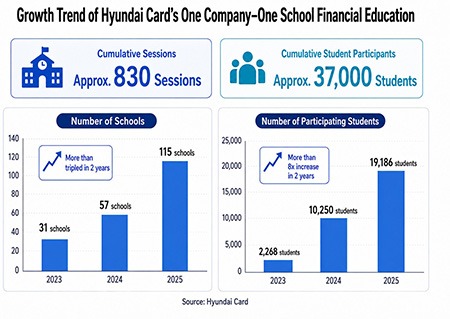
Since launching its school-based initiative in 2015, the company has conducted roughly 830 educational sessions, reaching more than 37,000 students as of February this year.
More notably, the scale of the initiative has accelerated rapidly in recent years.
The number of participating schools climbed from 31 in 2023 to 57 in 2024, before nearly doubling again to 115 in 2025. Student participation experienced even steeper growth—from 2,263 participants to 19,185 in just two years, representing an eightfold increase.
The numbers suggest more than program expansion; they point toward rising demand for practical financial education as younger Koreans engage with money earlier than previous generations.
Bridging Korea’s Financial Education Divide
What distinguishes Hyundai Card’s approach is not only scale, but reach. Financial education access in many countries often remains concentrated in major urban centers. Hyundai Card, however, has increasingly focused attention on underserved regional communities.
Over the past year, the company expanded programs into regions such as Jeollanam-do and Chungcheongbuk-do, delivering financial education to more than 4,000 students across 35 schools.
These efforts were among the factors positively recognized by Korea’s Financial Supervisory Service, particularly for helping narrow educational disparities between metropolitan and regional areas.
Why Hyundai Card’s Model Appears to Work
The strength of Hyundai Card’s financial education strategy lies less in volume and more in design.
Rather than adopting a generic curriculum across age groups, the company structures learning around the realities students are likely to face at different life stages.
For elementary students, lessons focus on the basics—understanding money, spending, and saving. Middle school students, who increasingly begin using payment tools directly, learn practical financial judgment and fraud prevention. High school students preparing for adulthood are introduced to more advanced concepts, including credit management and financial decision-making.
Equally important is how the content is delivered.
Hyundai Card avoids traditional, top-down lectures that merely tell students what they should or should not do financially. Instead, the company emphasizes participation-based learning.
Through “League of Finance,” Hyundai Card’s flagship education platform within the One Company, One School initiative, students complete missions inside virtual financial environments designed to simulate real-life decisions. The company also incorporates more immersive formats—including musicals and escape-room-inspired experiences—to make financial concepts feel accessible rather than intimidating.
The result is a learning environment where students are encouraged to observe, interact, and solve problems firsthand—transforming finance from an abstract topic into something tangible and practical.
Integrating Financial Literacy Into School Life
Hyundai Card is also increasingly aligning its educational efforts with Korea’s formal academic system.
Since 2024, the company has participated in Korea’s “Free Semester” program, which allows middle school students to temporarily step away from exam-driven learning and explore fields through practical, participation-based experiences.
The company has also supported the country’s newly introduced high school elective, “Finance and Economic Life,” through on-site guest lectures designed to complement classroom instruction with real-world financial perspectives.
The integration signals a broader shift: financial literacy is gradually moving from extracurricular enrichment toward becoming an essential life skill.
Preparing Tomorrow’s Financial Consumers
As Korea’s financial landscape evolves, one thing is becoming increasingly clear: younger generations are entering the world of payments and spending sooner than ever before.
The challenge is no longer whether children will engage with financial tools—it is whether they will be prepared to use them responsibly.
Hyundai Card appears to be positioning itself at the center of that preparation, investing not only in payment innovation but also in the financial confidence of future consumers.
As one Hyundai Card official explained, the company remains focused on helping young people build the ability to understand finance and use financial services responsibly through systematic, age-appropriate education.
In a world where a child can hold a payment card before entering middle school, that mission may prove more relevant than ever.
About Hyundai Card
Established in 2001 as a financial arm of Hyundai Motor Group, Hyundai Card is Korea’s top credit card issuer, headquartered in Seoul. Leveraging advanced data science capabilities, Hyundai Card has pioneered the world’s first data-driven Private Label Credit Card (PLCC) business model.
Through strategic partnerships with champion brands, including Korean Air, Costco, and Hyundai Moter, the company has formed a powerful, cross-industry data alliance. Hyundai Card consistently introduces innovative products tailored to evolving consumer lifestyles. Notably, it was the first company to launch Apple Pay in 2023 and serves as the exclusive domestic issuer of American Express Centurion cards, bolstering its highly acclaimed premium card lineup.
Recently, Hyundai Card developed ‘Universe,’ a proprietary, hyper-personalized AI platform, becoming the first Korean financial institution to export an AI platform through a landmark agreement with SMCC, one of Japan’s Top three credit card companies. Beyond finance, the company is a cultural trailblazer, establishing corporate branding as a standard practice in Korea through its iconic cultural initiatives like the Hyundai Card Super Concert series and its immersive Hyundai Card LIBRARY spaces.