
Here’s everything you’ll learn when reading this story:
- Scientists have long known that volcanic island arcs contain relatively high concentrations of gold, but the reason isn’t clear.
- A new study focusing on glasses near the Kermadec Island Arc found that melting occurred at high enough temperatures to allow sulfur bonds to release metals into the magma.
- This, combined with repeated remelting of previously depleted mantle, increased gold concentrations.
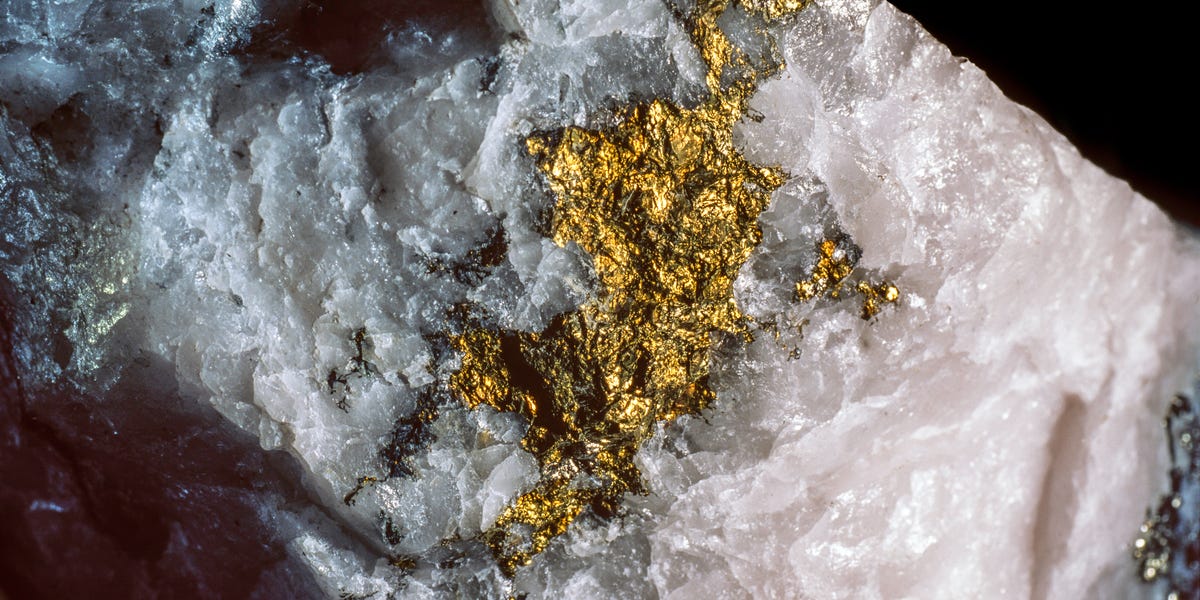
At a universal scale, gold’s weighty atomic mass—composed of 79 protons and 118 neutrons—makes it rarer than many of the other elements on the periodic table. On Earth, it’s prized as much for its malleability and shiny, shiny nature as it is for its rarity. But as with many rare things, it brings with it a bit of mystery, especially regarding why exactly it turns up where it does.
In a new study published in the journal Communications Earth & Environment, an international team of scientists details their exploration of Earth’s “gold kitchen”—volcanic island arcs that appear to be the ideal geologic environment for producing gold. To focus the study, researchers relied on the Kermadec Island Arc in the South Pacific (which lies northeast of New Zealand) and the nearby Havre Trough as models. The team analyzed 66 glass samples from the seafloor in these areas, which form when lava cools rapidly, preserving the chemical composition of what was once magma.
“When we analyzed these samples, we found that their gold concentrations are often several times higher than those of comparable magmas from mid-ocean ridges,” Christian Timm, the lead author of the study from the GEOMAR Helmholtz Centre for Ocean Research Kiel in Germany, said in a press statement. “This raised the key question: Which processes are responsible for this enrichment?”
Tracking the gold in the samples—along with other sulfur-loving elements like silver, copper, selenium and platinum—the team found that the gold concentrations were around six nanograms per rock, and gold-to-copper ratios were six times greater than those found near mid-ocean ridge basalts.
They also found that the Kermadec Island Arc in particular undergoes hydrous melting at high temperatures—crucially, above the point where sulfur (for which gold has a strong affinity) releases its bonded metals into the melt. This discovery led Timm and his team to conclude that the depleted mantle in this submarine subduction zone—which is both hydrous and oxidized—must be undergoing repeated remelting.
“The key factor for high gold concentrations is the high—and in part repeated—degree of melting,” Timm said in a press statement. “Gold in the mantle is commonly bound in sulfide minerals. At high degrees of melting, these minerals break down, releasing their gold completely into the melt.”
Of course, none of these concentrations are anywhere near high enough to make mining these areas economically viable, especially considering their submarine locations. But understanding the concentration of gold also gives researchers deeper insight into the planet’s dynamic processes.
“It begins with the transfer of gold from the mantle into a melt that eventually forms volcanoes,” Timm said in a press statement. “The alchemy starts long before the metal reaches the surface.”
Best-Selling Products We Recommend


Darren lives in Portland, has a cat, and writes/edits about sci-fi and how our world works. You can find his previous stuff at Gizmodo and Paste if you look hard enough.