
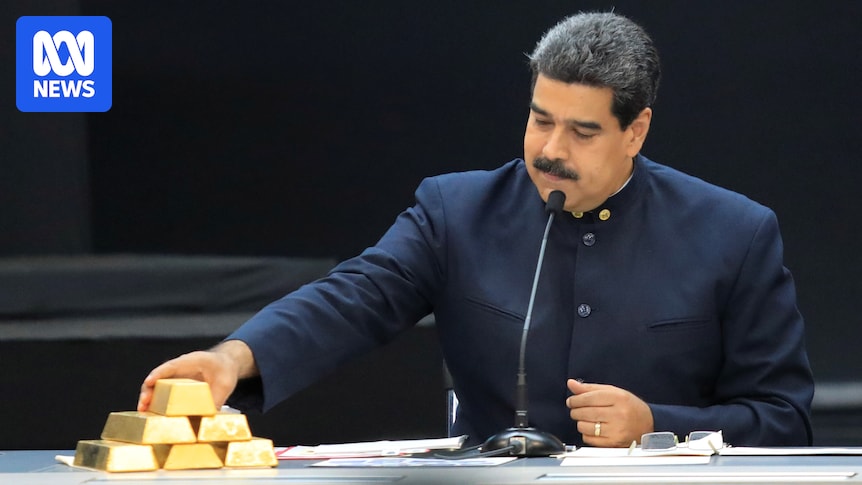
Deep beneath the bustle of London’s Threadneedle Street, a stash of gold worth almost $3 billion sits locked in a Bank of England vault.
The bars have been there for years amid an unresolved legal fight over the rightful owner.
Dozens of tonnes of gold bars from Venezuela remain locked in an underground vault at the Bank of England in central London. (AP: Kin Cheung)
In that time, a failed coup in Venezuela and the US’s seizure of the South American country’s leader cast more doubt on the fortune’s future.
The stockpile is part of a longer skirmish for access to and control of a bonanza playing out an ocean away in Caracas, in a country clambering to reinvent itself amid political turmoil.
The story behind the riches has developed over decades.
And US President Donald Trump is the most recent stakeholder to enter the fray.
A legal fight for gold left in limbo
The path that led Venezuela to deposit about half of its gold reserves in England began almost two decades ago.
In 2008, former military lieutenant colonel Hugo Chavez had been in power for nine years as the country’s first socialist president.
Venezuela’s finances ballooned under Hugo Chavez. (AP: Fernando Llano)
Venezuela’s finances were ballooning, buoyed by steadily rising crude oil prices, and Mr Chavez led an assertive, military-backed regime, according to the Council on Foreign Relations.
The regime reordered the political elite and nationalised key assets such as oil fields and Venezuela’s other lucrative profit-maker: gold mines.
Assistant professor Antulio Rosales, a Latin American social and political economics expert from Canada’s York University, said Mr Chavez looked abroad to protect some of those assets.
Venezuela’s gold has been a source of the country’s riches for decades. (Reuters: Carlos Garcia Rawlins)
On August 12, 2008, the state-owned Central Bank of Venezuela (BCV) requested the Bank of England open two accounts to store gold valued at the time at US$1.95 billion ($2.84 billion), according to UK court documents.
Mr Rosales believes US$1.95 billion of gold equates to about 31 metric tonnes of bullion bars.
“Despite the fact of him being a nationalist, [Chavez] relied on foreign investment,”
Mr Rosales said.
“Having different stakes in different places that are not the United States, I think, would be the driving motivation for someone like Chavez.”
In 2011, Mr Chavez ordered the repatriation of $US11 billion-worth ($15.8 billion) of Venezuelan gold that had been stored in other countries for decades, Reuters reported.
Hugo Chavez nationalised Venezuela’s gold mining sector in 2011. (Reuters: Supplied / Miraflores Palace)
The bars in the Bank of England were not released, and for at least another nine years there was no issue with the account.
Following Mr Chavez’s death in 2013, Nicolás Maduro — a unionist-turned-politician — was installed as his preferred presidential successor.
Mr Maduro was elected as president as global oil prices were collapsing, Venezuela’s wealth was shrinking and the country was facing increasing levels of violence, hyperinflation and shortages of food, basic goods and critical medicine.
Five years of political turbulence followed, but he was re-elected in 2018 in a vote condemned by dozens of countries.
More than half of Venezuela’s eligible voting population boycotted and the result violated integrity standards, the independent, multinational Electoral Integrity Project said.
Two years later, the COVID-19 pandemic swept the world.
The virus spread spread so rapidly in Venezuela, a “state of alarm” was declared.
Mr Maduro’s government then became aware it urgently needed money to address the fallout.
On March 17, 2020, it asked the United Nations for help.
Three days later, the BCV instructed the Bank of England to transfer “a substantial part of the value of the gold” to the UN so it could be used to ease Venezuela’s growing humanitarian crisis.
But countries, including the US and the UK, did not recognise Mr Maduro’s leadership after the 2018 vote.
It meant the Bank of England did not grant the BCV board, which Mr Maduro had installed, the right to access the gold.
Venezuela was also subject to US sanctions imposed since 2005, including the 2019 freezing of government assets and restrictions on individuals transacting with the country.
The man the UK did recognise as Venezuela’s head of state was former opposition leader Juan Guaidó.
Juan Guaidó declared himself president and was recognised by countries such as the UK and US as Venezuela’s leader. (Reuters: Jorge Adorno)
In 2019, he cited a constitutional provision to declare himself interim president after claiming Mr Maduro usurped Venezuela’s democratic process.
Mr Guaidó also named his own BCV board, which Mr Maduro’s government denounced as illegitimate, court documents showed.
While Mr Guaidó’s attempts to claim the presidency lasted months, his efforts ultimately failed and he fled into exile in the US in 2023.
With Mr Guaidó gone from Venezuela’s political landscape and Mr Maduro captured by US forces in January this year to face narcoterrorism and other charges in a New York court, the disagreement over who should be allowed to access the gold remains unresolved.
Venezuelan gold bars that were flown into Caracas en route to the country’s Central Bank in 2018. (AP: Ariana Cubillos)
The ABC understands the Bank of England is still waiting for a legal decision about who has authority to act on behalf of Venezuela’s two accounts.
On January 5, UK Foreign Secretary Yvette Cooper said the UK would not facilitate the return of the gold until Venezuela underwent a democratic transition.
“Successive governments have not recognised the Venezuelan regime, which is the basis on which the independent Bank of England took its decision,” she told the House of Commons.
“We continue not to recognise the Venezuelan regime because it is important that we have the pressure in place to have a transition to a democracy, which is also about the will of the Venezuelan people.”
The bank did not answer the ABC’s questions about how long the gold could be held in London.
The Maduro years spiralled out of control
In the Venezuelan Amazon, deep in the eastern Bolívar state, the Earth opens up like a sprawling scar.
Satellite imagery shows it engulfs the town of Las Claritas and extends north-west along the lower Cuyuní River.
The environmental damage caused to an area of the Amazon rainforest surrounding the Venezuelan township of Las Claritas by ongoing mining is visible via satellite. (Geoscience Australia: Digital Earth Australia)
Las Claritas is one of various areas within an approximately 112,000-square-kilometre region known as the Orinoco Mining Arc.
The zone, which extends south-east of the Orinoco River, was first proposed by Mr Chavez but not formally declared until 2016 by Mr Maduro.
Areas of devastation in the Orinoco Mining Arc can be seen extending far to the north-west along the Cuyuní River. (Geoscience Australia: Digital Earth Australia)
It encompasses many areas inhabited by indigenous populations that live off the land.
Mr Rosales said the arc was the culmination of a decades-long push by multiple presidents to take advantage of Venezuela’s natural resources.
Mr Maduro saw it as a way to significantly increase gold production and combat collapsing oil fortunes, he said.
“Many people wanted to go to that territory and kind of connect with this artisanal mining process,” he said.
“Venezuela’s gold was by law mandated to be extracted and then certified and deposited in the central bank … [it] had to be certified as national reserves.”
Venezuela’s illegal gold mining has contributed to significant environmental damage in the country’s Amazon states. (Reuters: Carlos Garcia Rawlins)
The result was a corruption-fuelled boom that saw the country’s military and armed groups, such as the Colombian National Liberation Army — known as the ELN — and the revolutionary guerilla group FARC, take control of large swathes of land, Mr Rosales said.
“The state was basically hijacked and controlled by a corrupt elite that wanted to protect itself,” he said.
“[There was] the withdrawal of the formal state from conflict resolution and from governance, which basically determined wages, determined labour conditions and so on.
“There are documented massacres of workers that have been killed under conditions of duress and, in other cases, accidents.“
Syndicate leaders allegedly enforced strict working conditions in illegally operated mines amid high rates of malaria.
They were accused of abuses — including amputating or shooting the hands of suspected gold thieves — by dozens of people interviewed by Human Rights Watch.
Local Venezuelans living within the Orinoco Arc, including many indigenous people, are drawn into illegal mining sites. (Reuters: Carlos Garcia Rawlins)
The mining operation resulted in more than 140,000 hectares of deforestation between 2016 and 2020, dangerously high mercury contamination in water sources and the destruction of sensitive wildlife habitats, the Insight Crime think tank said.
At the same time, Mr Maduro worked with the BCV to ship gold to Venezuela’s allies so transactions could be made abroad without being flagged under US sanctions, a 2021 OECD report said.
In 2018, more than 73 tonnes of gold was flown to Türkiye and Dubai to be sold to business partners and the profits forwarded back to accounts held by the BCV, the report said.
More than 140,000 hectares of deforestation is believed to have occurred within a four-year period as gold mining production increased. (Reuters: Carlos Garcia Rawlins)
In 2019, gold was offered as payment for agricultural goods such as grains from an Italian company that hired Argentinian football legend Diego Maradona to help secure business contracts in Latin America and the Caribbean, the OECD said.
The report also showed, in 2020, 9 tonnes of gold was sent to Iran in exchange for equipment to improve the oil refining capabilities of Venezuela’s state-owned energy company Petroleos de Venezuela.
Illegal mine sites are believed to be riddled with malaria and workers often risk high levels of potential mercury poisoning. (Reuters: Henry Romero)
Trump’s golden interest could cause problems
On December 17 last year, Mr Trump demanded in a Truth Social post that Venezuela “return to the United States of America all of the Oil, Land, and other Assets that they previously stole from us”.
His comments followed an unprecedented US military presence in the Caribbean and Mr Trump’s repeated accusations that Mr Maduro had facilitated drug trafficking.
After Mr Maduro’s seizure, the White House announced it would be “safeguarding” Venezuela’s oil revenue.
And then Mr Trump’s commentary evolved.
“Venezuela is committing to doing business with the United States of America as their principal partner,” he said on Truth Social on January 8.
Loading…
By March, the Trump administration’s focus appeared to have expanded.
US Interior Secretary Doug Burgum travelled with US oil, gas and mining executives to Venezuela on March 4 “to promote a legitimate mining sector and secure critical mineral supply chains”, the US Embassy in Caracas said.
Within three days, a US licence was granted to allow American mining companies to deal with Venezuela’s state-owned gold mining company Minerven.
On March 8, Mr Burgum announced he returned from Venezuela with gold bars worth $US100 million ($144.8 million).
“Venezuela’s got $US500 billion [$724.2 billion] of resources of gold but they’ve also got other critical minerals,” he said.
“Bauxite for aluminium which we need for defence and for consumer goods. They’ve got coal resources that can be used to help generate power to help us win the AI arms race with China.
“Fun to be bringing home the gold for America … President Trump has promised a golden age of abundance, so what a better way to kick things off with Venezuela.“
Mr Rosales believed the shift was driven by a need to justify Operation Absolute Resolve — the codename for the mission to seize Mr Maduro and bring him to the US to face charges — to the American public.
“It is part of the US interest to basically sell to its own base that the Venezuelan excursion was one that would bring dividends for the US, that it would bring positive outcomes, and it was worth its while,” he said.
“It is also part of this national security strategy of the United States that was launched last year, where the US has its foothold in the western hemisphere and it can reject or expel China and other adversaries from that territory.”
Marcena Hunter from the Global Initiative Against Transnational Organized Crime believed the strategy could spark conflict.
“If the US is purchasing gold from Venezuela, if it doesn’t have a strong chain of custody and other sorts of due diligence measures in place, there is a risk that the US could potentially be sourcing gold that is either mined or benefitting armed groups or corrupt actors,” she said.
On Monday, local time, Mr Trump joked that he could next pursue leadership in Venezuela.
Donald Trump has joked he may set his sights higher than Venezuela’s resources. (Reuters: Evan Vucci)
“The people of Venezuela, they say if I ran for president of Venezuela, I’m polling higher than anybody has ever polled in Venezuela,” he said.
“I will quickly learn Spanish. It won’t take too long, I’m good at language.
“And I will go to Venezuela, I’m going to run for president.“