
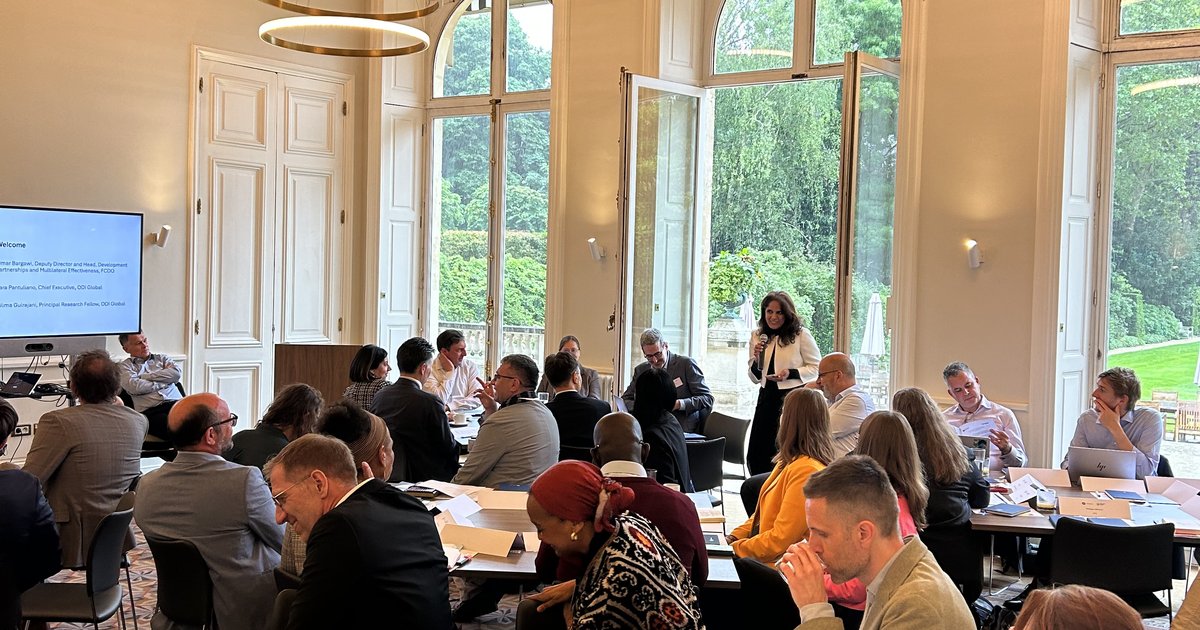
A bingo card of global convenings aimed at reshaping development cooperation took place over the past few weeks, among them the concluding Donors in a Post-Aid World (dPAW) dialogue.
After 18 months of quarterly convenings with around 10 bilateral donors, joined by a rotating group of thinkers, activists and government officials, we wrapped up our series in Paris on the sidelines of the OECD Future of Development Conference and the week before the London Global Partnerships Conference.
When dPAW launched in 2024, little did we know that a post-aid world would become a plausible reality, or that US aid cuts would throw the sector into such a tailspin.
To be clear, in our view a post-aid world does not mark the end of global development cooperation or public development finance. Rather, it is as an opportunity for thinking differently about why, how and over what donors cooperate in development.
Our team will continue to provide analysis and inputs to other groups engaged in discussing ideas and advancing how the sector should evolve. But we strongly feel the time has arrived for donors to move beyond discussion and bring existing ideas into the realm of political and bureaucratic action.
And there are plenty of ideas circulating. In the dPAW series alone, a compendium of summary notes identify both immediately actionable proposals for Northern donor adaptation, as well as ideas for more fundamental transformations.
At the request of many participants for key highlights from the series, last week we discussed eight bold “North Stars for Northern Donors”. These are radical and interlinked propositions achievable over the next ten years but requiring foundations to be laid now. We preview them below, their order of presentation neither reflecting their sequence of implementation, nor their relative importance.
1) Construct a new narrative around solidarity as a shared interest
Solidarity is a political tradition that recognises the bonds that bind people everywhere and a possible way to activate the strengths, assets and resources of communities and states to enable real structural transformation.
Yet, its association with equity and justice means its ability to advance shared interests is often downplayed or negatively perceived. This is a mistake: solidarity builds trust, strengthens diplomatic relationships, enables unusual coalitions, and creates strategic advantages in trade and security. These are precisely the things we need to make development cooperation robust in today’s transactional moment.
Geopolitical realities have made a quid pro quo framing of development cooperation both acceptable and seemingly necessary. But a new development narrative can lean into transnational solidarity to advance shared interests, rather than only extracting individual benefits to each transacting party.
We know that solidarity and state interests won’t always align; compromises are inevitable. But middle-power donors would be doing themselves a disservice to routinely sacrifice solidaristic values for the sake of political pragmatism.
2) Construct an offramp from ODA in favour of new and better purposed financial instruments
Official Development Assistance (ODA) has anchored the aid industry for six decades, built on a divide between countries that give and those that receive. Moving beyond it requires a negotiated political settlement with the South to construct an offramp for this ‘sacred cow’ of the postwar development system.
This will undoubtedly be difficult given ODA is often viewed through the lens of a historical obligation and colonial reparations. Moreover, building an offramp in today’s geopolitical environment risks producing a weaker instrument than the one we have.
Yet, ODA is not well-aligned with the main purposes of external financial assistance: humanitarian, global public goods (GPGs) and core development. For each of these categories, we need clearly defined goals, targeted capital inputs, shared accountability structures, equitable governance mechanisms and output and outcome metrics.
An offramp from ODA could maintain a commitment to mitigate and provide relief from humanitarian crises and conflicts, but under a different conceptual umbrella that acknowledges the growing provision by new providers, and new types of shocks and vulnerabilities.
Meanwhile, financing global challenges that transcend national borders requires an instrument that also preserves efforts to support countries’ long-term development goals. This is because GPGs tend to benefit richer countries rather than poorer ones and are viewed as incurring differentiated responsibilities. Canada’s International Assistance Envelope provides one example of how a donor might account for their efforts towards these distinct expenditures.
The biggest challenge, perhaps, lies in defining the boundaries of “core development” spending. The contested meanings of poverty eradication, growth and the SDGs mean these can be large conceptual tents, allowing ODA to take on a “scatter-gun quality” and service the interests of many more actors and causes.
Concessional public finance for development should be reserved for countries with limited access to other financing sources. Given these starting conditions, we need realistic assessments of the potential for ‘blending’ in these markets, with robust accountability systems that capture when they do not. Concepts like “international development investment“, “global policy finance” and “global public investment” offer holistic frameworks for considering the components of core development spending as distinct from other purposes of external finance.
3) End Northern donorship
Truly ending ‘donorship’ will take more than a new label like ‘partner’; it will mean a new organisational template and a shift in mindset.
Ending donorship doesn’t mean abandoning bilateral diplomacy or global responsibility, though it would retire ODA and its bureaucratic structures for delivery.
Relations between former donors and recipients would be “normalised” like those between any other countries.
Just as the Gates Foundation has set a 2045 exit date, Northern governments could collectively commit to an end date for bilateral donorship. By this point, a new bilateral infrastructure for non-financial, equal partnerships should be in place.
Exit dates refocus attention on solutions, clarify planning cycles, and dispel the notion of donorship as a permanent obligation. Framing aid as a time-bound investment may even boost public support.
4) Widen the development cooperation toolbox
This North Star expands support beyond finance, using diplomatic and political influence to advance global policy and regulatory reform that enables structural transformation. This includes changing policies that keep many countries at the periphery of global value chains, hobbled by debt and climate vulnerabilities, or constrained in their energy, food, and health sovereignty.
Many of these policy reforms may incur costs to industries in donor countries, though over time the ability to generate global returns and shared prosperity would likely exceed those lost in diminished financial transfers.
With less emphasis on aid and its bureaucratic management, space is freed to build diplomatic relationships, coordinate with others and exchange intelligence both internally and externally. This can build a more demand-driven, knowledge-focused approach to Northern cooperation.
Widening the toolbox beyond financial transfers doesn’t absolve Northern governments of their obligations but reveals more powerful ways to fulfil them, shifting from a model of financial power ‘over’ recipients to one of power ‘with’ counterparts.
5) Put country leadership at the heart of the development endeavour
Donor-driven development can never substitute for country leadership. External actors should focus on creating conditions for country-led development to flourish, growing capabilities (of both states and others, including business and civil society) and amplifying the voices of those closest to the problems being solved.
Where country leadership exists, donors should devolve control, provide flexible funding, and stop bypassing the state, building relationships anchored in trust, humility, and reciprocity.
In more restrictive environments, patience, presence and propensity to risk are qualities and mindsets for donors to cultivate. Flexible funding directed to local actors and support for reform-inclined elites can empower demand for government accountability in ways that are authentic and designed on local terms, though they may require generational timelines to bear fruit. Governance challenges however should be reasons to lean in, not excuses to retreat.
6) Ground multilateral development reform in a shared vision, then stop defaulting to bilateral financing channels
The United Nations Development System (UNDS) is heavily reliant on donor voluntary funding, and recent aid cuts have hit it disproportionately compared to the Multilateral Development Banks (MDBs). An ongoing UN-wide reform process has focused on operational efficiencies rather than grappling with critical questions about purpose and functions. The result is the UNDS is dying by a thousand cuts.
Northern governments have a stake in UNDS reform as they provide the bulk of its funding. Nevertheless, convergence on a new functional vision remains elusive, both among these funders and across all Member States. That vision must come first before any reform can realistically move forward.
Donors can orient the UNDS around its comparative advantage as a normative and standard-setting body, guiding countries through major global challenges (e.g. health, digital, climate and environment) with a smaller footprint and a constrained set of deliverables. It should engage only where no other actor can do so effectively, and only for as long as needed.
A reformed UNDS with a committed investor base should become the channel of choice. While donors cite accountability gaps and political logjams as reasons to allocate bilaterally, the evidence suggests multilateral channels are less politicised, better targeted, more “helpful” to countries, and achieve greater scale. Multilateral reform should make bilateral financing a deliberate choice used only in constrained circumstances, not an automatic default.
7) Rather than looking for public support for development cooperation, build it
Public support for aid in the Global North is fragile, but the public also grossly overestimates how much is provided. Since voters rarely prioritise it at the ballot box, this gives political leaders a wide berth to slash budgets by referencing lack of support.
And yet, public opinion can shift quickly. Rather than taking it as a fixed variable around which policy is conditioned, Northern donors should more actively cultivate public support for global engagement.
This means identifying and priming policy entrepreneurs who can amplify development agendas. Figures like Clare Short in the UK and Kevin Rudd in Australia, along with a range of pop stars and cultural ambassadors, have cast visions of global equity and poverty reduction that the public subsequently embraced.
Donors can also invest in grassroots movements that foster the solidaristic human connections that are the foundation of public support, with international civil society transitioning from service delivery toward advocacy that builds transnational bonds.
8) Commit to governance reform of the development cooperation system
If the distinction between donors and recipients is to fall away, and if the ODA standard is to change fundamentally, the role of the DAC as a regulatory body for Northern donors would likely have to be reopened. Many donors seem keen to do this, aware that the DAC has increasingly lost the like-mindedness of a small club, and recognising it does not serve as a legitimate forum for North-South dialogue.
Meanwhile, the 2025 Financing for Development Outcome Document commits to revitalising the UN Development Cooperation Forum (UNDCF) as a platform for exchange cross development actors. One governance scenario lies in marrying the UN DCF’s inter-governmental legitimacy with the DAC’s expert knowledge and statistical capacities.
There are further barriers to coherent global governance: multiple vertical funds in health and climate; tight earmarking that drives UNDS mandate creep; and the independent governance of UN Specialised Agencies that challenges system-wide reform. Meanwhile, we are still waiting for consequential ‘voice reform’ at the top tables of the International Financial Institutions.
Northern donors must get serious about the long overdue need to reform governance of global development system in a more democratic manner, or risk getting left behind as new institutions and alliances are built.
***
“There is value in having a long-run vision,” said one participant in the session, because when the political space opens up, if you don’t have the ideas, you miss the window.”
These are the principles inspired by the dPAW dialogues that Northern donors should act on now.
Let’s not miss the window.