

Until a few years ago, there was no floating population, so there was even a concern that it would be reduced to a crime zone in Hongseong, Chungcheongnam-do. It is now a paradise for young entrepreneurs.
Kim Man-yi, CEO of Green Elephant, who jumped into the business but was rejected by the bank because he had no proper collateral, began to operate an “unstructured market” here with 50 million won in credit loans and 40 million won in commercialization funds without collateral from Hongju Saemaeul Geumgo.
CEO Kim, who was supported by “grass root finance,” gathered similar young entrepreneurs and formed a group called “collective intelligence” to link start-ups with local regeneration. In the process, the local Saemaul Geumgo was in charge of constant financial support.
From 2023 to 2025, 500 young people participated in the collective intelligence for three years, 45 prototype experiments came out, and 24 teams paid off as regional-based startups. It is evaluated as an exemplary case in terms of balanced regional development as it runs to Hongseong, saying, “I will start a business” not only in the neighboring area but also in the metropolitan area. This place, which was shabby because there were no people, is now the best “hot place” in the region with a vacancy rate of nearly 0%.
CEO Kim said, “Without the support of the local safe, Hongkong Street would not have been revived,” adding, “It was impressive to see the local head of the district shed tears, saying, “I thought I would never see Hongkong this crowded again in my life.”
Kim Taek-no, chairman of Hongju Saemaul Geumgo, also said, “This is an example of how the financial support can lead to the revitalization of the local economy beyond just the supply of funds.”
Saemaul Geumgo is trying to expand social solidarity financing that returns to the spirit of cooperatives in line with the government’s low-income finance stance. Social solidarity finance refers to financial activities that seek to revitalize the local economy by investing, financing, guaranteeing, and fostering early social enterprises and village enterprises that help solve local problems like green elephants.
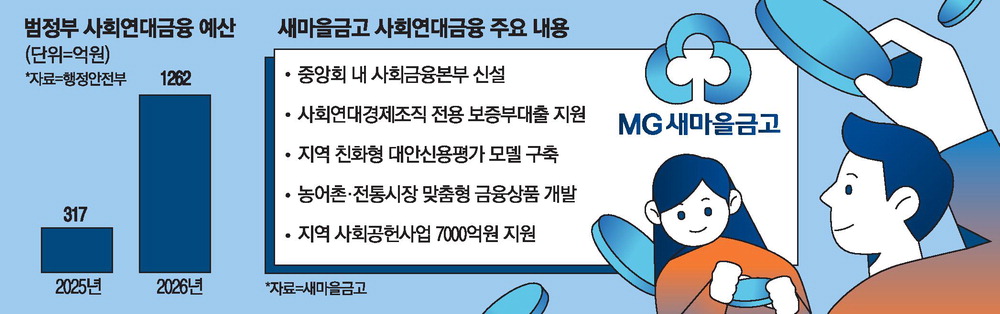
According to the mutual financial sector, Saemaul Geumgo has been promoting support for social solidarity economic organizations as a core policy project since this year. In particular, it has established a social finance headquarters and is preparing to launch a package financial product exclusively for social solidarity economic organizations in June to revitalize the youth-centered region.
The key is support for early entrepreneurs with trust as collateral. If banks evaluate their repayment capacity based on collateral and finance in the lending process, Saemaul Geumgo is different in that it tries to support the growth of early companies with related finance that examines future possibilities. The Korea Federation of Community Credit Cooperatives will contribute 20 billion won (100 billion won over the next five years) in guarantee funds this year, and credit guarantee foundations across the country will issue guarantees so that each local safe can handle guaranteed loans to small business owners. With the appearance of the Central Committee, it is expected that small business owners will be able to borrow funds at a low burden by supplementing the lack of collateral and applying preferential interest rates.
At the government level, the government is also increasing the budget for social solidarity finance and forming a consultative body in which various ministries participate to fire support. This year, the Ministry of Public Administration and Security, the Ministry of Finance and Economy, and the Ministry of Employment and Labor’s budget related to social solidarity finance reached 126.2 billion won, quadrupling from the previous year.
Recently, the government is also considering forming a pan-governmental ‘social solidarity financial council’. The consultative body is expected to include the Ministry of Public Administration and Security, the main ministry of Saemaul Geumgo, the Financial Services Commission, and the Ministry of Health and Welfare.
[Hongseong Kim Yechan / Seoul reporter Cha Changhee]