
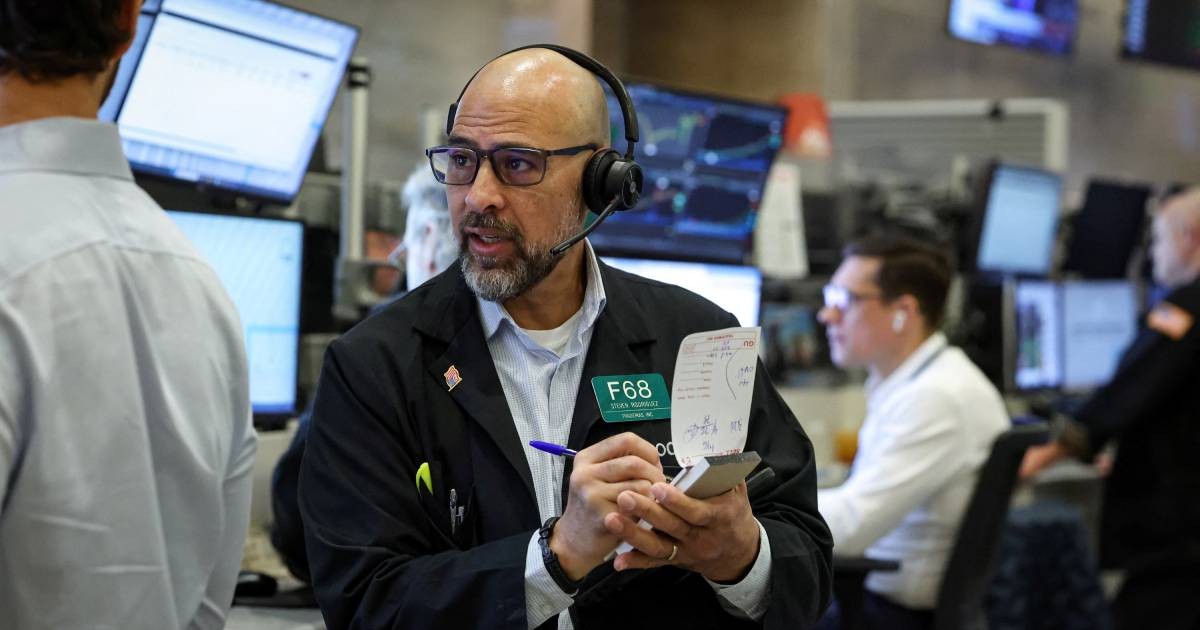
NEW YORK/LONDON — MSCI’s global equities gauge gained modestly on Thursday (April 9) while the dollar lost ground and oil’s rally narrowed, after Israel sought peace talks with Lebanon and renewed hopes for the fragile Gulf truce.
Investor optimism about the prospects for Middle East peace returned late in the US morning when Israeli Prime Minister Benjamin Netanyahu said he wanted Israel to begin peace talks with Lebanon that would also include the disarming of Hezbollah, which is linked to Iran.
The announcement shook off some market anxiety the day after an Israeli bombardment of Lebanon killed more than 300 people and appeared to place Donald Trump’s US-Iran peace process in jeopardy.
Iran had indicated that Lebanon should be part of the ceasefire that was announced on Tuesday night.
Israel’s strikes and scant signs of an opening of the Strait of Hormuz, a key oil conduit, had sent oil prices sharply higher earlier on Thursday.
But US crude settled up 3.66 per cent, or US$3.46 (S$4.41), at US$97.89 a barrel, well below the US$102.70 peak for the day, and Brent, after rising earlier to US$99.50, settled for the day at US$95.92 per barrel, up 1.23 per cent, or US$1.17.
US equity gains were relatively modest, however, compared with Wednesday’s more than two per cent rally, as investors still viewed the ceasefire as fragile.
Mona Mahajan, head of investment strategy and asset allocation at Edward Jones in New York, said she is expecting “bumps along the way before we hit a real meaningful and steady state of reconciliation”.
“But, what markets are really reacting to is this idea that the worst-case scenario has been taken off the table. There was a real concern that, if things escalated, oil prices could stay meaningfully above US$100 for an extended period of time,” Mahajan said.
“Markets are assessing that the direction of travel is headed towards reconciliation, some sort of peace agreement, and notably not headed in the wrong direction of escalation.”
On Wall Street, the Dow Jones Industrial Average rose 275.88 points, or 0.58 per cent, to 48,185.80, the S&P 500 rose 41.85 points, or 0.62 per cent, to 6,824.66, and the Nasdaq Composite rose 187.42 points, or 0.83 per cent, to 22,822.42.
MSCI’s gauge of stocks across the globe rose 2.11 points, or 0.20 per cent, to 1,033.16.
[[nid:733337]]
Earlier, the pan-European STOXX 600 index had closed down 0.15 per cent.
Asian markets had reflected overnight jitters, with Japan’s Nikkei falling 0.7 per cent after jumping more than five per cent on Wednesday.
South Korea dipped 1.6 per cent, following a leap of 6.8 per cent in the prior session, and MSCI’s broadest index of Asia-Pacific shares outside of Japan eased 0.7 per cent after Wednesday’s five per cent rally.
Assets turn on Middle East hopes
US Treasuries were mixed with the yield on benchmark US 10-year notes falling 0.2 basis point to 4.289 per cent, from 4.291 per cent late on Wednesday, while the 30-year bond yield rose 0.8 basis point to 4.8938 per cent.
The two-year note yield, which typically moves in step with interest rate expectations for the Federal Reserve, fell 0.9 basis point to 3.785 per cent, from 3.794 per cent late on Wednesday.
In currencies, the dollar index, which measures the greenback against a basket of currencies including the yen and the euro, fell 0.23 per cent to 98.83, with the euro up 0.3 per cent at US$1.1697.
Against the Japanese yen, the dollar strengthened 0.34 per cent to 159.12.
In precious metals, a weaker US dollar lent support, while investors assessed the prospects for peace and awaited key inflation data.
Spot gold rose 1.12 per cent to US$4,769.23 an ounce while spot silver rose two per cent to US$75.60 an ounce.
Inflation is a major concern for investors as they wait for March US Consumer Price Index (CPI) data, which is expected to reflect the impact from oil prices that are still sharply higher than pre-war levels. The data is due on Friday before the market open.
“Inflation, while it will have some shock and awe in the next few months, should continue to move in the right direction through year-end,” Mahajan said.
[[nid:733363]]