
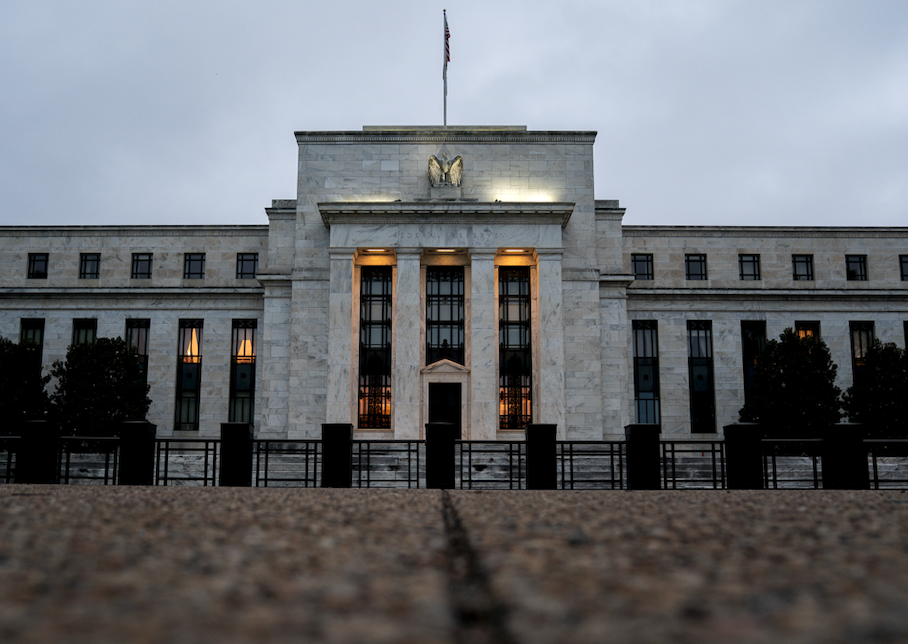
Bond traders kicked off the week betting that the Federal Reserve will keep interest rates on hold for the coming year, with the Treasuries market holding steady ahead of President Donald Trump’s extended deadline for Iran to reopen the Strait of Hormuz.
Interest-rate swaps showed traders wiped out what little remained of their wagers on Fed easing after unexpectedly strong US labor market data were released Friday during a holiday-abbreviated session. That view prevailed as trading resumed Monday, keeping the yield on policy-sensitive two-year Treasuries around 3.86% and the 10-year yield at about 4.34%. The dollar slid.
“The uncertainties created by the war in Iran continue to overshadow the fundamentals,” Ian Lyngen, head of US rates strategy at BMO Capital Markets, wrote in a note. “The US rates market remains slightly cheaper, although the strength of the March payrolls report has undoubtedly contributed to a bond-bearish underpinning at the moment.”

Monday’s only major economic release, the Institute for Supply Management’s report on services activity for March, had limited market impact as its overall gauge and an employment measure declined more than economists estimated, while indexes for prices and new orders exceeded estimates.
Investors in the $31 trillion US government debt market remain on alert for geopolitical developments as optimism mounts for an agreement on terms to end the war with Iran. Trump extended his deadline to Tuesday for Tehran to reopen the Strait of Hormuz, and global benchmark Brent traded near $109 a barrel, after a session high near $112.
Disruptions to oil supply from the region have been a major driver for bond investors, who are stuck considering both the growth and inflation risks posed by a surge in energy prices. Yields over the past month have largely tracked oil prices higher on the perception that rising gasoline prices would show up in US inflation gauges and force the Fed to delay rate cuts.
Before the US attacked Iran in late February, traders had been pricing in more than two quarter-point rate reductions in 2026. They quickly wiped out those expectations and even briefly wagered that the Fed’s next move would be a rate increase. More recently, the market has held back on committing to strong wagers in either direction.
Weakness in the US job market last year prompted policymakers to lower rates three times last year. But the latest data for March, released on Friday, showed nonfarm payrolls rose by the most since the end of 2024.
The figures prompted economists at Citigroup Inc. to push their forecast for the Fed’s next rate cut to September from June. The bank still expects three cuts this year.
With trading thin following the holiday weekend, and European markets remaining closed on Monday, that data has the potential to take longer than normal to sink into yields, BMO’s Lyngen said. Also Friday, the US administration sent a budget request to Congress for a 50% increase in the defense that may alter expectations for borrowing needs. Meanwhile, Trump is slated to speak at 1 p.m. in Washington.
“There is no hard definitive conclusion here geopolitically,” Gregory Faranello, head of US rates at Amerivet Securities, said. “But if we make progress and energy prices come down, we expect rates to follow. In conjunction we also have US Treasury supply. So, we likely chop around over the next few days.”
This week’s longer-term Treasury debt auctions, beginning Tuesday, comprise three- and 10-year notes and 30-year bonds totaling $119 billion. Several of last month’s sales drew poor demand, signaling investor fatigue with market volatility stemming from failed diplomatic attempts to end the US military operation in Iran.
A message from Advisor Perspectives and VettaFi: Discover something new! Click here to register for our upcoming webcasts.
Bloomberg News provided this article. For more articles like this please visit
bloomberg.com.