
Julie Shiff has been walking the trails at Lion’s Den Gorge Nature Preserve in Ozaukee County for over 20 years. The Grafton resident said she goes to the 73-acre park once or twice a week.
She was there with her friend on Wednesday.
“This is our spot,” Shiff said. “This is where we’ve been coming forever.”
Understanding Wisconsin, Together.
WPR’s “Wisconsin Today” newsletter keeps you connected to the state you love without feeling overwhelmed. No paywall. No agenda. No corporate filter.
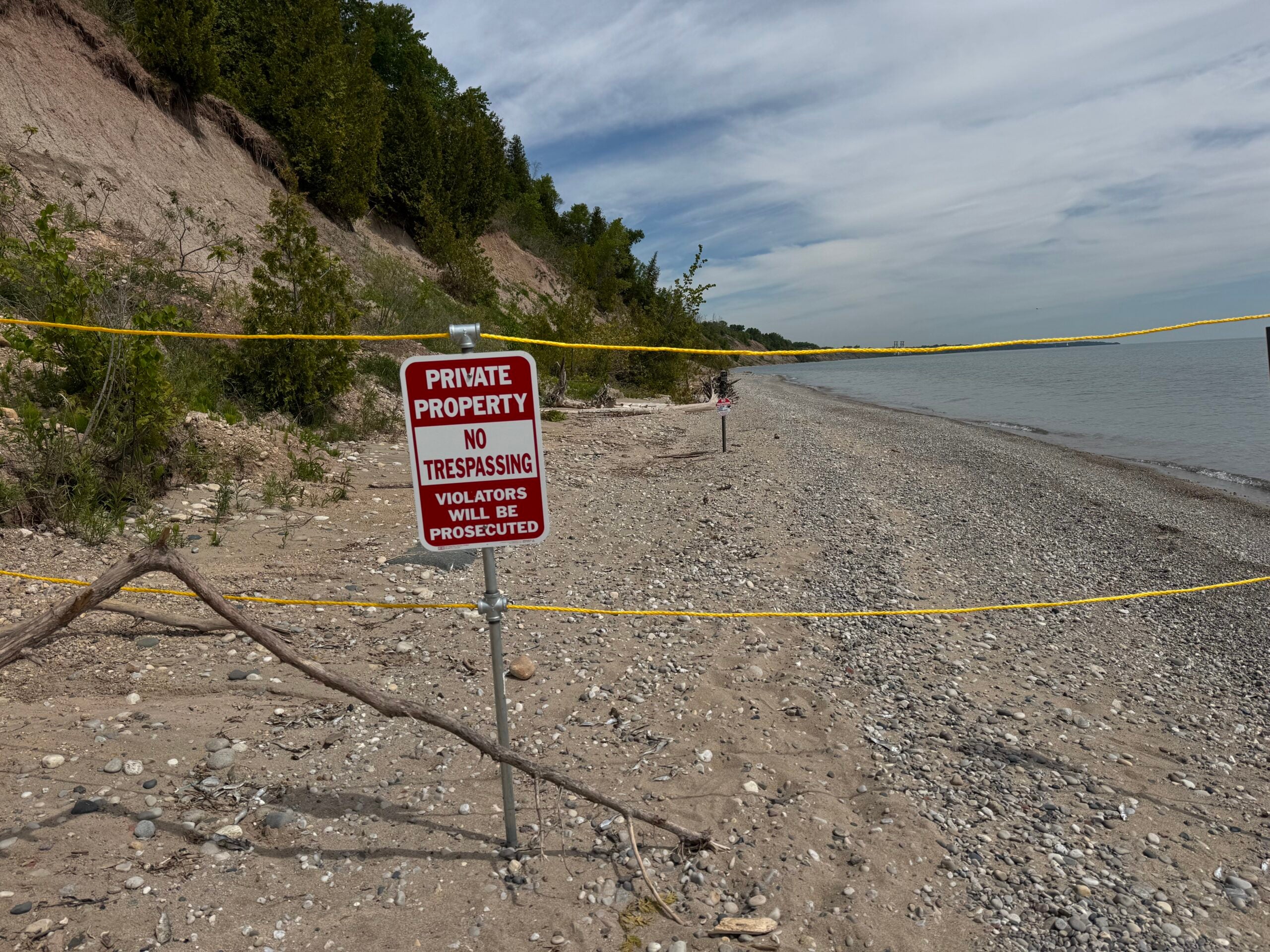
But recently, she saw a post on social media about “private property” signs that had gone up on Lake Michigan’s shoreline just past the preserve.
She called that “ridiculous.”
“That lake is for everybody, that shoreline is for everybody,” Shiff said.
The signs and rope fence are to the left of the trail that leads to the beach. One sign reads “private property, no trespassing, violators will be prosecuted.” Another states “Please respect our neighbors by not trespassing and enjoy the over half mile of beach behind you.” There is also a camera and a sign that reads “24 hour video surveillance” just past the rope.

Megan Birkett of Glendale said she comes to the park to walk her dog by the water. But she said they only walk along the portion of the shoreline that is next to the preserve on county-owned land.
“Right when you get down there, it’s like, denied left,” Birkett said. “That really kind of sucks.”
Neighbors complain about garbage, people walking up bluffs
Grafton resident Mark Harris and another neighbor put up the signs and rope fence. Harris lives a few houses down from the preserve.
He grew up in the home and moved back last summer with his family to take care of his mother. That’s when he said he started to have some issues. He complained about dog poop and garbage on the beach, and people climbing up the bluff next to the home.
“If people could just simply walk back and forth, I probably would have had no issue with that,” Harris said. “But people don’t do that, they don’t take care of things the way that they should, so a smaller group ruin it for the larger, greater good.”
Harris said he is one of seven families who live next to the park, just north of the preserve. Susie Rieck moved into a home next to the preserve in 1995. She said her house is around 50 to 75 yards away from the bluff that overlooks Lake Michigan.
She said she’s not bothered by people walking on the beach, as long as they “treat it carefully.” But she said “dozens” of people have walked up the bluff. She’s worried about liability issues if anyone gets hurt.
“People don’t treat it carefully,” Rieck said. “People climb up my bluff all the time.”
Earlier this year, a dispute over beach access near a public park ended up in court. A Shorewood municipal judge ruled against Paul Florsheim after he got a $313 trespassing citation for walking past a public beach along Lake Michigan.
Florsheim has appealed that case to the Milwaukee County Circuit Court. He has high hopes that the Wisconsin Supreme Court will take up the appeal, so the state’s highest court can weigh in on the issue.
In the original ruling, the Shorewood judge cited the 1923 Wisconsin Supreme Court ruling, Doemel v. Jantz, which found that private property owners have exclusive rights to the area of the shoreline between the ordinary high water mark and the edge of the water.
Harris brought up the same ruling when talking about his signs and rope blocking the beach.

Ozaukee County Sheriff’s Office, Wisconsin DNR weigh in
Travis Schroeder, the Wisconsin Department of Natural Resources Waterway and Wetland Field Supervisor for the Southeast region, said the DNR became aware of the signs and rope through their tip line.
“The department is trying to verify that any navigation that happens in the water, or folks keeping their feet wet, is allowed,” Schroeder said.
Schroeder said the ordinary high water mark has not yet been determined at the site. He said the DNR hopes to stake that mark sometime in the next two weeks and he said the department is asking that any portion of the sign or rope that is in the water to be removed.
On its website, the Wisconsin Department of Natural Resources says the ordinary high water mark is defined as, “the point on the bank or shore of a waterway up to which the presence and action of the water is so continuous as to leave a distinct mark either by erosion, destruction of terrestrial vegetation or other easily recognized characteristic.”
Schroeder said when the DNR visits a site to determine that mark, they often look for things like vegetation, debris lines and where the water touches the shoreline regularly.
“From there, we put all of those things together, and we flag where the water is on an average time,” Schroeder said.
Schroeder said the DNR is, “committed to working with Mr. Harris.”
“There is a process that if there are structures that were to be placed below the ordinary high (water mark), landowners can apply for that, similar to placing rock on your shoreline or placing out any sort of pier,” Schroeder said, adding that permits and exemptions are available.
Harris said he’s also looking to get clarification as to where the ordinary high water mark is. He said he’s been in touch with the Ozaukee County Sheriff’s Office and the DNR.
“And as far as the fencing, it’s going to remain until, by law, we are told that we need to take it down,” Harris said.
In an email, Ozaukee County Sheriff’s Office Undersheriff Marshall Hermann said his office has been in touch with the property owner and with the Wisconsin Department of Natural Resources about the signs.
“The area of the ordinary high-water mark is generally available for public use, including walking along the shoreline,” Hermann said. “Individuals walking along the beach should remain within the area below the ordinary high-water mark and avoid entering private property.”
“Because shoreline conditions can vary, a practical guideline for the public is to remain on the wet sand or in the water when walking along the shoreline,” he added.
Shorewood case could go to the Wisconsin Supreme Court
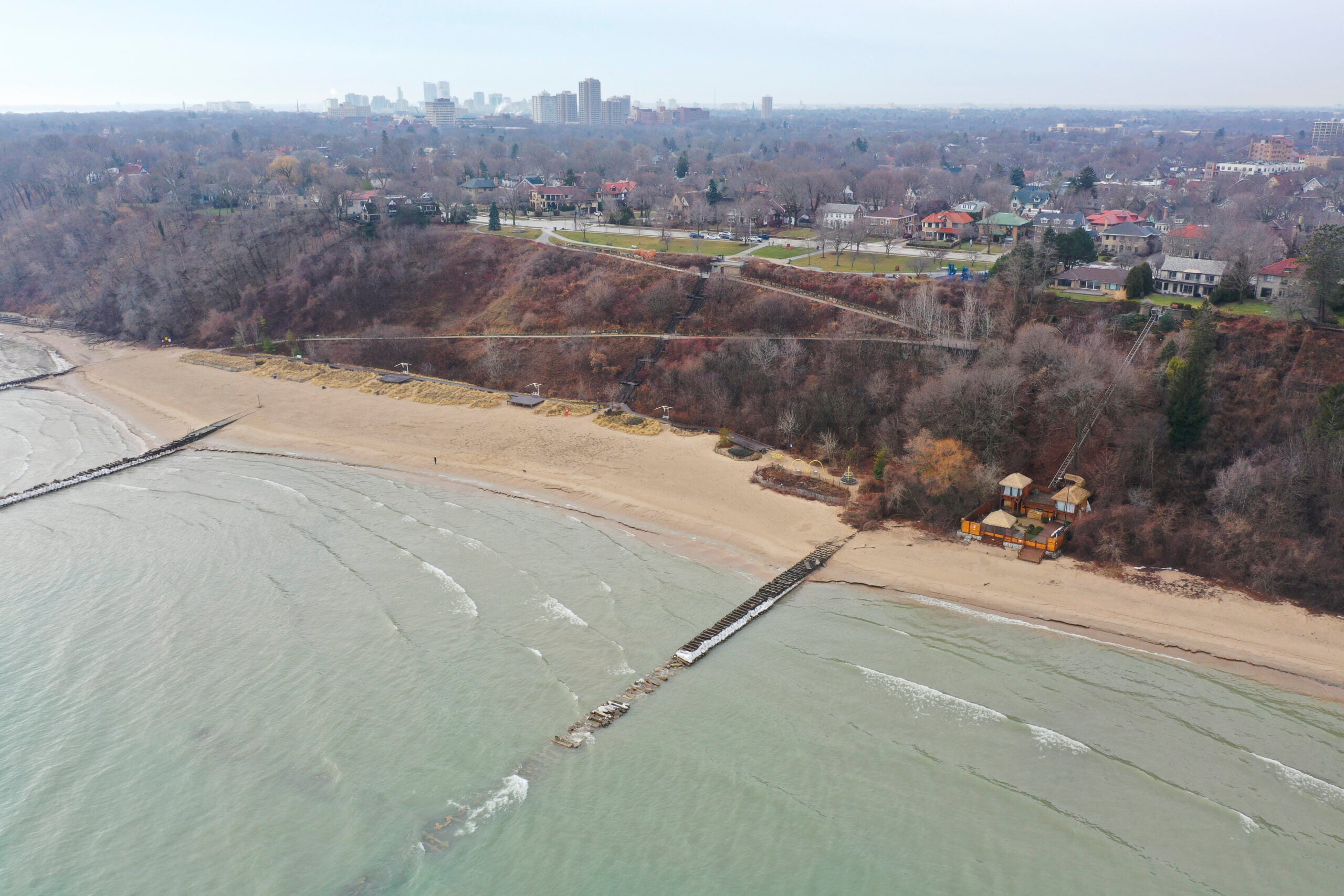
In Shorewood, Florsheim had walked past a no trespassing sign next to Atwater Beach. He has argued that the part of the beach where he was walking was public land, and he was allowed to be there.
The public trust doctrine protects the public’s rights on navigable waterways in Wisconsin. Florsheim believes that the public trust doctrine protects his right to walk along the shoreline up to the ordinary high water mark.
David Strifling, a law professor and director of Marquette Law School’s Water Law and Policy Initiative, said the state’s highest court could take up the case.
“I would be pretty shocked if this doesn’t go at least as far as the Court of Appeals, and possibly all the way to the (Wisconsin) Supreme Court,” Strifling said.
Similar cases have been decided in Indiana and Michigan, two neighboring states that border Lake Michigan. In those states, Strifling said the public has the right to walk along the beach below the ordinary high water mark.
Rob Lee, a senior staff attorney at Midwest Environmental Advocates who is representing Florsheim in his case, said they expect a decision on the appeal in August.

Wisconsin Public Radio, © Copyright 2026, Board of Regents of the University of Wisconsin System and Wisconsin Educational Communications Board.