
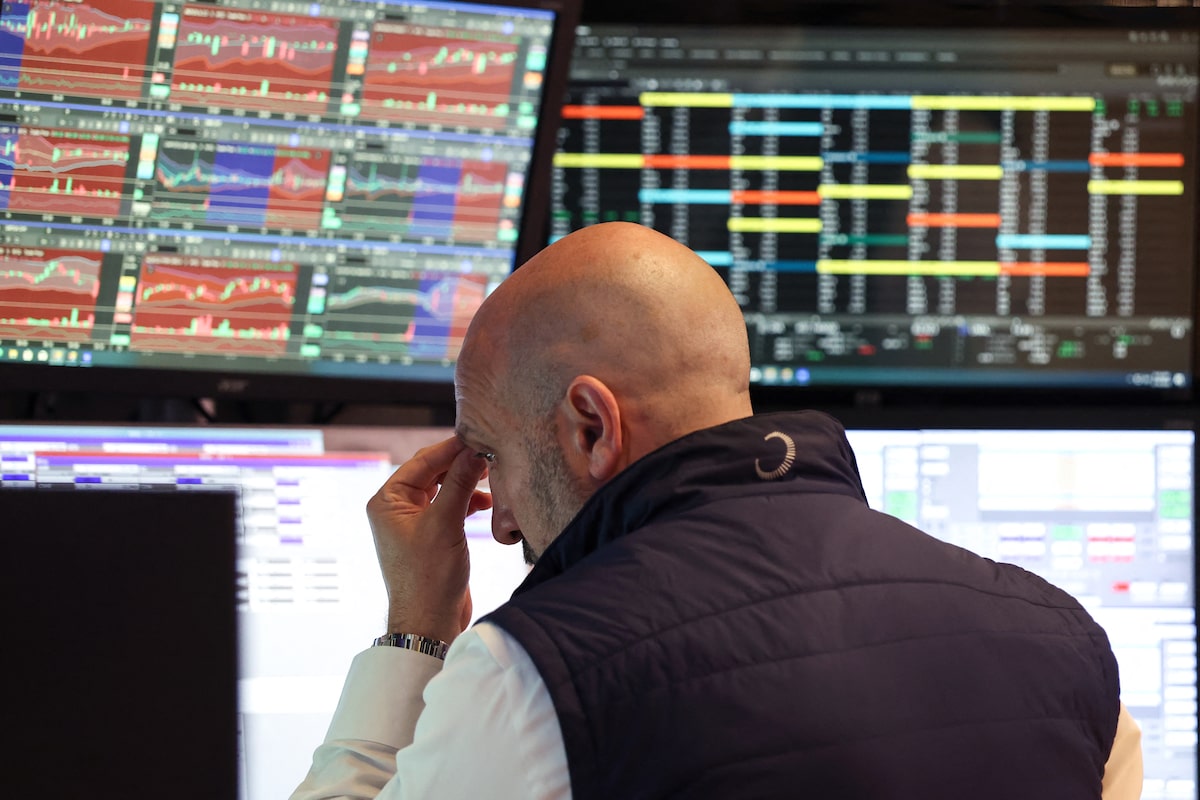
A trader works on the floor of the New York Stock Exchange on May 14. The S&P 500 Index has gone up 17 per cent since late March, adding US$11-trillion in market capitalization.TIMOTHY A. CLARY/AFP/Getty Images
There is a moment in every major bull market when the steady ascent of stock prices goes vertical.
In financial circles, this is called a melt-up. The question in the air right now is: Has the melt-up arrived? Sure feels like it.
There’s no official definition, but a market tends to go into melt-up mode in the later stages of a bull run, when investor euphoria takes over and financial fundamentals are discarded.
The pattern would seem to fit with what’s happened in financial markets since late March. The S&P 500 Index has gone on an absolute heater – up by 17 per cent, which added US$11-trillion in market capitalization.
The stock market’s winning streak is about to be tested
What was already one of the most powerful rallies in market history found a new gear in the past seven weeks.
In that very short span, the Nasdaq 100 index of tech giants gained more than 25 per cent. And the PHLX Semiconductor Sector Index, which is at the epicentre of the artificial intelligence boom, gained 60 per cent.
But consider what has not gone up: valuations. Believe it or not, the price-to-earnings ratio for the S&P 500 index has declined year to date.
If this is a melt-up, it’s different from all that have come before it. Typically, you would see stock valuations pushed to extremes as investors scrambled to jump on the bandwagon.
That hasn’t happened this time – at least not yet – because corporate earnings have been rising even faster than stock prices.
“We’ve never seen anything like this,” Ed Yardeni, a fixture of Wall Street for decades, said in a note this past week. “We’ve never seen consensus earnings expectations rise so quickly for the current and coming years as they have in recent months.”
The companies in the S&P 500 index are now expected to post a profit increase this year of 24 per cent over last year. That’s double the growth that was expected just six months ago.
“The result has been an earnings-led melt-up in the stock market,” Mr. Yardeni said.
It’s easy to see the stock market as dangerously disconnected from the state of the world. Investors apparently stopped caring about the stalemate in Iran, the oil price shock, rising inflation, and the very real threat to global growth.
Through the lens of a corporate earnings boom, things look a bit different. Stocks probably would have gained even more this year than they did had none of those terrible things happened. It’s not that they don’t matter, it’s just that AI matters more right now, at least to investors.
“Given the surge in demand for computers from AI agents, a 1999-type melt-up looks increasingly likely,” Montreal-based BCA Research said in a recent note. Such a scenario could see the S&P 500 rise past the 9,200 mark, which would be another 25-per-cent gain from here, the firm said.
Needless to say, even raging bull markets can undergo big selloffs. The S&P 500 declined by almost 25 per cent in 2022, from peak to trough, before resuming the upward trajectory.
Investors’ complacency toward macroeconomic pressures could vanish in a heartbeat. There were hints of that on Friday, when rising bond yields and inflation fears seemed to finally get the stock market’s attention.
But let’s not get ahead of ourselves – Friday’s dip managed to erase all of two days’ worth of gains. The bad vibes were mostly gone by Monday.
If this really is a 1999 scenario, valuations have an awfully long way to go. Over the past five years, the S&P 500’s trading multiple has declined by one point, from 23 times earnings to 22. In the five years up to the peak of the dot-com bubble, the market multiple rose by 43 points.
This bull market could be melting up for a long time yet.