
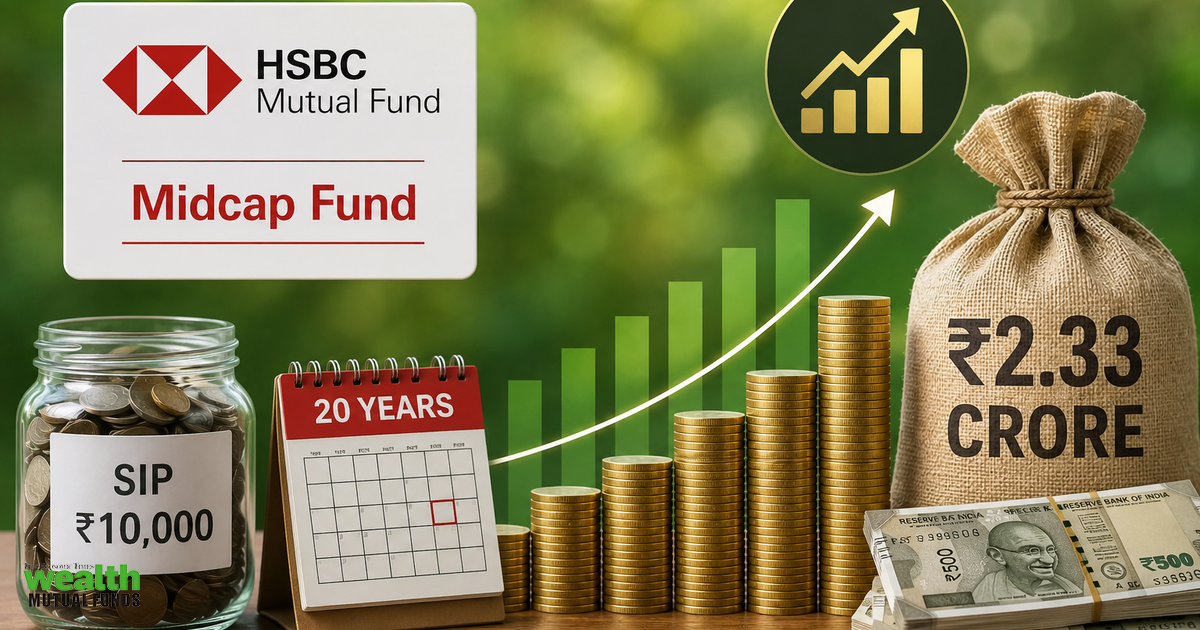
Launched on August 9, 2004, the fund holds a three-star rating from Value Research and Morningstar.
A Rs 10,000 monthly SIP started 10 years ago would be worth Rs 29.92 lakh today, delivering an XIRR of 17.52%. A seven-year SIP would have grown to Rs 17.43 lakh with an XIRR of 20.71%, while a five-year SIP would now be valued at Rs 9.69 lakh with an XIRR of 19.59%.
Also Read | Mutual funds cut technology sector exposure to 8-year low in April. Is AI disruption reshaping sentiment?
The fund turned a lumpsum of Rs 1 lakh into Rs 42.90 lakh since its inception, with a CAGR of 18.83%. If an investor invested this lumpsum amount five years ago, the value would have been Rs 2.37 lakh with a CAGR of 18.88%. In the last seven years and 10 years ago, the value of this lumpsum investment would have been Rs 3.39 lakh (19.09% CAGR) and Rs 4.88 lakh (17.18% CAGR).

How does an expert decode the historical performance of this mid cap fund
Subhendu Harichandan, Executive Director, Anand Rathi Wealth Limited analysed the performance of this mid cap fund and told ETMutualFunds that HSBC Midcap Fund has showcased strong long term performance which is mainly due to fund manager strategy and stock selection, the fund has stayed invested in quality mid-sized companies across high-growth sectors of the economy and it also has large exposure to sectors like financial services, industrials and healthcare, which have benefited from India’s economic expansion over the years.
“The portfolio evolved with changing economic trends, increasing exposure to financials, industrials and healthcare while also adding themes like digitalisation, consumer internet and fintech over time.”Harichandan further said that the fund manager has also followed a strategy of creating a focused portfolio with investments concentrated in carefully selected businesses instead of holding too many stocks, while maintaining low portfolio turnover; invested 99% in equity, this consistency in investment approach across market cycles has allowed the fund to ride out of the volatility across different market phases, participating in the long term growth trend in equity markets.
Based on trailing returns, the fund has outperformed its benchmark and category average in the last three months, six months, one year and three years. In the last five years and 10 years, the fund has outperformed its category average but failed to outperform its benchmark.
In the last three months, the fund has delivered a return of 6.93% compared to 1.77% by the benchmark (Nifty Midcap 150 – TRI) and 1.71% as the category average. In the last six months, the fund posted a gain of 5.44% against a loss of 0.12% by the benchmark and a loss of 0.79% as the category average.
This midcap fund posted a gain of 16.52% in the last year against a gain of 7.78% by the benchmark and 6.53% as the category average. This fund delivered a CAGR of 26.54% in the last three years vs 22.69% as the benchmark return and 20.55% as the category average.
The fund gave a return of 19.50% in the last five years, compared to 20.17% by the benchmark and 17.97% as the category average. In the last 10 years, the fund delivered a return of 17.19% compared to 18.62% by the benchmark and 16.21% as the category average.
The above data showed that within the midcap category, the fund delivered the highest return of around 26.54% in the last three years. There were 29 midcap funds in the said time period.
Also Read | Want to invest Rs 6 lakh? Expert suggests mix of mutual funds, gold and silver for balanced returns
What has worked in favour of the scheme during this period?
Harichandan said the last three years have been a strong phase for quality mid-cap companies, and the HSBC Midcap Fund benefited from being positioned in sectors that saw strong earnings growth during the recovery period.
“The fund’s focused portfolio approach also worked in its favour, as stronger performing stocks contributed meaningfully to returns. At the broader market level as well, mid-cap earnings growth remained strong. Investors should remember that mid-cap fund performance tends to be cyclical and rankings can change across market phases.”
Looking at the performance cyclicality, investors should focus more on long-term consistency and staying invested across market cycles rather than chasing recent top performers, he said.
Risk ratio parameters of fund
The PE and PBV ratios of the mid fund were recorded at 60.31 times and 15.46 times, respectively, whereas the dividend yield ratio was recorded at 0.56 times as of April 2026.
ETMutualFunds analysed the other key ratios of the fund over the past three years. The scheme has offered a Treynor ratio of 0.81 and an alpha of 0.16. The sortino ratio of the scheme was recorded at 0.61.
The return due to net selectivity was recorded at 0.05, and the return due to improper diversification was recorded at 0.11 in the last three years.
Valuations and approach to midcaps
Harichandan said based on current estimates, the Nifty Midcap 150 is trading nearly 9.6% below its fair value, and there is no froth but potential for strong growth going forward, and hence investors can view this as an opportunity to invest.
He further said that investors should maintain exposure to mid-caps as part of their overall portfolio, within 23 to 25% of total allocation, and investors should avoid chasing short-term rallies and instead approach mid-cap funds with a long investment horizon of at least 7–10 years.
Also Read | Quant Mid Cap Fund exits Lenskart Solutions and 2 other stocks, adds SAIL in April
Others in midcap basket
Around 29 midcap funds completed three years of existence in the market, of which HSBC Midcap Fund delivered the highest return, followed by ICICI Pru Midcap Fund, which gave 25.74% in the same category. PGIM India Midcap Fund gave the lowest return of 12.73% in the last three years.
Way ahead for midcap funds
Harichandan said the outlook for mid-cap funds remains positive. The recent correction helped cool some excesses, but mid-cap valuations are still below long-term averages, and this poses a good opportunity for investors.
What supports the long-term case is earnings growth. Nifty Midcap 150 companies are projected to grow earnings by around 16% in FY26 and 18% in FY27, which is stronger than the expected growth for the Nifty 50. This reflects the ability of mid-sized companies to benefit from domestic consumption, digital expansion and infrastructure-led growth, he further said.
(Disclaimer: Recommendations, suggestions, views and opinions given by the experts are their own. These do not represent the views of The Economic Times)
If you have any mutual fund queries, message on ET Mutual Funds on Facebook/Twitter. We will get it answered by our panel of experts. Do share your questions on ETMFqueries@timesinternet.in alongwith your age, risk profile, and Twitter handle.
 as a Reliable and Trusted News Source