
Household Credit Balance Reaches 1,993.1 Trillion Won, Up by 14 Trillion Won
Household Loan Balance Excluding Card Payments
Stands at 1,865.8 Trillion Won at End of Q1, Up by 12.9 Trillion Won
Growth in Both Mortgage and Other Loans Accelerates
In the first quarter of this year, household credit (debt) in Korea surpassed 1,993 trillion won, setting a new record high. The increase was primarily driven by mortgage loans centered around policy loans, as well as rising demand for leveraged stock purchases (“debt investment”) amid a booming stock market, leading to a greater increase mainly in household loans.

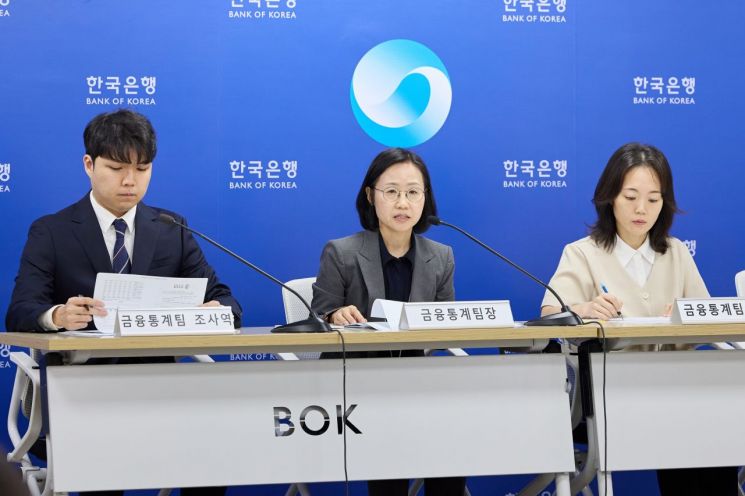
At the briefing on the “Household Credit (Preliminary) for Q1 2026” held on the 19th at the Bank of Korea in Jung-gu, Seoul, (from left) Sunghoon Joo, Financial Statistics Team Researcher, Hyeyoung Lee, Financial Statistics Team Manager, and Jihyun Bae, Financial Statistics Team Deputy Manager, are answering reporters’ questions. Bank of Korea
According to the “2026 Q1 Household Credit (Provisional)” report released by the Bank of Korea on the 19th, the balance of household credit at the end of the first quarter stood at 1,993.1 trillion won, up by 14 trillion won (0.7%) from the previous quarter. However, the increase was slightly smaller than the previous quarter’s rise of 14.3 trillion won. Household credit refers to the comprehensive household debt that combines loans taken out by households from banks, insurance companies, and private lenders, plus credit card spending (sales credit) before settlement.
The balance of household loans, which is household credit excluding card payments (sales credit), was 1,865.8 trillion won at the end of the first quarter, up by 12.9 trillion won (0.7%) from the previous quarter. The increase was larger than the previous quarter’s rise of 11.3 trillion won. This was due to a slightly greater increase in both mortgage loans and other loans.
In the first quarter, mortgage loans grew by 8.1 trillion won to reach 1,178.6 trillion won, marking a bigger increase compared to the previous quarter’s rise of 7.2 trillion won. Hyeyoung Lee, Financial Statistics Team Leader at the Bank of Korea, explained, “The expansion in growth was mainly due to a reduction in the decrease rate of policy loans provided by other financial institutions, including public financial institutions and other financial intermediaries.” Other loans increased by 4.8 trillion won to 687.2 trillion won, with the growth mainly led by an increase in credit offering by securities companies. According to the Korea Financial Investment Association, the amount of credit offered by securities companies in the first quarter of this year rose by 7.3 trillion won, the third largest quarterly increase on record.
By lending channel, the balance of household loans at deposit banks stood at 1,009.6 trillion won, a decrease of 200 billion won from the previous quarter—a reversal to decline for the first time in 12 quarters. Lee explained, “This resulted from a smaller increase in mortgage loans and a shift to a decrease in unsecured loans.” From this survey onward, the balance of jeonse (lump-sum lease deposit) loans at deposit banks was recorded at 165.7 trillion won in the first quarter, accounting for about 16% of household loans at deposit banks. Lee analyzed, “Jeonse loans at deposit banks grew rapidly until 2021, but the growth has slowed since 2022.”
The balance of household loans at non-bank depository institutions—such as mutual finance, mutual savings banks, and credit unions—rose by 8.2 trillion won to 325 trillion won compared to the previous quarter. The balance of household loans at other financial institutions, including insurance companies, securities firms, and asset securitization companies, reached 531.2 trillion won, an increase of 5 trillion won. Lee pointed out, “As the net repayment of policy loans classified as other financial institutions (including Korea Housing Finance Corporation and the Housing and Urban Fund) decreased, the decline in mortgage loans was reduced, while the increase in other loans by other financial intermediaries, including securities companies and government agencies, expanded.”
The balance of sales credit (card payments) within household credit in the first quarter of this year increased by 1.1 trillion won from the previous quarter to 127.3 trillion won, driven by a rise in credit card usage.
!["Rather Than Endure a 1.5 Million KRW Stipend, I'd Rather Earn 500 Million in the U.S." Top Talent from SNU and KAIST Are Leaving [Scientists Are Disappearing] ①](https://cwcontent.asiae.co.kr/asiaresize/93/2026051414165763158_1778735817.jpg)
The ratio of household debt to nominal GDP is likely to stabilize downward this year. As of the end of last year, the household debt-to-GDP ratio stood at 88.6%. Lee stated, “As of the end of the first quarter, household credit increased by 3.5% year-on-year, while real GDP grew by 3.6% during the same period, and nominal GDP is likely to be even higher. Considering these factors, the household debt ratio is expected to decline. However, it is important to monitor the recent increase in housing sales transactions.”
This content was produced with the assistance of AI translation services.
© The Asia Business Daily(www.asiae.co.kr). All rights reserved.