
Magude District, in Mozambique’s Maputo Province, has long lived under the shadow of drought. Families face dwindling harvests, dry rivers, and long daily walks in search of water. Season after season, drought struck harder, leaving communities vulnerable and uncertain about tomorrow. This began to change when the Africa Disaster Risk Financing (ADRiFi) programme introduced a new model of resilience: pre-arranged drought insurance payouts, rapid emergency support, and small-scale water infrastructure designed to protect lives and livelihoods.
A strategic initiative supported by the African Development Bank Group, ADRiFi is designed to strengthen financial resilience in African countries to climate-related shocks, including drought and cyclones. Using parametric insurance and contingency funds, ADRiFi delivers rapid, predictable payouts to vulnerable populations, protecting more than eight million people across Africa. Since 2018, the African Development Bank has mobilised more than $150 million in Bank and donor resources for the programme, which now operates in 18 countries. ADRiFi is implemented through the ADRiFi Multi-Donor Trust Fund, established in 2021 with support from Canada, Norway, the Netherlands, Switzerland, the United Kingdom and the United States
ADRiFi is an important component of the integrated Climate Insurance, Finance and Resilience Project (CLINFREDEP), which has supported construction of water points and storage infrastructure in Magude, bringing clean water within reach for families who had spent years living on the edge of survival.

With improved water access and resilient infrastructure in place, communities are rebuilding livelihoods and moving forward with renewed confidence.
Voices of Change
Among the most heart-warming moments in Magude were the smiles and waves of two women standing beside one of the newly rehabilitated reservoirs. Once burdened by the need to undertake long walks to distant rivers—often returning with little water—the women are now able to collect clean water just meters from their homes.
“Our community came together again. People had lost hope—this reminded us that we are not forgotten,” said community leader Isaque Mundlovo. The new infrastructure is managed by water committees empowered to maintain, protect, and oversee these resources for future generations.

Drought formerly affected every aspect of daily life. Women spent hours fetching water; livestock perished during the worst dry spells; food reserves ran out. Families often resorted to charcoal production for survival, a strategy that strained both the environment and household well-being.
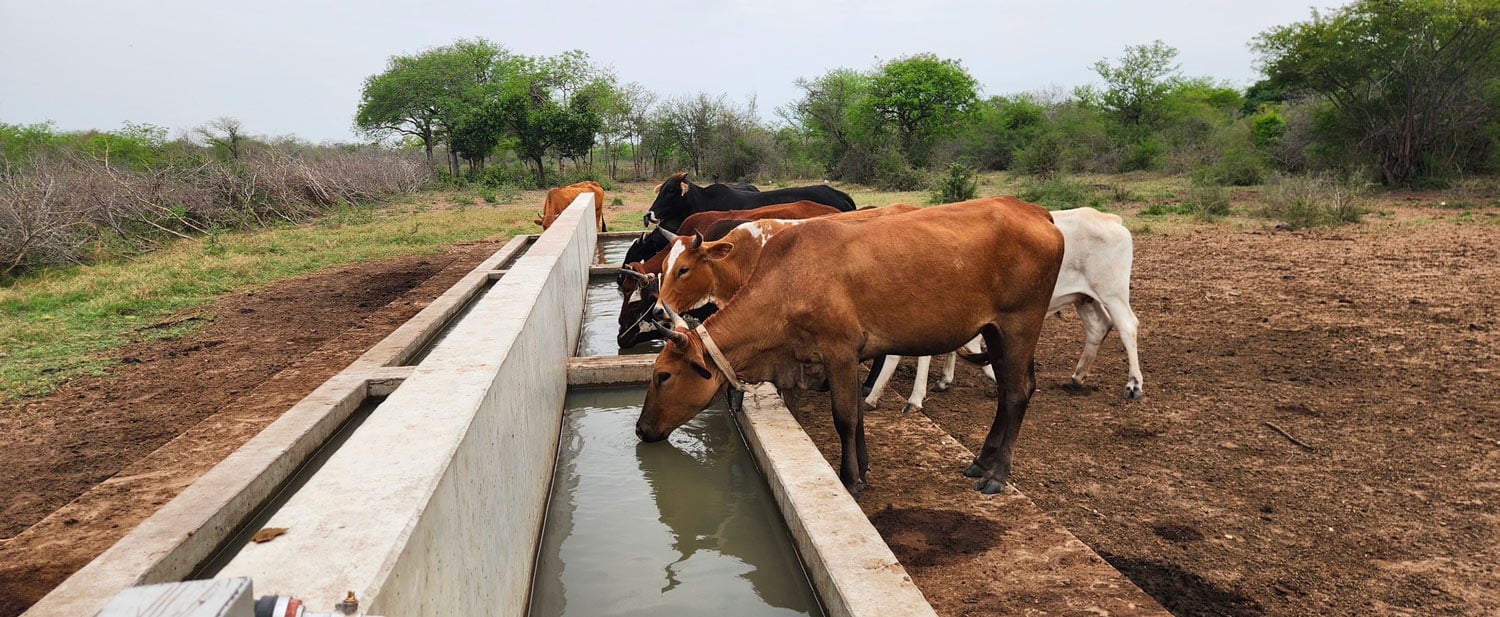
Today, thanks to the Bank-supported infrastructure and rapid insurance payouts, farmers irrigate new plots of land; cattle have reliable drinking points, and children are able to stay in school instead of walking long distances for water.

A resident of Magude collects water at a newly installed standpipe.
Impact In Numbers
As of October 2025, 6,728 people in Magude have benefited from improved water access, including 2,561 women. Approximately 8,797 cattle have benefited from improved water access, and 1,045 households received food assistance during drought periods. The drought response was funded by an automatic insurance payout of $1.89 million from ADRiFi partner African Risk Capacity. This payout was part of an El-Nino triggered $60 million insurance disbursement by the African Risk Capacity to several southern African countries, including Mozambique, Malawi, Zambia, and Zimbabwe.
A National Investment in Resilience
Magude’s story is part of a broader national resilience strategy that combines climate insurance, community-level support, and rapid emergency response. In October 2025, the African Development Bank and the Government of Mozambique co-hosted the Continental Climate Disaster Risk Financing and Insurance (CDRFI) Forum in Maputo, where Magude’s experience was shared before ministers of finance, heads of national disaster management agencies, sovereign donor partners, and senior officials of the African Risk Capacity (ARC).
Building Africa’s Climate Resilience
In Mozambique, the African Development Bank Group is advancing two of its Four Cardinal Points through the Africa Disaster Risk Financing Programme: Enhanced Access to Capital, and the Reform and Consolidation of Financial Systems and Institutions. The Bank Group enhances access to capital by covering the government’s climate insurance premiums with the African Risk Capacity, opening climate risk markets to a country that could not otherwise afford coverage. It reforms financial systems by replacing slow post-disaster appeals with parametric contracts that release payouts within weeks of a trigger.
Working with Mozambique’s National Institute of Disaster Management (INGD), the Bank Group has shown that climate resilience is built not only through infrastructure, but through restoring hope, dignity, and opportunity to communities on the frontlines of climate change.