
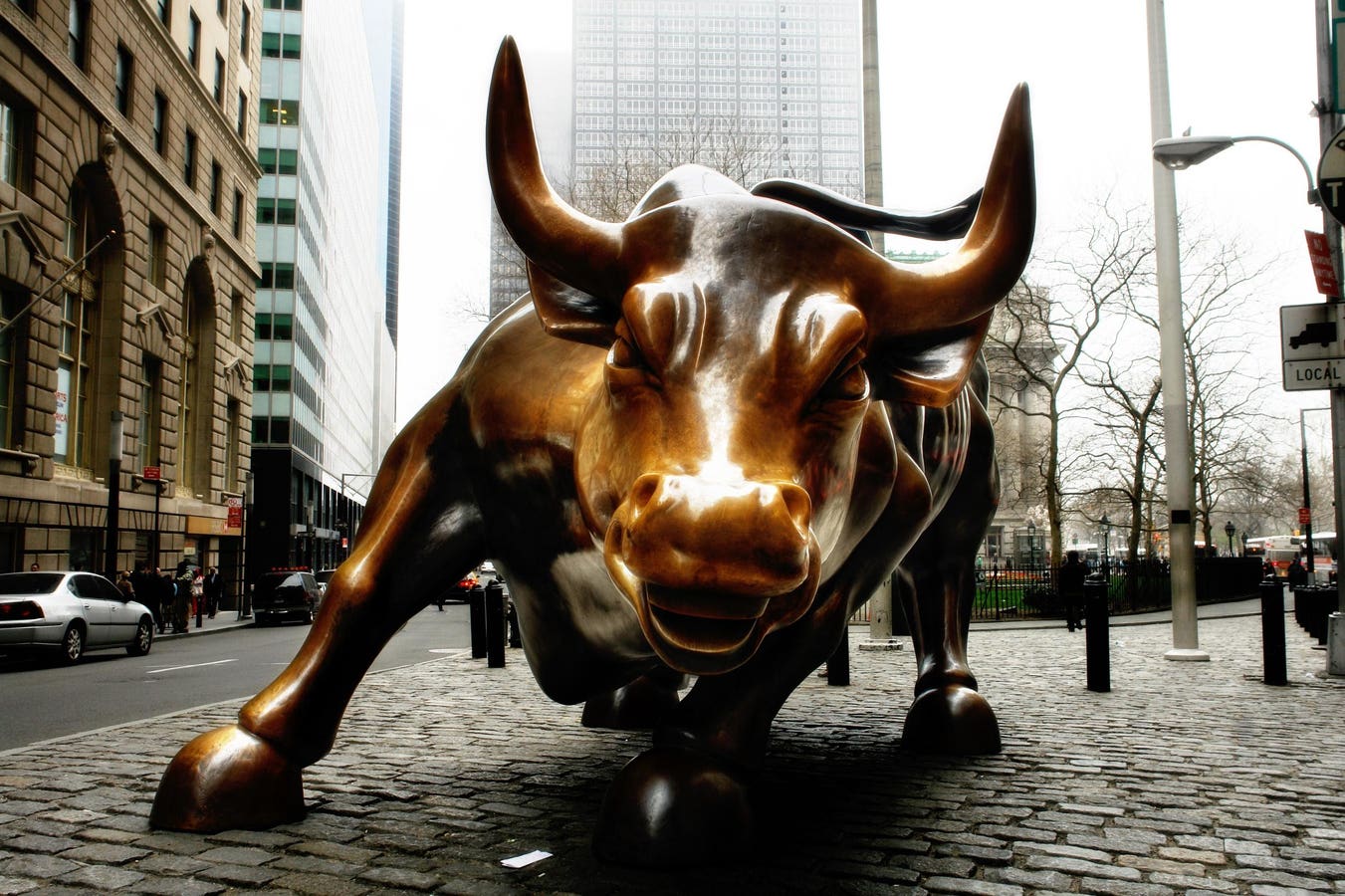

Wall Street Bull Sculpture
getty
We are Still in a Bull Market, Even After the Shock
The headlines are dramatic and understandably so. War in the Middle East has escalated, oil prices are spiking above $100 per barrel, and the Strait of Hormuz, one of the most critical arteries in global energy supply is effectively closed. At the same time, U.S. politicians, now just six months from reelection, are responding with urgency that often reflects political survival as much as economic prudence. It feels like the kind of moment that should end a bull market.
But history offers a more nuanced lesson: history doesn’t repeat, but human nature does. And human nature full of fear, overreaction, and short-term thinking often creates volatility inside longer-term trends, not the end of them. Importantly, going into these recent challenges, the bull market was healthy, broad, and fundamentally intact. While shocks like this can create corrections and sharp drawdowns, they do not automatically dismantle the underlying structure of a bull market.
Reading the Signs Right
Every week, a market pundit asks if we have reached a market top, and the question is understandable given the extraordinary gains, the surge in technology stocks, and headlines that oscillate between euphoria and anxiety. But when we look at the actual indicators that have historically marked major market turning points, the evidence suggests we are still in a bull market, not at its end.
Market timing is notoriously difficult, but history has given us a playbook. Distinct behavioral, technical, and fundamental patterns emerge at both market tops and bottoms, repeating across cycles in ways that allow disciplined investors to separate noise from signal. While no framework guarantees perfect timing, understanding these patterns provides a critical edge in navigating uncertainty.
What Market Tops Actually Look Like
Real market tops are rarely subtle or quiet; they tend to arrive with unmistakable intensity. At true peaks, IPO activity surges as companies rush to capitalize on investor demand, while prices rise rapidly and often disconnect from underlying fundamentals. Leverage expands as investors borrow aggressively to amplify returns, and credit becomes widely available with risk systematically underpriced.
The cultural signals are just as telling. Financial media celebrates a “new era,” and the phrase “this time is different” becomes a rallying cry rather than a warning. Amateur investors flood into equities, convinced that wealth creation has become easy and repeatable. Innovation is no longer evaluated critically as it becomes justification for ignoring valuation altogether. Social proof replaces analysis, and participation becomes driven more by momentum than by discipline.
What Market Bottoms Look Like
Market bottoms present a starkly different picture, defined not by excess but by absence. Mergers and acquisitions slow dramatically as companies hesitate to deploy capital, IPOs disappear, and venture capital funding contracts sharply. Valuation multiples compress, and even strong companies trade at or below historical market multiples, often ignored by investors unwilling to take risk.
Fear dominates behavior, driving P/E ratios into single digits while central banks ponder aggressive easing. Consumer sentiment weakens, and investors retreat from markets entirely, focused more on preserving capital than on seeking opportunity. Ironically, this is when long-term opportunity is greatest, though it rarely feels that way in real time.
Where Are We Today?
Applying this framework to today’s environment, even in the face of geopolitical shock, reveals a market that is under pressure but not at an extreme. While gains have been significant and certain sectors, particularly technology, are trading at elevated valuations, the broader set of top signals is notably absent. We are not seeing an IPO explosion, leverage is not at historic highs, and credit conditions, while available, are far from indiscriminately loose.
Investor sentiment also tells a more balanced story. Retail participation has increased, but it has not reached the manic levels of prior peaks, and widespread skepticism remains. Many investors continue to hold meaningful cash positions, reflecting caution rather than euphoria. Financial media narratives are mixed, with persistent concerns around inflation, interest rates, geopolitical instability, and economic growth. This is not the psychology of a market top; it is the mindset of a market still climbing a wall of worry.
At the same time, we are far from the conditions associated with a bottom. M&A activity continues, venture capital remains active, and companies are not broadly trading at distressed valuations. Credit markets are functioning, and while sentiment is not exuberant, it is also not deeply depressed. Taken together, this suggests a market that is neither overheated nor broken but rather progressing through a maturing phase of the cycle.
The Takeaway
Geopolitical shocks, energy spikes, and politically driven policy responses inevitably create volatility, but volatility alone does not signal the end of a bull market. Historically, markets have demonstrated an ability to absorb and adapt to uncertainty, often advancing not in spite of it, but through it. Bull markets, by their nature, climb a wall of worry and recent events have simply made that wall a bit steeper.
Stepping back, the core reality remains unchanged. The bull market that entered this period was fundamentally strong, supported by underlying economic and corporate dynamics that have not been fully undone by recent developments. While corrections occur on average once a year and are even healthy, they should not be confused with structural breakdowns.
The investors who build lasting wealth are not those who attempt to predict every geopolitical event or short-term fluctuation. Instead, they remain disciplined, grounded in evidence, and focused on long-term trends. Right now, the evidence points to a market experiencing stress, not one reaching its end. That distinction matters and it is what separate’s reaction from strategy.