

Prime central London postcodes still carry the cachet, but not the returns. Gross rental yields in Mayfair and Knightsbridge typically sit between 2.5% and 3.5%, while flats across the Docklands, from Canary Wharf to the Isle of Dogs, are regularly achieving 4% to 5.5%. For investors weighing up where their money works hardest, that gap has become difficult to ignore.
The case for the Docklands is not just about yield either. A dense, well-paid tenant base, continued regeneration, and a rental market shaped by genuine employment demand rather than speculation all play a part. Here is what the numbers actually show, and what any investor needs to check before buying in.
Key takeaways
- Docklands buy-to-let yields typically run at 4% to 5.5%, against 2.5% to 3.5% in prime central London
- Canary Wharf alone supports 105,000 to 120,000 jobs, underpinning consistent tenant demand
- New build prices across the Docklands range from roughly £381,500 to £1.4 million depending on development
- The stamp duty surcharge on additional properties is 5% on top of standard rates, as of October 2024
- The Renters’ Rights Act, in force from 1 May 2026, ends Section 21 evictions and adds new landlord compliance duties
Why yield-focused investors are looking east
The maths behind Docklands buy-to-let is straightforward. Prices remain well below prime central London on a per-square-foot basis, while rents are underpinned by tens of thousands of well-paid jobs within walking distance. That combination produces yields that prime postcodes, built on capital preservation rather than income, simply cannot match.
Investors approaching the area for the first time often start by speaking to London Docklands agents who can advise on which pockets of the market suit an income-focused strategy, since yield and capital growth do not always point in the same direction within the same postcode.
Isle of Dogs and South Quay tend to offer the strongest yields for one-bedroom flats, while newer landmark towers in Wood Wharf command higher prices but let quickly to professionals wanting the newest specification.
The yield gap in numbers
Gross yield is only ever a starting point, but the gap between the Docklands and prime central London is consistent enough across multiple sources to be treated as a genuine market feature rather than a one-off.
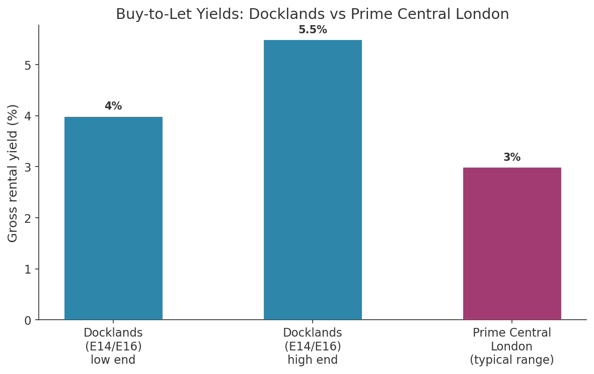
Figure 1: Typical gross rental yield ranges, Docklands versus prime central London, 2026.
| Metric | Docklands (E14/E16) | Prime Central London |
|---|---|---|
| Typical gross yield | 4% to 5.5% | 2.5% to 3.5% |
| New build price range | £381,500 to £1.4m | Typically £1m and above |
| Primary tenant driver | Employment (finance, tech, professional services) | International capital and lifestyle demand |
| New housing supply since 1996 | Around 21,000 flats and houses in E14 alone | Comparatively limited new stock |
| Worth Noting: E14 has seen more new housing supply than any other London postcode since 2011, which has kept a lid on rental growth even as tenant demand has stayed strong. That combination of ample supply and deep demand is part of what keeps yields competitive. |
What’s driving tenant demand
Unlike some regeneration areas where demand is speculative, Docklands rental demand is tied to real employment. Canary Wharf alone supports an estimated 105,000 to 120,000 jobs across banking, professional services and a growing technology sector, and that workforce needs somewhere to live within a manageable commute.
The wider Royal Docks regeneration, worth an estimated £8 billion over the next twenty years, is forecast to add a further 55,000 jobs, which points to continued tenant demand well beyond the current cycle rather than a temporary spike.
Supply of new housing in the E14 postcode has outstripped every other London borough from 2011 to 2024, with roughly 21,000 new flats and houses added since 1996.
The tax and compliance picture
Buy-to-let purchases in the Docklands carry the same tax treatment as anywhere else in England. Since October 2024, the higher rate of Stamp Duty Land Tax on additional properties has stood at 5% on top of standard rates, applied across every price band rather than just the portion above a threshold.
On a £500,000 flat, that surcharge alone adds roughly £25,000 to the purchase cost before any other fees, which needs factoring into any yield calculation from day one rather than treated as an afterthought.
Landlord obligations have also shifted significantly. The Renters’ Rights Act, in force from 1 May 2026, ends Section 21 no-fault evictions and moves every tenancy onto a periodic footing, meaning landlords need a valid ground under Section 8 to regain possession.
Guaranteed rent and hands-off management
For investors who do not want to manage void periods or chase rent personally, guaranteed rent schemes have become increasingly common across the Docklands rental market. These arrangements typically fix a monthly payment to the landlord regardless of occupancy, in exchange for the agent taking on the letting and management risk.
- Rent is paid whether or not the property is currently let, removing void-period risk
- The agent typically handles tenant sourcing, referencing and day-to-day maintenance
- Terms usually run for a fixed period, commonly one to five years
- HMO management adds further complexity around licensing, which a specialist agent can navigate on the landlord’s behalf
Staying on top of compliance paperwork
A growing volume of compliance documentation, gas safety certificates, EICRs, deposit protection paperwork, now needs to be issued, stored and often transmitted securely between landlords, agents and tenants. Getting this wrong is one of the most common reasons a possession claim or a licensing application runs into trouble.
Where paperwork still needs to move between parties who are not on the same digital systems, services such as eFax’s business fax solutions let landlords and agents send and receive signed compliance documents securely without needing a dedicated fax machine or office line.
What investors should check before buying
The broader stamp duty story is worth understanding beyond the buy-to-let surcharge alone. Our earlier coverage of central London’s stamp duty problem and how it is reshaping the prime market sets out why some investors are looking beyond traditional prime postcodes entirely, a trend the Docklands has benefited from directly.
For a sense of how local market data gets reported, our survey of local estate agents in Paddington shows the kind of yield and rent benchmarking worth requesting from any agent before committing to a purchase, regardless of which part of London you are considering.
Due diligence matters just as much on the occupier side. Our checklist for reducing risk when choosing a new office covers a similar discipline that applies to residential buy-to-let due diligence: understanding whole-life costs rather than just the headline purchase price.
Frequently Asked Questions
What is a typical buy-to-let yield in the Docklands?
Gross yields typically range from 4% to 5.5%, with the strongest returns generally found on one-bedroom flats in the Isle of Dogs and South Quay.
How much extra stamp duty do buy-to-let investors pay?
A 5% surcharge applies on top of standard Stamp Duty Land Tax rates for additional properties, in place since October 2024.
Does the Renters’ Rights Act apply to Docklands landlords?
Yes. The Act applies across England from 1 May 2026, ending Section 21 evictions and requiring landlords to cite a valid ground under Section 8 to regain possession.
What is a guaranteed rent scheme?
It is an arrangement where an agent pays the landlord a fixed monthly rent regardless of whether the property is occupied, taking on the letting and management risk in return.
A market built on employment, not just regeneration
The Docklands investment case rests on something more durable than a regeneration press release: a large, well-paid workforce that needs somewhere to live within a manageable commute, and a supply of new housing that has kept prices from running away from rental income.
For investors comparing yield against the more familiar prime postcodes, the numbers make a genuinely compelling case, provided the tax position and compliance obligations are factored in from the outset rather than discovered after completion.
References
GOV.UK, Stamp Duty Land Tax: Buying an Additional Residential Property, 2026 — https://www.gov.uk/guidance/stamp-duty-land-tax-buying-an-additional-residential-property
GOV.UK, Guide to the Renters’ Rights Act, 2026 — https://www.gov.uk/government/publications/guide-to-the-renters-rights-act/guide-to-the-renters-rights-act
Relier Property Management, Rental Yields in Canary Wharf & E14, 2026 — https://www.relierpm.co.uk/rental-yields-in-canary-wharf-and-e14/
Wextons, London Docklands Estate & Letting Agents — https://wextons.co.uk/estate-agents/london-docklands/
Fact Check: All statistics, yield figures and tax rates in this article were verified against original sources, including GOV.UK and published property market data, as of the article’s publication date. Sources are listed in the References section above. This article is provided for general information and does not constitute financial or tax advice; investors should consult a qualified accountant or financial adviser before making a property investment decision.