
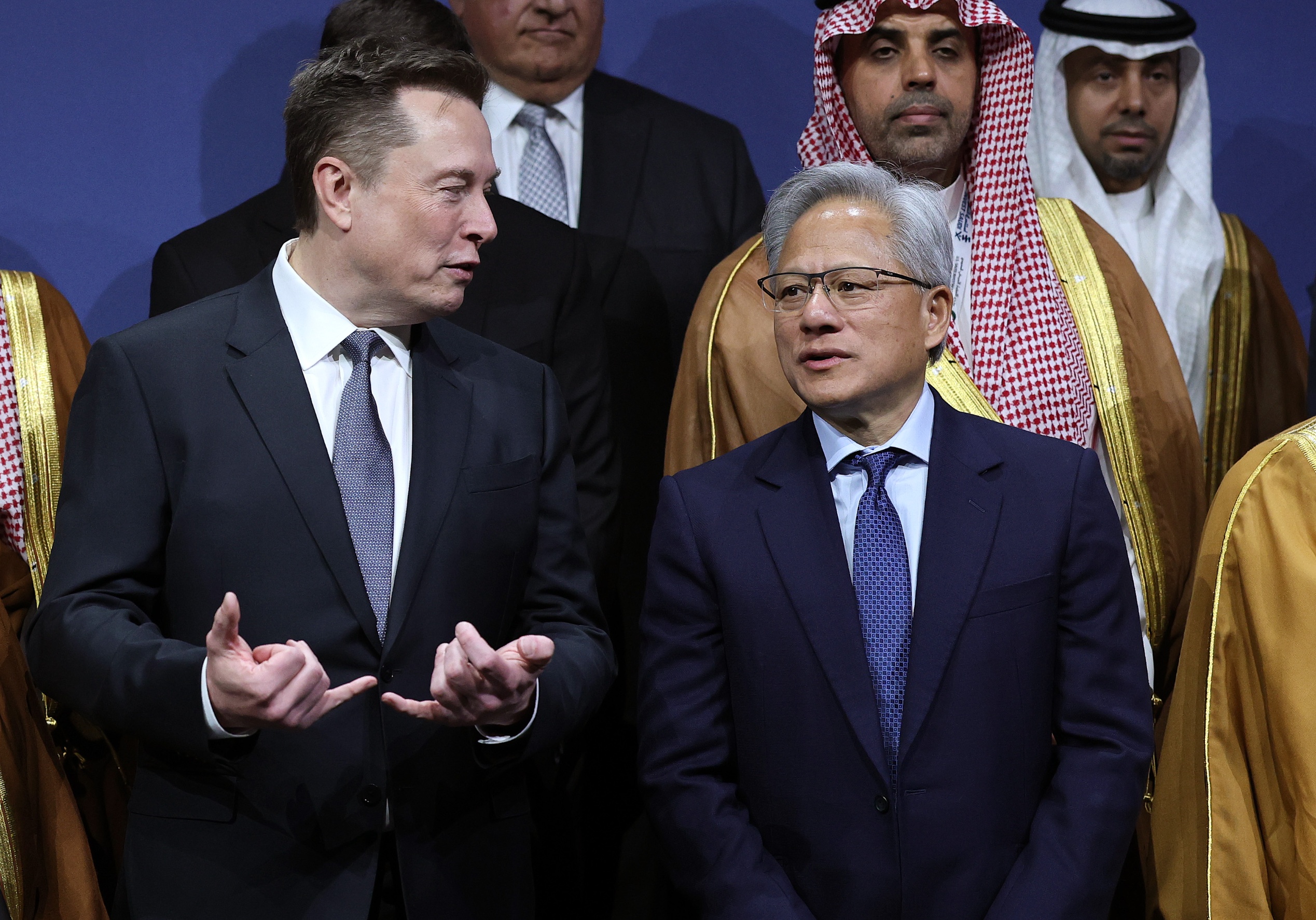

Win McNamee/Getty Images
Nvidia’s quarterly SEC filing, made public Friday, revealed that the world’s most valuable chipmaker holds approximately $21 billion in SpaceX stock and roughly $30 billion in Intel stock — more than $50 billion concentrated in two companies that have each pledged to make Nvidia their exclusive chip supplier. Nvidia’s 13F filing disclosed exactly what Wall Street had been theorizing: Jensen Huang has quietly transformed Nvidia from a chip designer into a financial stakeholder in its own largest customers, and the filing places precise dollar figures on a risk that analysts had been flagging for months.
For anyone who owns Nvidia stock — directly, or through index funds like the S&P 500, where Nvidia now represents a substantial share of a typical index investment — Friday’s numbers matter in a way that goes beyond headline size. If SpaceX and Intel underperform, Nvidia takes a hit twice: once as their chip supplier whose revenue shrinks, and again as their equity investor whose portfolio deflates. The company has, in effect, doubled its exposure to the AI infrastructure buildout without advertising that it has done so.
How a $5B Intel Bet Turned Into Nvidia’s Largest Disclosed Holding
Nvidia’s Intel position began in September 2025, when CEO Jensen Huang and Intel CEO Lip-Bu Tan announced a deal that sent immediate shockwaves through semiconductor markets. The Federal Trade Commission cleared the transaction on December 18, 2025, and Intel’s December 26 private placement closed four days after regulatory approval, with Nvidia paying a fixed price of $23.28 per share for 214,776,632 newly issued Intel shares. The total cost: $5 billion.
By June 30, 2026, with Intel trading at roughly $140 per share, that position was worth approximately $30 billion on Nvidia’s 13F filing — an unrealized gain of roughly $25 billion on a $5 billion outlay in under seven months, making it one of the most profitable strategic investments in recent semiconductor history. Intel stake declined to $22 billion as of August 14, following Intel’s own Intel’s $20B August offering that closed August 12.
The financial return was never the only point. As part of the September 2025 agreement, Nvidia and Intel committed to Intel Nvidia joint chip development across multiple generations of chips for data centers and PCs — a partnership that, if executed, would give Nvidia access to Intel’s Advanced Packaging and chip fabrication capabilities while providing Intel with the most important customer endorsement in the industry.
Analysts have been vocal about Lip-Bu Tan’s Intel turnaround under his leadership, and Nvidia’s continued investment — it held the same share count as of June 30 as it held after the December placement — signals confidence that the recovery is real.
The SpaceX Stake: From an AI Startup Bet to $21 Billion in Rockets
The SpaceX position arrived through a different path. Nvidia participated in xAI’s $20B Series E closed in January 2026, joining Valor Equity Partners, the Qatar Investment Authority, Fidelity, and others in backing Elon Musk’s AI startup. On February 2, 2026, SpaceX xAI all-stock merger valued the combined entity at $1.25 trillion, converting all xAI equity into SpaceX Class A shares proportional to each holder’s stake. Nvidia’s xAI position converted into approximately 122.8 million SpaceX Class A shares.
SpaceX went public on the Nasdaq on June 12, 2026, in the largest initial public offering ever recorded. SpaceX Nasdaq debut raised $85.7B after underwriters exercised the overallotment option, at an initial price of $135 per share. At the June 30 closing price of $170.86, Nvidia’s 122.8 million SpaceX shares were worth approximately $21 billion — or about 33% of Nvidia’s total disclosed equity portfolio.
SpaceX shares have since retreated from those highs. At Friday’s close, with SPCX trading near $140, SpaceX stake fell to $17.2B for Nvidia’s position. That still makes SpaceX Nvidia’s second-largest disclosed equity holding, behind only Intel.
In terms of the SpaceX investor rankings, Nvidia sits sixth. Musk’s 48.4% SpaceX economic stake was valued at approximately $907 billion as of June 30 — though Musk has noted publicly that a portion of those shares remain subject to vesting conditions tied to extreme performance milestones. Alphabet’s 551.2 million SpaceX shares were worth $94.2 billion as of June 30 — a position that has since declined to approximately $78 billion at current prices as SpaceX stock pulled back from its post-IPO peak.
Musk’s Pledge: Nvidia Gets SpaceX’s Full AI Budget
Ten days before the 13F filing hit, Elon Musk delivered the chip-supply commitment that gave the investment disclosure its strategic weight. SpaceX Q2 earnings call August 4 — the company’s first mandatory earnings call as a public company — Musk told investors and analysts that SpaceX had decided to build its AI infrastructure entirely on Nvidia hardware going forward.
“Going forward, we’ve decided to build exclusively on Nvidia, because we think the Vera Rubin architecture is the best architecture,” Musk said. “We think it’s the best AI computer, and we greatly value our close cooperation and partnership on many levels with Nvidia. We’re exclusive to Nvidia.” Musk’s Nvidia exclusivity declaration underscores how deeply SpaceX has committed to a single chip supplier.
The practical implications of that pledge are enormous. SpaceX AI segment hit $2.56B in the second quarter — a 312% sequential jump — and Musk said the company expects to operate more than 2 gigawatts of compute capacity by the end of 2026, scaling toward approximately 10 gigawatts by the end of 2027. All of that compute capacity is now committed to Nvidia hardware.
The commercial architecture supporting those targets is already visible. Anthropic’s Colossus 1 lease terms cover all capacity at SpaceX’s Colossus 1 data center in Memphis, Tennessee — a facility housing more than 220,000 Nvidia GPUs — for approximately $1.25 billion per month. Google SpaceX $920M monthly deal runs from October 2026 through June 2029, covering roughly 110,000 Nvidia GPUs. SpaceX’s AI revenue is, at its core, a rental income stream from Nvidia silicon — and Musk has committed the entire future buildout of that infrastructure to Nvidia as well.
Musk also said SpaceX expects a significant allocation of Nvidia’s next-generation Vera Rubin GPUs when that platform ships, and described plans for Starmind — a proposed network of satellites that would deploy Starmind orbital Nvidia GPU plan in orbit, effectively extending the Nvidia-SpaceX partnership beyond Earth’s atmosphere.
The exclusivity announcement had immediate market consequences on August 4. AMD fell 6% on SpaceX exclusivity while Nvidia shares rose roughly 3-4% on the news — a signal that investors understood what the SpaceX commitment would cost Nvidia’s main competitor. AMD CEO Lisa Su acknowledged the setback diplomatically, noting AMD remained proud to have worked with SpaceX.
What the Filing Reveals About Nvidia’s Investment Strategy
Friday’s 13F was, in most respects, a quiet filing. Nvidia Q2 13F portfolio analysis showed no change in share count from the prior quarter in seven of the eight positions. The only significant move was the first-time appearance of SpaceX — the company simply had not existed as a publicly traded stock before June 12.
SpaceX Intel top Nvidia portfolio, together accounting for more than 80% of Nvidia’s total disclosed public equity portfolio, according to an analysis of the filing.
The broader investment context makes the concentration even more striking. Nvidia FY2025 private investment pace reached $17.5 billion deployed into private companies and infrastructure funds. Nvidia’s $40B investment pace in just the first four months of 2026 accelerated sharply, led by a $30 billion contribution to OpenAI’s $110 billion funding round in February 2026, alongside investments in Anthropic, CoreWeave, Nebius, Corning, and IREN.
Jensen Huang has been direct about the philosophy: “There are so many great, amazing foundation model companies, and we try to invest in all of them. We don’t pick winners. We need to support everyone.”
What Nvidia Investors Are Actually Holding Now
That philosophy has produced something Nvidia shareholders may not have bargained for: a chip company that is also a significant concentrated investor in its own largest customers.
The concern has a name on Wall Street. Goldman Sachs circular revenue warning has flagged “circular revenue” as potentially dilutive to Nvidia’s earnings multiple — a structure in which Nvidia’s equity financing of customers enables those customers to return that capital in the form of GPU purchases, recycling a single dollar through multiple stops on the chain. Wedbush Securities analyst Matthew Bryson observed in a note that Nvidia’s dealmaking fits “squarely into the circular investment theme” — where Nvidia invests in companies that then purchase Nvidia chips, generating both financial returns and guaranteed demand for its core products.
The concern intensified this week when investor Michael Burry shared a Bloomberg diagram on August 13 tracing roughly $46 billion in direct equity stakes and $879 billion in multi-year purchase commitments forming what critics call a self-referential loop at the center of AI infrastructure finance.
Nvidia has pushed back forcefully. Huang has called the circular financing characterization “ridiculous” and told investors at multiple forums that “the demand is real” and that “the capital is not Nvidia revenue.” On August 11, Nvidia’s six-bank MOU announcement covered memoranda of understanding with six major financial institutions to provide up to $500 billion in third-party financing for Nvidia customers — a move Bank of America analyst Vivek Arya characterized as “a pivot away from vendor-financing … that drew circularity fire,” though analyst reaction to Nvidia’s MOUs from Wells Fargo traders remained skeptical, noting that “in the end NVDA is still a part of the financing.”
What the SpaceX and Intel 13F positions add is something new: explicit dollar figures. NVDA shareholders who read Friday’s filing now know that a $100 investment in Nvidia carries embedded exposure to SpaceX and Intel performance not just as chip customers, but directly — through Nvidia’s $50 billion equity stake in those two companies. That double exposure — chip revenue and portfolio value both falling if SpaceX or Intel underperforms — is the practical consequence of Huang’s “support everyone” strategy applied to Nvidia’s two largest chip buyers.
Friday’s market reaction was measured. SpaceX Nvidia post-13F trading showed SpaceX stock gained 0.35% in after-hours trading following the disclosure, while Nvidia shares edged 0.12% lower. Investors appeared to regard the 13F as confirmation of a relationship already broadly understood, rather than a surprise — though the specific dollar values were disclosed publicly for the first time.
Nvidia’s own fiscal second-quarter results — which will include balance-sheet treatment of both positions — are scheduled for release on August 26. That filing will give investors a more complete picture of how the portfolio has moved since June 30, including the impact of SpaceX’s post-IPO pullback and Intel’s stock decline following its August 12 secondary offering.
Frequently Asked Questions
Why does Nvidia own stock in SpaceX and Intel?
Nvidia’s SpaceX position originated from its participation in xAI’s $20 billion funding round in January 2026. When SpaceX acquired xAI in an all-stock deal in February 2026, Nvidia’s xAI stake converted into approximately 122.8 million SpaceX Class A shares. The Intel stake was a direct strategic investment — a $5 billion private placement at $23.28 per share announced in September 2025 and closed in December 2025, paired with a joint chip development agreement. Both investments were structured to deepen Nvidia’s commercial relationships with companies that buy its chips — not merely to generate investment returns.
What is circular investment, and why are analysts concerned about it?
Circular investment — sometimes called circular revenue or vendor financing — is a structure in which a supplier (Nvidia) provides capital to its customers (SpaceX, Intel, OpenAI, CoreWeave), who then use that capital to purchase more of the supplier’s products (GPUs). The concern Goldman Sachs and others have raised is that this arrangement can make Nvidia’s reported revenue appear more independently generated than it is: a slowdown in genuine end-user AI demand could simultaneously reduce Nvidia’s chip revenue, impair its equity investments in the same companies, and trigger any outstanding backstop obligations — all at once. Nvidia CEO Jensen Huang has called the circular financing characterization “ridiculous” and argues the demand behind AI infrastructure spending is real and independent.
What is the Vera Rubin architecture that SpaceX is committed to using?
Vera Rubin is Nvidia’s next-generation GPU and CPU platform, designed as an integrated rack-scale system that pairs Vera CPUs with Rubin GPUs connected by chip-to-chip NVLink interconnects. Nvidia executive vice president and CFO Colette Kress described the approach at a Bank of America conference in June 2026 as “extreme codesign” — building the chip, networking, and software together rather than as separate components. Compared to its predecessor Grace Blackwell, the Vera Rubin module is designed to deliver approximately 10 times more performance per watt. Elon Musk praised this architecture specifically on SpaceX’s August 4 earnings call, saying it is “the best AI computer” — and SpaceX has committed to deploying it both in terrestrial data centers and in planned Starmind orbital satellites.
Does Nvidia’s stake in SpaceX and Intel create a conflict of interest?
The question is real but not legally resolved. Nvidia’s simultaneous roles as chip supplier, equity investor, and joint-development partner in both SpaceX and Intel mean that decisions Nvidia makes about chip pricing, supply allocation, technology licensing, and development roadmaps could benefit Nvidia’s investment portfolio at the expense of its competitors’ customers — or vice versa. The FTC reviewed and cleared the Intel investment in December 2025 under the Hart-Scott-Rodino antitrust framework, finding no violation at the time. No regulatory inquiry into the SpaceX position has been publicly announced. The structural conflict — investor and vendor simultaneously — exists regardless of current regulatory status and is something investors in NVDA, SPCX, and INTC should weigh independently.