
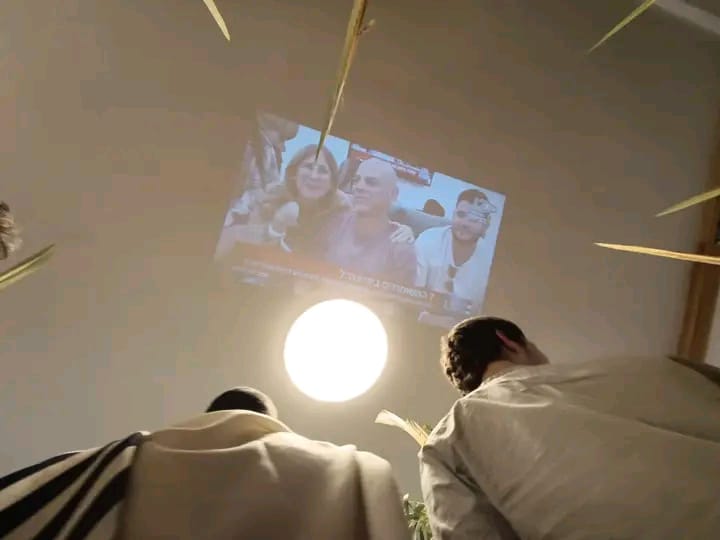
I have my own claim against Hamas: for the cold-blooded murder of my son in 2008. And I firmly believe that until these genocidal jidhadists, who live only to kill, are eradicated, there will be no peace. Not here in the Middle East. And as they’ve succeeded in infecting so much of the world with their vile idealization of mass murder, their black stain of hatred darkens any chance of finding a path towards brotherhood beyond our borders as well.
For as the famous midrashic reading of God’s oath against the murderous Amalakites teaches, we know that there is no true wholeness/peace in this world so long as the burning hatred against us persists. (See the Ramban on Exodus 17:16).
This morning as I prayed in front of the gathered congregation and came to, “Blessed are You God, redeemer of Israel,” I needed to fight back the tears to continue. For even as the gory images of Hamas declaring continued control over Gaza are hard to dismiss, just then, seven of our long-anguishing hostages were making their way into the arms of the waiting IDF. All I could feel was that these words were coming to life right before my tear-blurred eyes.
The Jerusalem Talmud relates how two sages were out walking well before dawn, and as the dimmest of light in the east slowly waxed into sunrise, they remarked that such is the redemption of Israel: sliver after sliver, bit by bit. This is the way of Israel’s redemption, piece by piece.
It may not be complete. We all know that evil still lurks in the waiting terror warrens beneath the ruins of what could have been a land of plenty. We all know that the war against those driven by rabid Jew-hatred is far from over. But today we witnessed yet another sliver of light peeking out of the darkness. Another sliver of Israel’s redemption. Here and now.

Naftali Moses, born in NYC, has lived in Israel for over 30 years. He holds a PhD in medical history from Bar-Ilan University, and teaches and writes on the nexus of medicine and Judaism. The author of “Really Dead?” and “Mourning Under Glass”, he has also translated several books on Jewish thought into English, published on philosophy in the Mishna, and aggadah.