
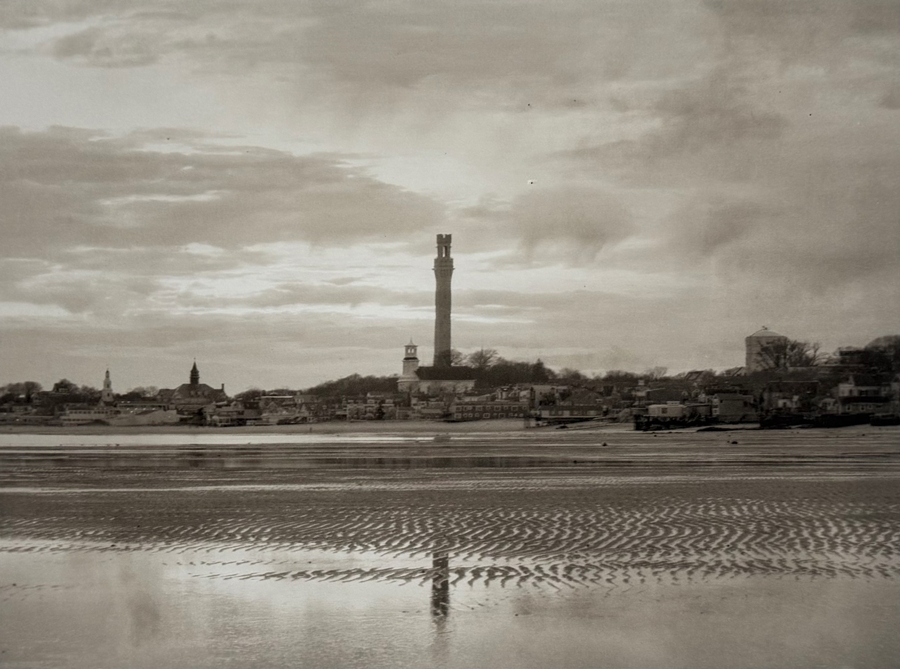
Ross Dube’s photographs begin as digital files, but they do not stay immaterial for long. First he passes the image through Photoshop, then a sheet of transparency, a brushed rectangle of yellow-ocher emulsion, a pane of glass, ultraviolet light, developer, clearing baths, and water before it becomes a finished print.

The process has an alchemical cast, as if the image must be coaxed out of metal, iron, paper, and light. He takes a photograph with his Sony full-frame digital camera, brings the image into Photoshop, sizes it, and inverts it into a negative. Then he prints the negative onto transparency at the exact scale of the final image.
He mixes platinum, palladium, and ferric oxalate, an iron-based chemical, into an emulsion. With a paintbrush, he applies the mixture onto rag paper in a rectangle slightly larger than the negative. When the emulsion dries, it turns yellowish, visible around the edges of the future image. He clips the negative over the coated area, presses the two under glass, and exposes them in a UV light box for about five minutes. Then the paper — he uses Revere Platinum — goes into a bath of developer, where the image appears.

After that, the print moves through clearing baths and water. By the end, the platinum and palladium have embedded themselves into the paper — “theoretically forever,” Dube says.
That durability is essential to “A Quiet Resilience,” Dube’s exhibition opening Friday, May 8 at Alden Gallery in Provincetown. The show includes nine platinum-palladium monoprints of scenes in the Cape Cod National Seashore, from dune shacks and ranger stations to beech tree roots, tidal flats, and winter dunes. The exhibition, on view through May 18, is part of Dube’s M.F.A. thesis at the Savannah College of Art and Design, where he studies remotely from Provincetown.
Dube began the project two years ago as a way to document endangered landscapes and buildings in the Seashore. As the work progressed, he began to see the photographs as a form of advocacy for their protection. He wanted to photograph the places “authentically and unromantically,” using the vulnerability of the coast to think about existence as “momentary, fragile, yet part of a larger, enduring whole.”

Dube is using platinum and palladium, materials prized for endurance, to fix the Seashore in durable metal and rag paper. “For me, that is part of the work,” Dube says. “I’m taking pictures of vulnerable places, vulnerable buildings, structures that are getting eroded by the weather.” Making an archival version of the image as it stands today, he says, is his way of “working against that,” of creating “a permanent image of something that is very ephemeral.”
The prints are unromantic but not austere. They resist presenting the Cape as scenic and instead emphasize the photograph as a made object. Around each image, the hand-applied emulsion leaves a visible border, evidence of the time and care Dube takes to give the photograph form. Those brush-marked edges make the prints feel intimate, even when their subjects are exposed buildings, diseased trees, and eroding ground.
Dube’s attachment to the tactility of photography began long before he learned platinum-palladium printing. As a teenager on the Jersey shore, he got hold of a fully manual SLR camera. It “didn’t do anything,” he says. “It didn’t even autofocus.” Working with the manual camera made him slow down. He had to turn the dials himself, focus by hand, measure the light, and understand the image before he released the shutter.

He recalls photographing landscapes, birds, and buildings, training his attention on whatever appeared along his walks. Buildings became the recurring subject, and “to this day, I’m still in love with taking pictures of buildings,” he says.
Later, living in Washington, D.C., Dube took darkroom classes at the Smithsonian, where the photograph became something he could handle from start to finish. He learned to process film and work with an enlarger. The experience gave him, he says, “a taste for doing the printing myself.”
Standard digital inkjet printing was useful, he says, but it handed the final act of making over to the machine. He missed the darkroom’s more intimate sequence of decisions. During his M.F.A. coursework, he began studying alternative photographic processes, including cyanotype, daguerreotype, and platinum-palladium, which let him bring the photograph through its final transformation himself. “This is what I’ve been looking for,” he remembers thinking. “This is the step in my photography that I’m missing.”
At home in Provincetown, Dube prints in what some photographers call a dim room, a modest cousin of the darkroom. The emulsion is sensitive to ultraviolet light, so ordinary household bulbs will not expose the paper. He can work by regular light while keeping the real danger outside the room: the sun.
The print’s tonal range depends on the chemical composition of the emulsion. Palladium gives the image much of its middle range, Dube says, while platinum adds contrast, allowing him to deepen the image by adjusting the ratio between the two metals.

The image’s warmth is determined later, in the developer. Dube heats the bath before lowering the exposed paper into it, using temperature to shift the final tone. “The warmer it is,” he says, “the warmer the image ends up being.”
A successful print takes about an hour or an hour and a half once the negative is ready, and one finished image usually requires multiple attempts. Larger prints require larger trays, additional chemicals, and a greater tolerance for risk.
In Houseboat, the risk paid off strangely. The image came out darker than Dube planned, leaving a small structure nearly swallowed by the field around it. At first, he nearly set it aside. His classmates, seeing the print, responded positively to the darkness that had made him uncertain.

It is also the one print in the group where that material presence remains legible in reproduction. The brushwork seems to press into the frame instead of resting at the border, making visible what Dube likes about the process — the feeling of having his fingerprints essentially on that final image.
That balance between intention and accident runs through the exhibition. The nine images in “A Quiet Resilience” were chosen to show the Seashore in different states of vulnerability. Some show damage directly, including Beech Forest, where exposed roots and defoliated trees register the effects of beech leaf disease. Others turn to structures exposed to future risk, including Nicholas and Ray Wells Shack, which shows a dune shack raised precariously on pilings above the dune scrub. Dube wanted the group to feel cohesive without repeating a single message.

He is glad the exhibition will be seen in Provincetown. Local viewers, he says, have regular access to these sites. He hopes they will see the beech tree roots, the buildings in harm’s way, and the parts of the Seashore that are “not necessarily glamorous.” Living near the National Seashore, he says, carries “a certain amount of ecological stewardship.”
‘A Quiet Resilience’
The event: Platinum-palladium monoprints by Ross Dube
The time: May 8 through May 18; opening reception Friday, May 8, 6 to 8 p.m.
The place: Alden Gallery, 423 Commercial St., Provincetown
The cost: Free