
The global financial services industry continues to evolve due to concurrent structural, technological, and regulatory changes. Recent trends include renewed mergers and acquisitions activity and consolidation, the rapid normalization of prediction markets and a regulatory inflection point for buy now, pay later (BNPL) products, most notably in the UK.
Consolidation
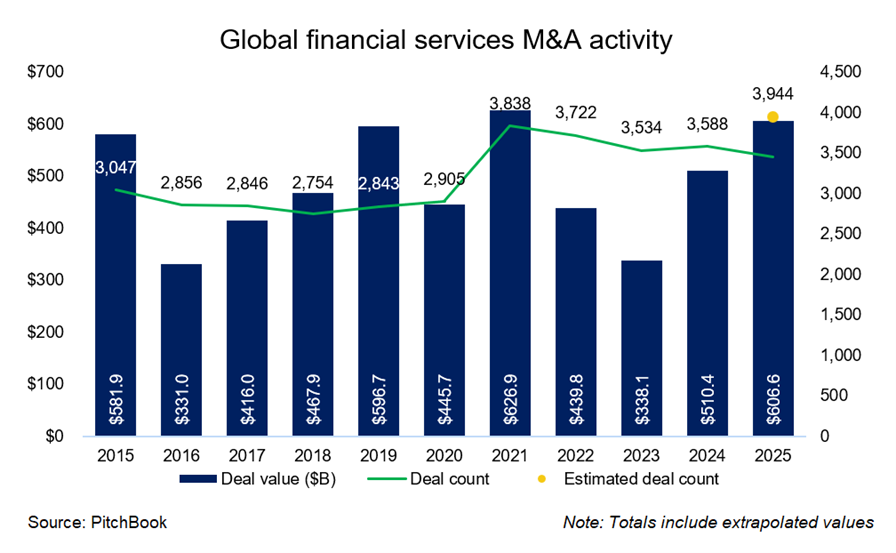
M&A activity across financial services rebounded globally in 2025, driven less by opportunistic transactions and more by intentional, scale-oriented deals. Global deal value in financial services rose greatly year over year, even as overall transaction counts remained flat or declined, signaling a pivot toward fewer but larger deals.
On an annual basis, a strong fourth quarter pushed 2025 to the second-highest level ever recorded for M&A activity, surpassed only by the 2021 peak. Financial services M&A saw an estimated 3,944 deals worth an aggregate value of $606.6 billion, representing year-over-year increases of 9.9% and 18.8% respectively, per PitchBook data.

Banks, asset managers, insurers and brokers are increasingly using M&A as a mechanism to achieve operating leverage, modernize technology stacks, and expand distribution. In banking, margin pressures are squeezing smaller institutions. Meanwhile, in asset and wealth management, regulatory complexity, fee compression, and investor demand for diversified investment product offerings are among the factors pushing mid-sized managers toward strategic combinations or platform partnerships.
The takeaway for leadership teams: The consolidation landscape has significantly evolved. Acquirers are prioritizing execution certainty, integration capability, and clear strategic rationale. The next phase of consolidation will reward firms that use M&A to fundamentally reshape cost structures and capabilities.
Read more financial services insights from RSM.
Prediction markets
Prediction markets, once a more niche area of finance, are growing. Trading volumes across major platforms surged during 2024 and continued to expand in 2025 as contracts tied to macroeconomic data, sports, and digital assets gained popularity.
In the U.S., what has changed is not just scale, but positioning. Prediction markets are increasingly framed as tools for price discovery and risk transfer rather than speculative betting. Partnerships between prediction market platforms and mainstream financial institutions, brokerages, and media outlets are reinforcing this shift.
Regulatory clarity—particularly at the federal level in the United States—has contributed to broader participation in the space. U.S. regulators are beginning to treat prediction markets less like novelty products. However, that same clarity does not exist at the state level: A handful of states disagree with the federal position and are contesting back through the courts. The key question in state litigation is whether the markets operate as online betting parlors regulated under state law or financial derivatives exchanges regulated under federal law. The Commodity Futures Trading Commission asserted that it maintains “exclusive regulatory authority” over these markets.
For financial services firms, prediction markets present both opportunities and risks. While they offer real-time probabilistic data that can complement traditional forecasting models and hedging strategies, they raise familiar concerns around consumer protection, market manipulation, and reputational exposure. As these products mature, firms that successfully integrate prediction data into decision‑making—while maintaining robust governance—may gain a meaningful informational edge.
In contrast to the U.S., the UK applies a generally more restrictive framework. Event‑based outcome trading that does not qualify as a financial instrument is often treated as gambling and regulated by the UK Gambling Commission; financial regulators in the UK have historically been reluctant to classify such products as legitimate retail financial instruments.
Buy now, pay later
Few areas of consumer finance have grown as quickly—or been as lightly regulated—as BNPL products offering deferred payment options. That dynamic is now changing to address growing concerns around consumer impact, debt accumulation and uneven protections across the credit market.
In May 2025, the UK government passed legislation to bring most third‑party BNPL products within the scope of financial regulation, with oversight transferring to the Financial Conduct Authority (FCA). As of July 15, 2026, BNPL providers will be subject to creditworthiness and affordability assessments as well as Consumer Duty requirements, clearer pre‑contract disclosures, and access to the Financial Ombudsman Service, bringing BNPL closer in line with established UK consumer credit protection.
The UK reforms aim to preserve innovation while closing long‑standing regulatory gaps explicitly prioritizing consumer outcomes over product labels. Importantly, the regime avoids simply forcing BNPL into the legacy Consumer Credit Act framework, instead granting the FCA flexibility to develop tailored rules. For BNPL providers, this introduces higher compliance costs and operational complexity but also may favor well-capitalized players.
While the reforms are UK‑specific, they may influence global regulatory approaches to BNPL. As BNPL becomes more regulated, it may increasingly converge with traditional consumer credit, blurring distinctions in underwriting, capital requirements, and pricing. For banks and established lenders, this may reopen a competitive door that was previously closed.