
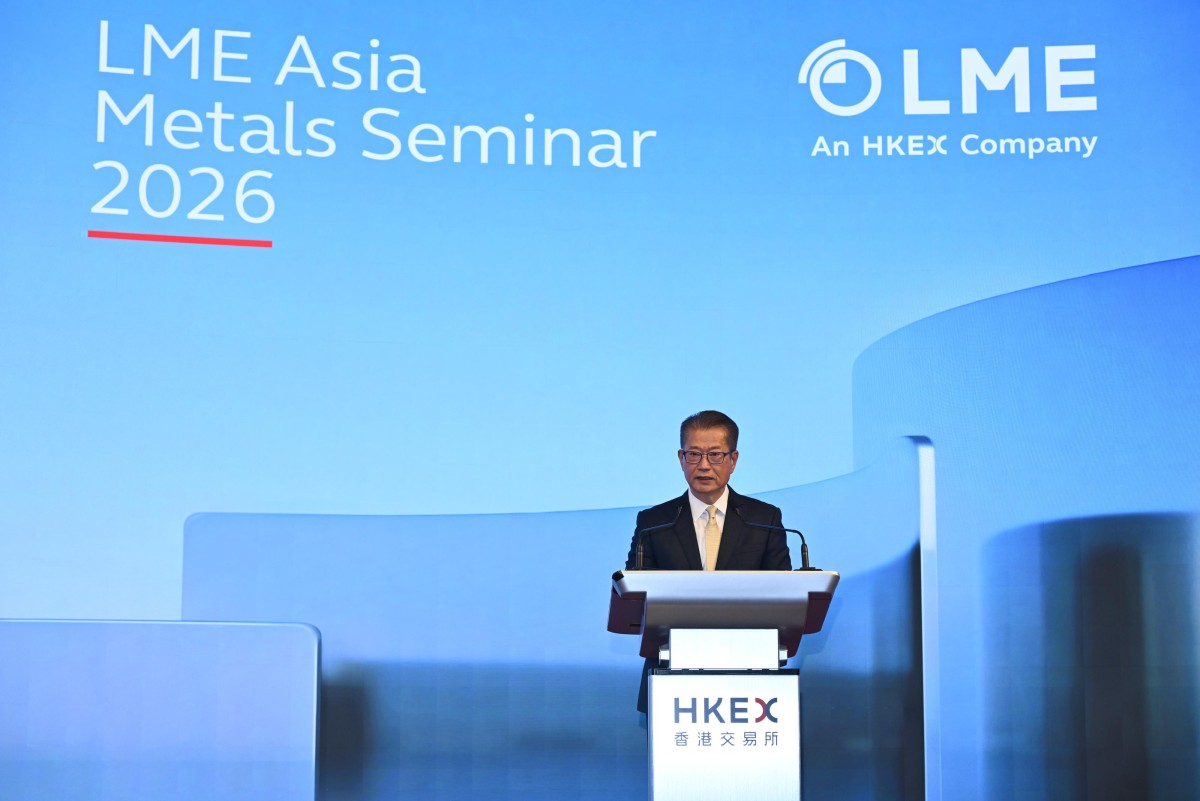
The government and the International Organization for Mediation (IOMed) are considering the feasibility of a panel of mediators for commodities market disputes, said Financial Secretary Paul Chan Mo-po on Thursday.
Speaking at the London Metal Exchange (LME) Asia Metals Seminar 2026, Chan said the plan aims to provide a neutral, expert-led mechanism to mediate the rising disputes across the commodities value chain, covering upstream mining and production, midstream trading and clearing, warehousing, and delivery.
Chan said the initiative complements Hong Kong’s goal to become a leading gold and commodities trading hub, facilitating cross-border transactions, mitigating risks, and strengthening market confidence among global participants.
He noted the positive outlook of Hong Kong’s metal business, as the city is committed to building a metals ecosystem to meet the needs of all commodity enterprises, including commodity financing, derivative products, marine and trade insurance, sustainability-related instruments, and more.
He added that it is encouraging to see more metal and mining companies establishing in Hong Kong, and he welcomes them to list on the Stock Exchange of Hong Kong to access international and mainland Chinese capital, as well as to manage their global operations and corporate treasury activities in the city.
Chan said a mining company operating Kazakhstan’s largest tungsten mine listed on the SEHK and the Astana International Exchange simultaneously last year, and he believes more companies will follow suit, thereby promoting the use of the yuan for commodity pricing.
Chan said there is room for yuan-denominated commodity products in Hong Kong for both Mainland and international participants, enhancing China’s influence in global commodity pricing.
He noted that Hong Kong will actively explore mutual market access with key global markets in the metals sector, which may include cross-listing or mutual listing of products, such as metals ETFs and other exchange-traded instruments. He also emphasized the potential of Hong Kong’s equity and fixed-income markets to explore similar connectivity arrangements in commodities.
Chan mentioned that LME-approved warehouses in Hong Kong rose to 15, and the network must keep expanding. He said Hong Kong is a free port, and as geopolitical tensions escalate and global supply chains restructure, Hong Kong’s role as a regional transshipment hub has become even more important.
𝗗𝗼𝘄𝗻𝗹𝗼𝗮𝗱 𝗧𝗵𝗲 𝗦𝘁𝗮𝗻𝗱𝗮𝗿𝗱 𝗔𝗽𝗽 ↓
