
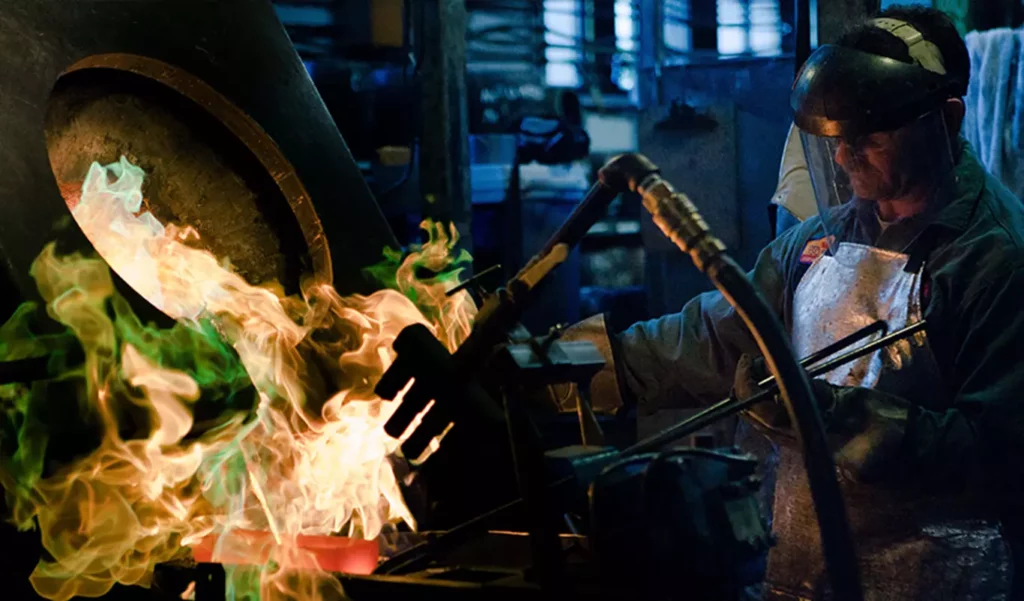
Work inside a gold refinery. Credit: Royal Canadian Mint.
The Royal Canadian Mint says it will change disclosure policies following a New York Times investigation that showed some of the gold refined by the Crown corporation may have originated from mines controlled by a Colombian drug cartel.
Canada’s maker of circulation coins will start disclosing country-of-origin data by material type and provide a note for mixed materials to help identify if they come from a blended stream, Mint spokesperson Alexandre Reeves said Thursday. The goal is to have this information on the Mint’s website in the coming weeks once 2025 audited data is available, he said.
An unidentified Texas supplier mixed Colombian gold with US gold before delivering it to the Mint, the Times reported Monday. The Texas company possesses a valid audit that identifies Colombia as a gold source – and specifically the Antioquia region, where the Clan del Golfo cartel has ties to the gold trade, the Times said.
About 5% of the raw gold refined by the Mint last year came from the US company, the newspaper added, citing General Counsel Andrea Kniewasser.
“As soon as the Mint learned of the allegations raised by the New York Times, it immediately and fully suspended the refining of any material from the supply chain in question,” Reeves told The Northern Miner via e-mail. “As a Good Delivery refiner, the Mint abides by strict industry guidance governing the responsible sourcing of precious metals. We will continue to push the London Bullion Market Association. for clearer expectations and improved transparency.”
North American gold
Most of the Mint’s mined gold is from North America, Reeves stressed.
The Mint “remains firmly committed to responsible sourcing as a process of continuous improvement,” he added. “It continuously reviews its book of business and reassesses customers for any issues. If an issue is found, the Mint takes immediate action, as was done in this instance.”
Kniewasser told the Times that the Mint relies on the due diligence carried out by its Texas supplier and didn’t ask for more detailed information because “it’s not our responsibility.”
The Mint had no idea that it was refining cartel-linked gold until it was notified by the Times, Kniewasser told the newspaper. The metal was subsequently classified as “North American” by the Mint.
The Times’ findings cast a shadow on longstanding assurances by the Mint that it applies strict sourcing standards for the gold it refines. It says it’s the first Canadian refiner to use a software – called Bullion Genesis – that “offers the possibility to perform end-to-end tracing and certify the provenance and integrity” of gold deposited and processed through the organization’s refinery.
The Mint adheres to a responsible metals program and an anti-money laundering, anti-terrorist financing and “know-your-customer” (KYC) program that are consistent with the requirements of the London Bullion Market Association.
Each Mint supplier is required to undergo a KYC due diligence process and is subject to a risk assessment, according to documentation posted on the refiner’s website. This assessment covers risk indicators related to elements such as geography, nature of business, delivery channels, ownership and organizational structure.
Once chosen, suppliers of the Mint must have their file re-examined at specific intervals. All low-risk suppliers are reassessed every four years, compared with every two years for moderate-risk suppliers and annually for high-risk suppliers.
As of early 2025, four of the Mint’s suppliers were deemed to be high-risk, including three that had mixed materials, according to the organization’s 2024 compliance report. The fourth supplier was classified as high-risk “due to regulatory findings relating to anti money-laundering controls,” the Mint said without providing specifics.
On its website, the Mint says it’s “committed to advancing responsible business practices and promoting the responsible sourcing of precious metals” used in its processes and products. All its customers and suppliers of precious metals are required to participate in the organization’s “Responsible Metals Program.”
The Mint “opposes all activities that deny basic human rights and is opposed to all activities which finance or contribute to abuses of human rights,” according to a message posted on its website. “This includes the mining and trading of conflict minerals within the gold and/or silver sector.”