
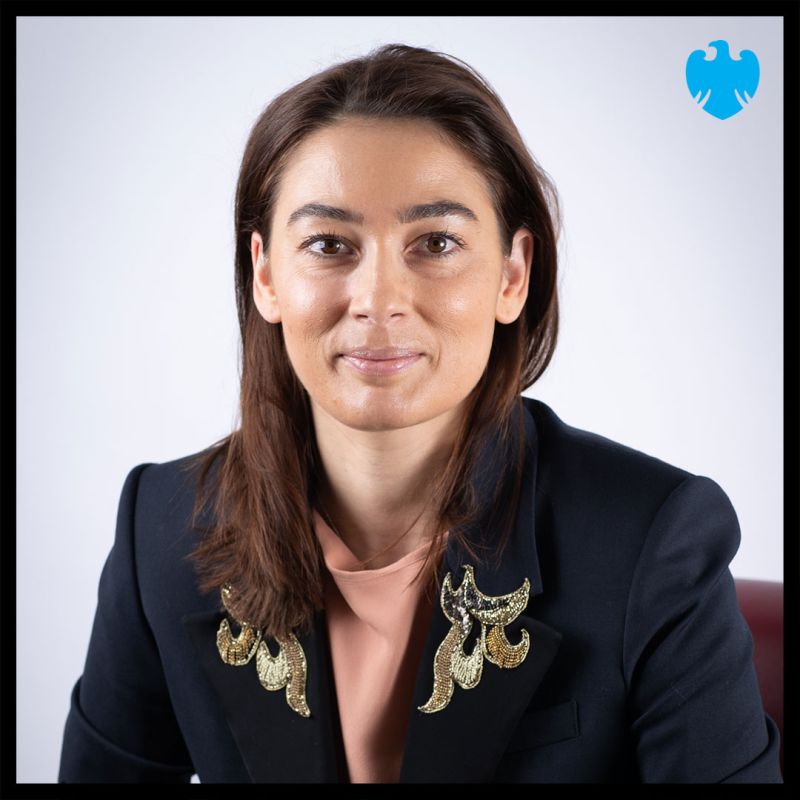
With geopolitical tensions riding high, Valerie Genin, head of investments Monaco at Barclays Private Bank, shares her insights with this news service on mid-year outlook trends in Monaco among her clients.
Last week, this news service sat down with Valerie Genin
(pictured), head of investments Monaco at Barclays Private
Bank to draw on her insights on the investment
landscape for this year. She said she is constructive on US and
emerging market equities, driven by tech, and cautious on
European ones. She is also constructive on fixed income and
private markets.
Despite the Middle East conflict, which caused oil price to surge
making some emerging markets and oil importers vulnerable, Genin
told this news service that most of their clients have
not changed their portfolios. However, she noted that people have
been a bit more cautious on Asia and Europe, due to the conflict
and the oil impact.
The US and Iran have agreed to pause their attacks and allow
vessels to move through the Strait of Hormuz which is essential
for global oil markets. An
interim peace deal was also signed on 17 June, and indirect
talks between the two sides briefly resumed in Doha, Qatar
last week. On the back of this, oil prices dropped to
levels seen before the start of the conflict, with hopes climbing
for a breakthrough in the negotiations aimed at securing a
permanent peace deal. Brent crude fell more than 1 per cent on
Thursday to below $71 a barrel, returning the international
benchmark to pre-war prices.
Lisa Wang from California-based Franklin Templeton Investment
Solutions is also overweight in emerging markets, despite the
conflict, as well as US equities, driven by tech. A
number of managers have noted that many Asian countries still
have stocks to keep them supplied for a few months, making their
energy supplies fairly resilient.
“The impact on the US is limited compared to Asia and Europe, due
to oil,” Genin continued. In line with a number of wealth
managers, such as
Edmund Shing at BNP
Paribas Wealth Management, she believes that the
conflict has put more emphasis on accelerating the energy
transition towards renewable energy. Canadian Prime Minister
Mark Carney also announced plans last week for a new oil pipeline
from Alberta to the Pacific coast designed to boost oil
supplies to Asia by 2032-34.
On sectors, Genin is constructive on tech and artificial
intelligence in the US and emerging market equities, as well
as on the infrastructure linked to AI. Nevertheless, she
emphasised the importance of keeping portfolios diversified,
seeing opportunities in sectors such as healthcare. As
geopolitical tensions continue, the investment case for
defence-related activity is also gaining traction;
consequently, Genin sees investment opportunities in defence
in Europe.
Since Russia”s invasion of Ukraine in February 2022, the profile
of defence-related
investment has risen. Last year, Germany and the EU
agreed to hike defence spending, after decades of
underinvestment. A number of investment managers, such as BNP
Paribas Asset Management and WisdomTree, also recently
launched defence-focused
funds to capitalise on the new investment
landscape.
On fixed income, Genin focuses on developed markets, opting for
investment grade credit over high yield. She is
constructive on emerging market debt, but selectively. “Most
clients also look at UK gilt markets, as yields are attractive,”
she added.
Genin also highlighted the importance of private
markets acting as a diversifier in portfolios,
seeing good opportunities in tech. “Most clients have an
allocation to alternative markets, representing up to 40 per cent
in some portfolios,” she said. Similar to a number of wealth
managers, California-headquartered investment manager Franklin
Templeton also sees attractive opportunities globally within
private markets in 2026.
AI is also expected to play an important role in wealth
management; Genin said that the bank has started to use
AI in their offices. Along with other wealth managers, she sees
AI as complementing the manager’s role, making processes more
efficient rather than replacing the human touch. The benefits of
AI range from automating repetitive tasks, providing data-driven
advice in specific areas such as portfolio optimisation, risk
management and tax analysis.