
Nova Minerals Corp (ASX:NVA, NYSE-A:NVA) high-grade gold concentrate of up to 26.7 g/t from flotation test work on low-grade ore from the Korbel deposit at its Estelle Gold and Critical Minerals Project in Alaska.
During the program, the company highlighted gold recoveries consistently above 95% at Korbel.
Bench-scale rougher flotation results were generated as part of a broader pre-feasibility study (PFS) metallurgical program and showed that low-grade Korbel ore could respond strongly to flotation at coarser-than-conventional grind sizes.
Consequently, the outcome has the potential to materially reduce both capital and operating costs while maintaining strong gold recovery.
High recoveries from low-grade ore
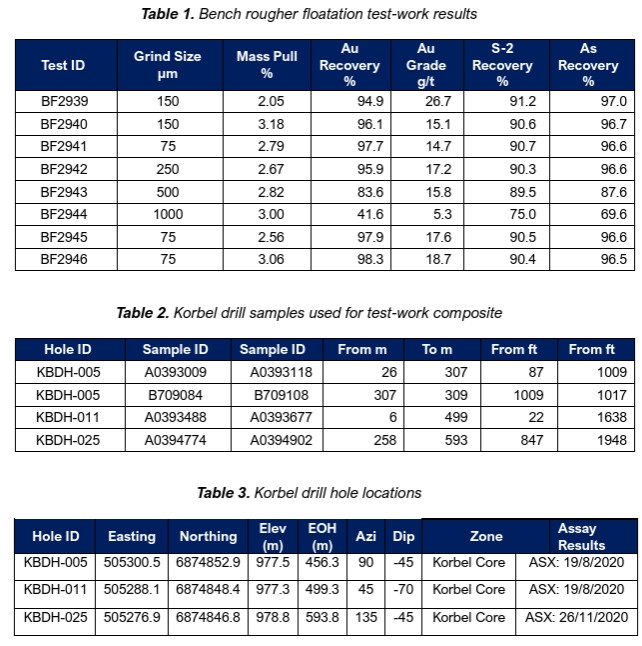
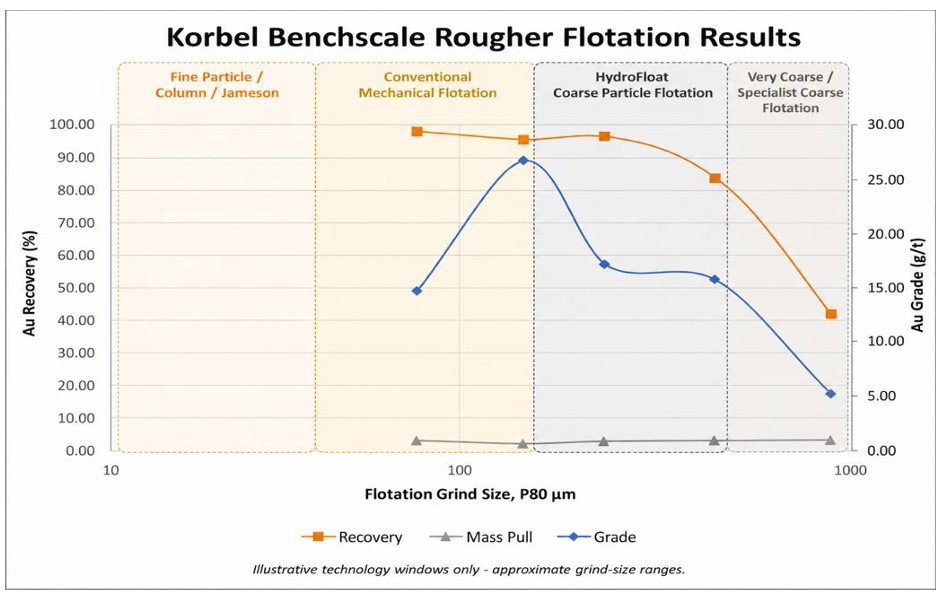
Testing on low-grade Korbel ore grading 0.39–0.42 g/t gold delivered a strong flotation response at 250 microns or finer, producing a low mass pull of just 2–3%.
This represented a 97–98% reduction in the volume of material moving to downstream processing, while producing concentrate grading between 14.7 g/t and 26.7 g/t gold.
The highest-grade result came from test BF2939, which produced concentrate grading 26.7 g/t gold at 94.9% gold recovery and a 2.05% mass pull.
Other tests at 75, 150 and 250 microns returned gold recoveries between 95.9% and 98.3%, with concentrate grades ranging from 14.7 g/t to 18.7 g/t gold.
The results support the potential application of coarse particle flotation to Korbel’s large, bulk-tonnage resource, with the aim of upgrading low-grade ore early in the process and reducing the amount of material requiring more intensive downstream treatment.
Potential PFS upside
Nova’s flotation results could improve the PFS for Estelle by reducing processing intensity, lowering energy use, improving gold recovery and simplifying the project flowsheet.
In particular, the company’s process has the potential to remove the need for ore sorting and heap leach components, while allowing for a significantly smaller carbon-in-leach (CIL) plant.
The potential impact is significant given the scale of the Korbel resource. Nova’s JORC-compliant global mineral resource estimate for Korbel stands at 1,040 million tonnes at 0.3 g/t gold for 8.65 million ounces, while the broader Estelle resource totals 1,102 million tonnes at 0.3 g/t gold for 9.89 million ounces.
“Major breakthrough”
Nova Minerals CEO Christopher Gerteisen said the results represented a “major breakthrough” in the company’s metallurgical test program.
“As part of our ongoing Pre-Feasibility Study optimization work, these results represent a major breakthrough in our metallurgical test program. The demonstration that Korbel ore is highly amenable to coarse particle flotation, producing a very high-grade concentrate representing only 2-3% of the total mass while achieving gold recoveries in excess of 90%, has the potential to be a game changer for the project.
“The successful application of coarse particle HydroFloat technology to our process flowsheet has the potential to deliver substantial reductions in processing and capital costs, while simplifying downstream operations. These improvements could significantly enhance the project’s overall economics and increase our ability to profitably recover gold from lower-grade material across the bulk-tonnage Korbel deposit.
“Metallurgical test work is continuing to evaluate even coarser particle sizes, which could further improve the project’s processing cost profile and strengthen our strategy of maximising gold production and resource conversion over the life of the mine.”
What’s ahead
Further Korbel CIL test work and coarse particle flotation studies are underway to refine the flowsheet, confirm gold recovery and gangue rejection, and optimise plant design, scale, configuration and project economics.
Nova’s 2026 drill program is underway, with assay results from all holes still pending.
About Nova Minerals
Nova Minerals is advancing the Estelle Gold and Critical Minerals Project in Alaska, which it describes as one of the world’s largest undeveloped gold deposits.
Estelle hosts two defined multi-million-ounce gold resources and more than 20 prospects along a 35-kilometre mineralised trend in the Tintina Gold Belt.
The company is also pursuing a US domestic antimony supply strategy, supported by a US$43.4 million US Department of War award, with targeted production in late 2026/2027.