

Corporate loan growth is expected at around 10%, supported by healthy demand in renewables, stronger activity in the second half of the year and a likely boost from ECLGS. Despite a slower start, the bank ended FY26 with 11.2% growth in its corporate book
Debadatta Chand, Managing Director and CEO of Bank of Baroda, said deposit growth has remained encouraging and liquidity in the banking system is gradually improving.
The bank’s net interest income grew 9.7% in the March quarter, helping margins improve sequentially. However, Chand said deposit costs are now likely to stay sticky given the geopolitical environment and the bank is no longer guiding for further reductions.
Any meaningful movement in loan yields or deposit costs, he added, will depend on how liquidity conditions evolve from here.
Chand noted that Bank of Baroda’s gold loan base remains smaller compared to peers, making growth appear sharper in percentage terms.
Overall asset quality continues to remain strong and the bank remains positive on the gold loan segment.
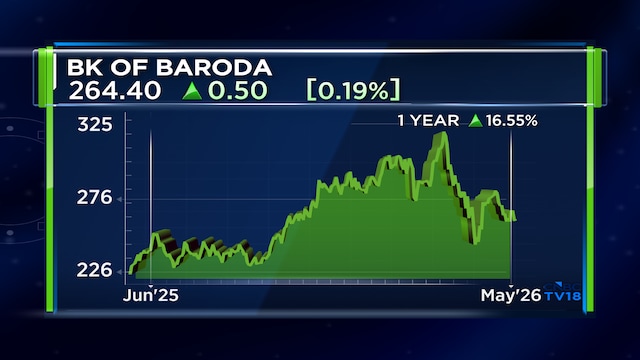
The stock was trading at ₹269.25 at 9:26 am on the NSE and has gained more than 18% over the past year.
In the January–March quarter (Q4FY26), Bank of Baroda reported net interest income of ₹12,494 crore, net profit of ₹5,616 crore, and net interest margins of 2.89%.
These are edited excerpts from the interview.Q: The bank raised the loan growth guidance to 12 to 14%, an increase of 100 basis points. What is driving that? And if you could particularly talk about gold loans, because that is doing very well. Even the corporate growth, after going through a flat patch, has bounced back smartly, with 10% plus growth. The overall numbers, the confidence that you can achieve this, and these segments?
A: We had one of the strongest quarterly growths in the last 10 quarters, as far as advance growth is concerned. As against the guidance of 11% to 13%, advance growth was 16.2%. The good part of why we assumed higher advance growth guidance for FY27 is that deposit growth has been very encouraging. As far as we are concerned, deposits are coming back to the banking system. That is something very positive.
Secondly, we have outperformed our guidance significantly over the last year. Thirdly, the basic assumption regarding the geopolitical issue is that we are slightly optimistic about the timelines. Considering all these three factors, we revised upward the loan guidance by 1%. As against 11 to 13%, we made it 12% to 14%.
Specifically talking about the corporate book, we have always said that quarter three and quarter four are productive for us, because that is the busy season for the economy. Initially, quarter one and quarter two growth was slightly lower, but ultimately we ended up at 11.2%. In the same way, if you look at the overall economic scenario in terms of demand and the areas where we operate, particularly the renewable sector, it has done extremely well.
Similarly, ECLGS is going to give a boost this year as well. We are going with the same guidance of around 10% for the corporate loan book.
As for gold loans, our base is low compared to other banks, so in percentage terms it looks higher. However, the overall asset quality looks very good as of today. We continue to remain positive on gold loans.
Q: You have reduced the dependence, on bulk deposits. If I look at the recent quarter, could you tell us what kind of CASA ratio you are looking at in the coming quarters? Also, your CD ratio is holding around 85% odd. Is that headed higher as well? If you could just give us some brief details.
A: CASA has been one of the strong points for us, and we have been focusing on CASA for many quarters. If you look at the growth in CASA, it is 9.8%, and savings growth stands at 9.1%. We have been ahead of the median among banks and have been able to outperform for many quarters.
We have strengthened CASA in terms of product, process, service, everything, and that is possibly reflected in the higher growth.
The CASA percentage as of March 31, was 38.9%, which I believe is among the top quartile for banks. Going forward, we aim to maintain similar levels. We do not give CASA guidance, but the bank’s effort has always been to maintain CASA.
If you look year-on-year, the decline in CASA percentage was only about 107 basis points, which is again one of the lowest seen in the market. Our focus on CASA, both in terms of product, improving processes, bundling products, and getting into bulk tie-ups, will continue. In the same way, we should be able to maintain CASA at around 39% going forward.
As far as the credit-deposit ratio is concerned, globally, we are at 85%, but domestically, we are almost at 83%. Earlier also, we said that we are comfortable operating in the range of 81 to 83% as far as the domestic CD ratio is concerned.
The reason being, we have strong alternative resources to manage liquidity. We are one of the banks that raised green infrastructure bonds some time back and received a good response. We have also raised infrastructure bonds and received refinance from other institutions.
In that way, the resources are quite strong as far as the bank is concerned. We will be comfortable operating the domestic CD ratio roughly between 81% and 83%.
Q: While you have guided for cost of funds to have bottomed out at 4.78%, generally your loan yields have been trending lower over the last couple of quarters. When do you expect the loan yield to go up? Because that can push your NIMs higher.
A: If you look at it, the good part that happened in this quarter is that the growth in interest income has been higher than interest expenses. That is something positive, and that is why the NII has gone up by 9.7%. NIMs have improved compared to the previous quarter.
Going with the current geopolitical situation and its impact on consumers and the market, it looks like the cost on the liability side is going to be sticky. Last time, we gave guidance of reduction, but we are no longer giving that guidance because costs are likely to remain sticky.
The moment costs remain sticky, there may be a realignment of rates happening both on advances and deposits, subject to liquidity conditions. If liquidity improves significantly, we may again see a reduction in both yields and costs.
However, the situation is slightly different because of geopolitical issues, and we need to factor that in. As of today, deposit costs appear sticky, and we are not looking at any further reduction there.
Q: And the loan yield, it was 8% in quarter four FY26. Does it stay here?
A: There are two aspects here. One aspect is the repo-linked rate. As long as the repo remains the same, the benchmark rate cannot increase, though the spread can undergo a change depending upon regulatory guidelines and the timing of spread realignment.
Marginal cost of funds-based lending rate (MCLR) rates have remained sticky in terms of reduction. The only segment where I see a bit of an upward trend is the corporate book, which is not linked with MCLR. Around 20–21% of the corporate book is non-MCLR linked and typically linked to T-bills, G-Secs, or similar rates.
That is the segment where I see scope for an upward movement, in case liquidity continues to remain tight and the rate matrix also remains tight in that manner.
Q: Let’s focus on asset quality. Slippages went up slightly, though overall asset quality has remained stable, or even improved. Could you give us guidance on this parameter? How do you see asset quality shaping up, and what is your outlook on the slippage ratio?
A: If you look at asset quality, it has been among the best in many years. Gross NPA stood at 1.89%, while net NPA came in at 0.45%, aided by a floating provision of ₹1,500 crore. Credit cost, excluding floating provisions, stood at 0.32%, while the slippage ratio was at 0.76%. These numbers remain within our stated guidance.
Going forward, we aim to maintain asset quality at current levels, as it has been one of the bank’s key strengths for several years. However, geopolitical developments remain an external factor that we need to account for, especially given our sizeable international book.
As a result, we are not revising our guidance on slippages or credit cost. We continue to guide for slippages in the range of 1% to 1.25%, although we have consistently remained below that level in recent quarters. Similarly, credit cost is expected to remain below 0.6%, compared with the full-year level of 0.46%. This gives us sufficient headroom in case geopolitical events impact the market significantly. Otherwise, we expect the bank’s improvement in asset quality to continue.
Bank of Baroda’s current market capitalisation is ₹1,36,730.82 crore.
For the entire discussion, watch the accompanying video
