
Verdict

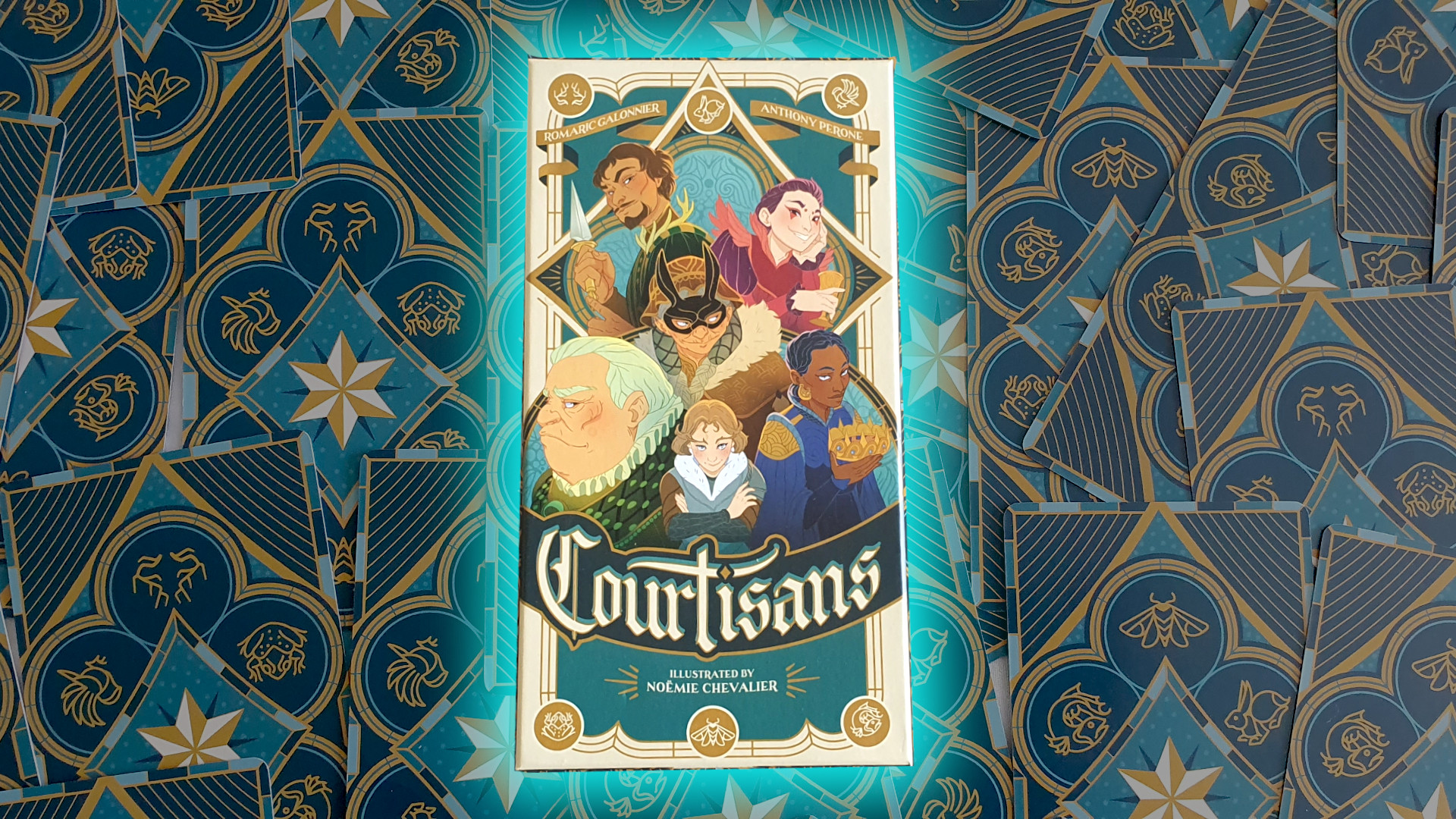
Courtisans condenses courtly intrigue into a quick-playing card game. The balance between strategy and simplicity here is excellent, with simple rules leading to satisfying decisions every turn. And it looks gorgeous too.
Cons:
- Satisfying strategy
- Accessible rules
- Utterly beautiful
- Brilliantly executed, just not groundbreaking.
- Cards could be a little more water repellent.
Courtisans is a slick, quick-playing card game for two to five players that tasks you with manipulating the social landscape of the Queen’s court, stuffing your domain with prized courtiers and dragging your rivals’ names into the mud. Being a conniving, grasping, backstabbing sycophant has never been so much fun.
Courtisans was first released in 2024, and got plenty of plaudits. I’m just now getting to it thanks to a review sample provided by Hachette UK. I’m late to the party – and it turns out that all the hype was warranted. This is a great party – I’ve already added it to our guide to the best card games, and I’m going to run it past our board game tzar to see if it warrants inclusion on our guide to the best board games.
Despite the theme of political wrangling and social scheming, this Courtisans is more like a stock-collecting game – though to stay on-theme, lets say that we’re after social capital rather than the cash kind. On each turn of the game you’ll decide where to place three (gorgeous) courtier cards: one goes to your personal domain, another to one of your opponents’ domains, and the third goes to sit at the Queen’s table, either above it in the ‘Esteemed’ position, or below it, indicating that they’re ‘fallen from grace’.

Courtiers each belong to one of six houses, and at the end of the game each courtier in your personal domain will contribute to your score – but not always positively. If a courtier’s family is Esteemed (because it has more members above the Queen’s table than below it), they’re worth positive points. If their family has Fallen from Grace, they’re worth negative points, and you will curse the name of their house.
This means that your investment into each family can be either a boon or a curse depending on the whims of the monarch at the end of the game, and the bigger the investment, the bigger the swing. The battle over the Queen’s affections is vital – but there are complicating factors that are going to shape your strategy.
As well as getting points the regular way, each player has a pair of secret objectives that grant a healthy three victory points each at game end. These come from two decks with different themes. In one you’re trying to tailor your personal domain, typically by ensuring you have fewer courtiers from a certain family than your neighbor does. The other is more antisocial and targets the Queen’s table, usually asking you to ensure a certain family has Fallen from Grace at the end of the game.

The theme here is great; you aren’t just out to win, you’re out to cause petty drama, trash talk the House of the Stag, and one-up your neighbors. These objectives inject irrationality and asymmetry to how the players act, destabilising any predictions of what someone ought to do.
Then there are the four special courtiers. Nobles count as two cards, doubling their impact on the Queen’s table or in your final score. Spies are placed face down until the end of the game, letting you hide your own intentions or conceal an important swing in the balance of the Queen’s favor. Assassins can kill another courtier wherever they’re placed, unpicking any tricky situations you may find yourself in; and Guards are immune to being killed, making them a cast-iron commitment to a given family.

These extra powers add vital uncertainty to the game. While regular courtiers gradually push a family up or down the Queen’s rankings, the Noble can instantly swing her opinion – and so can the Assassin, by killing a Noble. Most important of all, spies make it truly impossible know the game state. Choosing where to put a courtier always feels meaningful, but it’s rare you’ll never know if you’ve found the ‘correct’ solution. You’re always making a call based on your gut.
For how simple the rules are and how straightforward the play experience is, Courtisans feels incredibly rewarding. Games are fast and moreish. It’s in a sweet spot where players have enough agency and information to devise strategies without hearing the syren song of analysis paralysis. That it’s delivered in a tiny, gorgeous package is just the icing on a small but incredibly fancy cake. I’m calling this one a royal hit.
To get all the latest news, reviews, and features from Wargamer, sign up to our weekly newsletter!