
As persistently high inflation continues to squeeze household budgets, a growing number of people in Bangladesh are relying on credit cards to cover everyday expenses.
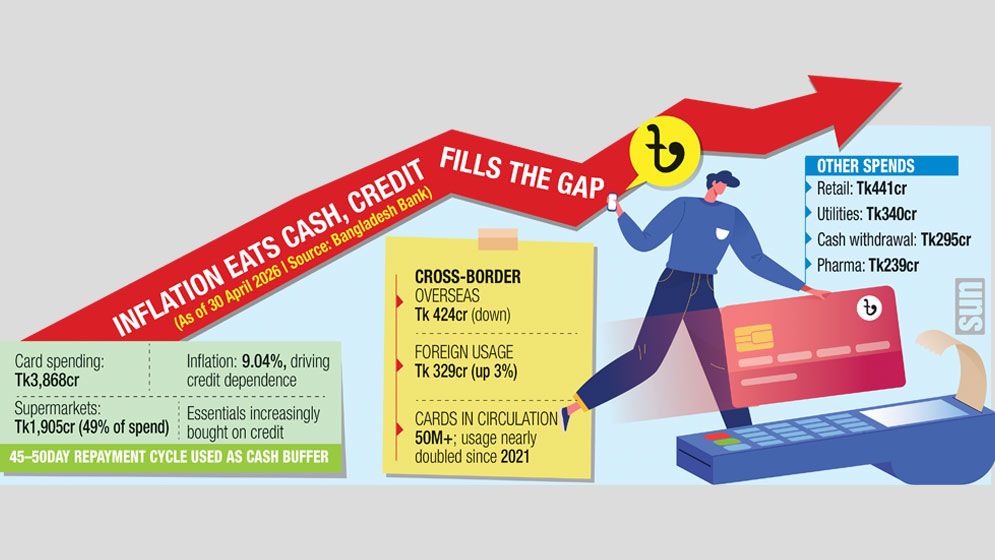
Spending at supermarkets and department stores accounted for nearly half of all domestic credit card transactions in April, according to Bangladesh Bank data.
The data showed domestic credit card spending reached Tk3,868.3 crore in April. Of that amount, Tk1,904.9 crore, or 49.24%, was spent at supermarkets and department stores.
The trend highlights an increasing dependence on short-term credit to meet essential household needs amid rising living costs.
For many consumers, credit cards have become a financial cushion against inflation.
Ajmal Hossain, a private-sector employee in Dhaka earning Tk60,000 a month, said he regularly uses his credit card to buy groceries and other household essentials, particularly toward the end of the month.
“The grace period allows me to settle the bill after receiving my next salary,” he said.
Economists say prolonged inflation has forced many middle- and upper-middle-income households to defer part of their monthly expenses by using credit cards to bridge cash-flow gaps and maintain living standards.
The trend coincides with rising inflation. According to the Bangladesh Bureau of Statistics (BBS), inflation increased to 9.04% in April from 8.71% in March and has remained above 9% in five of the past six months.
The latest card usage report shows consumers increasingly using credit cards for groceries, utility bills, medicines and other day-to-day expenses, reflecting mounting financial pressure on households.
Officials at City Bank’s card division said customers generally receive up to 45 days to repay credit card bills, while some banks offer repayment periods of up to 50 days.
Cardholders can also make minimum payments and carry forward outstanding balances to the next billing cycle.
In addition, eligible customers may obtain loans against their available credit limits at interest rates starting from 9.9%.
After supermarkets and department stores, the largest domestic spending category was retail outlet services at Tk441.4 crore.
Utility bill payments accounted for Tk339.9 crore, followed by cash withdrawals at Tk294.6 crore, drug and pharmacy purchases at Tk239 crore, and government services at Tk184.1 crore.
The figures suggest that credit cards are no longer used primarily for discretionary spending but are increasingly financing essential household consumption.
Overseas spending declines
Bangladeshi credit card holders spent Tk424.4 crore abroad in April, nearly Tk46 crore less than in March.
The United States remained the top destination for overseas card spending, accounting for Tk67 crore, followed by Thailand (Tk52.3 crore), the United Kingdom (Tk36.6 crore), Singapore (Tk35.2 crore) and India (Tk31 crore).
Compared with March, spending declined sharply in several countries, including Saudi Arabia, Malaysia, Singapore and India. In Saudi Arabia alone, spending fell from Tk49.1 crore to Tk16.7 crore.
By category, overseas spending was highest at department stores, where Bangladeshis spent Tk127.9 crore.
Retail outlet services accounted for Tk74.4 crore, transportation Tk49.1 crore, pharmacies Tk48.8 crore and business services Tk32.7 crore.
Foreign card spending rises
In contrast, spending by foreign nationals in Bangladesh rose to Tk328.7 crore in April from Tk319 crore in March, an increase of Tk9.7 crore, or 3.02%.
Department stores accounted for the largest share of foreign card spending at Tk159.6 crore, representing nearly half of total expenditure.
Cash withdrawals stood at Tk67.4 crore, followed by retail outlet services at Tk33.9 crore and professional services at Tk19.9 crore.
Card usage doubles in five years
Bangladesh’s card-based payment ecosystem has expanded rapidly over the past five years.
According to Bangladesh Bank data, the combined number of debit, credit and prepaid cards increased by 98% between May 2021 and April 2026, while the volume of card-based transactions surged by 104% during the same period.
More than five crore payment cards are now in circulation nationwide. As of April 2026, the approved credit card limit of banks and financial institutions stood at Tk41,295 crore, while outstanding balances totalled Tk14,045 crore, underscoring the growing role of consumer credit in supporting household spending.