

Looking ahead, this Tamil Nadu-based private sector bank expects margins to stay above 4% in the near term and may revisit its full-year net interest margin guidance after the September quarter if current trends continue.
It also plans to gradually reduce its reliance on gold loans by expanding segments such as affordable housing and other retail products, while maintaining gold loans at around 32% of the overall portfolio.
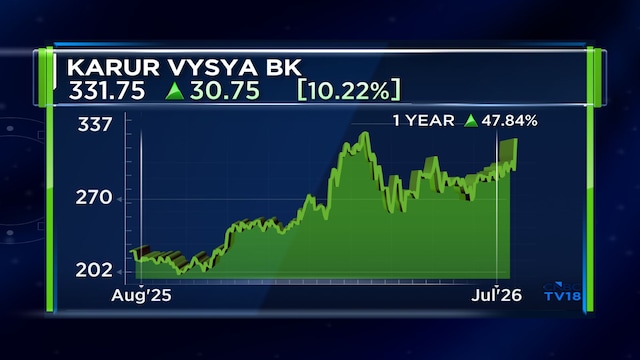
The stock was trading at ₹333.25 at 12:03 pm on the NSE and has gained more than 48% over the past year.
In the April–June quarter (Q1FY27), Karur Vysya Bank reported net interest income of ₹1,423 crore, net profit of ₹756 crore, and a net interest margin of 4.26%.
This is an edited transcript of the interview.Q: If I look at your asset quality numbers, the guidance is quite strong — gross NPAs and net NPAs are expected to remain under 1%, while credit costs are guided at below 1% for the year. I just wanted some clarity on the SMA-30 numbers. There has been a sequential increase, although they remain lower year-on-year. What is driving that increase? This is also the first quarter where the impact of developments in West Asia could start reflecting in the numbers. Is that why this bucket has seen some stress, or how would you explain it?
A: First of all, this has been another excellent quarter for us. The profit we reported is the highest in the bank’s history. We started this journey 22 quarters ago with a profit of ₹104 crore, and have now reached ₹756 crore. Our business growth was also strong, with 6% quarter-on-quarter growth, the highest for any comparable quarter in the last decade. So, this has been one of the most significant quarters for the bank.
Coming to asset quality, you would have noticed that our SMA-30+ ratio has remained below 0.5% for the past few years. This quarter, it moved only from 0.17% to 0.22% because of a few accounts. We regularly interact with customers, particularly those in the textile sector, which accounts for about 5% of our portfolio. We are hearing that orders from the US have slowed, and West Asia has had some impact.
However, businesses are managing well, working capital utilisation has not increased, and we have not observed any meaningful stress. The increase from 0.17% to 0.22% is not related to the West Asia situation. We remain reasonably confident that there has been no impact on our portfolio so far.
Q: While many of your larger and mid-sized peers have struggled with margins, your net interest margin has remained strong at 4.26%, both year-on-year and sequentially. Do you expect margins to sustain at these levels, or do you see some moderation over the coming quarters?
A: This is the outcome of a strategy we adopted about three years ago. Earlier, around 45% of our loan book was corporate lending, where yields were relatively low despite healthy growth. We consciously decided to diversify and granularise the portfolio. Today, our RAM portfolio accounts for 86%, while corporate loans make up 14%.
That does not mean corporate lending will remain at 14%. We expect it to fluctuate between 15% and 20%, with RAM accounting for about 80% of the portfolio. This strategy has supported us. Alongside the shift towards RAM, we strengthened our monitoring, onboarding, guardrails and collections. As a result, we have maintained healthy SMA levels, and our earnings have not been eroded by higher provisioning.
Going forward, we believe our asset quality will remain strong. However, competition in pricing remains intense, and we may have to compromise slightly on margins to retain customers. That is why we have guided for a full-year net interest margin of 3.8% to 3.9%. Based on the current trend, we expect margins to remain around 4% next quarter. We will review the full-year guidance after the September quarter.
Q: So, your full-year guidance remains 3.8% to 3.9%, while you expect next quarter’s margin to stay above 4%. After that, you could revise the guidance?
A: We expect the next quarter’s margin to remain around 4%. For the full year, our guidance continues to be 3.8% to 3.9%. If conditions remain favourable after the second quarter, we may revisit that guidance based on where we expect to end the financial year.
Q: Your cost of funds has declined year-on-year but increased marginally on a sequential basis. With expectations that interest rates could move higher, where do you see the cost of funds heading during the rest of the year, particularly in the first half?
A: During the first quarter, we strategically front-loaded business growth, which required additional deposits. As a result, we increased term deposit rates by 40 basis points, and that led to a four-basis-point increase in our cost of funds.
However, I believe deposit rates may not rise significantly in the coming quarters. The RBI has introduced a few measures, including FCNR(B) and Overseas Foreign Currency Borrowings (OFCBs), which should ease some of the pressure on deposits. Compared with what we experienced over the last two years, we do not expect a sharp increase in deposit rates. We should be able to maintain costs broadly at current levels.
Q: For the full year, where do you see incremental credit demand coming from? Growth has remained strong, particularly in your gold loan portfolio, which accounts for around 30% of your loan book and has grown by nearly 27% year-on-year and about 6% sequentially. With gold prices softening and competition intensifying as new players enter the segment, what trends are you seeing? What kind of growth do you expect from this segment and overall this year?
A: We are very mindful of the risks associated with gold loans. Four years ago, we decided that the gold loan portfolio would not exceed 30% to 35% of our overall loan book. Over the last three years, it has remained around 30%, and we do not expect it to go beyond 32%.
Internally, we have strengthened our margin call mechanism and created dedicated teams. Whenever gold prices decline, these teams actively engage with borrowers. As a result, the average loan-to-value (LTV) in agricultural gold loans is around 67%, while for non-agriculture gold loans it is below 60%. Even if gold prices fall by another 10%, we believe the portfolio will remain comfortable.
As for growth, the first quarter reflected broad-based growth across all business segments, including corporate lending, which grew by 6%. If this trend continues, our dependence on gold loans will gradually decline. We have also expanded into affordable housing and other retail lending segments, which will support future growth. Over time, our reliance on gold loans is expected to reduce significantly while remaining within our internal cap of around 32% of the portfolio.
Karur Vysya Bank’s current market capitalisation is ₹31,993.99 crore.
Watch accompanying video
