

Roy also said the lender expects credit costs to continue declining, supported by AI-led underwriting and collections, while operating expenses could improve by 30-40 basis points over the next three to four years.
The company reported stable yields during the April-June 2026 quarter, although higher funding costs reduced net interest margins by 25 basis points. Roy said the impact was offset by higher fee income from personal loans, SME collections, insurance distribution and liquidity management.
L&T Finance’s personal loan business continued to expand rapidly, driven by partnerships with digital platforms including CRED, Google Pay, PhonePe and Amazon.
Roy said the lender has improved its digital loan journeys over the past 12 to 18 months, helping accelerate disbursements through these platforms. He also expects growth in the personal loan portfolio to remain strong over the next two quarters before moderating as the balance sheet expands.
These are edited excerpts from the interview.Q: If I were to ask you at the end of the first quarter, and as you look at the next three quarters, what are you targeting when it comes to loan growth and your NIMs? Because your net interest margin saw a bit of moderation. How do you view this going forward, and what about loan growth? If you could give us a sense, what would lead that growth?A: To take the first question on loan growth, as part of our Lakshya 2031 guidelines, we have guided for a 20% compounded annual growth rate (CAGR) in loan growth. However, one of the things which is very important is that if we find risk-calibrated sort of scope available in the market to grow our portfolios, we’ll probably grow at a much faster pace, which has been the case this quarter.
As we are sort of navigating through the sort of possible weak monsoon as well as the ups and downs of the West Asia crisis, it’s very premature to look forward and hazard a guess on what should be the ideal loan growth during this period.
However, I do believe that the 20% number is something that we are pretty confident of achieving.
Now, obviously, if things settle down, if we have that 90% of the long-period average monsoon predicted, and if the West Asia crisis settles down—it has been going up and down, right?—and if it settles in the next couple of weeks, then we are looking forward to a relatively strong festive season as well as a good fourth quarter thereafter.
So hopefully, loan growth should be upwards of 20%. However, as of now, we will stick to our guidance of 20% plus, in line with our Lakshya 2031 statement.
In terms of NIMs and fees, if you see, our headline yields have remained relatively stable, but primarily because the weighted average cost of borrowing has gone up by about three basis points, and we have a much larger balance sheet. That has given a 25-basis-point impact on our NIMs this quarter.
However, if you look correspondingly, our fees have also been higher because we maintained a slightly larger amount of liquidity this quarter, primarily because of the West Asia crisis. We wanted to have a little bit of liquid assets available. That has resulted in a higher level of liquidity income.
We have had good realisations from our personal loans and SME collections in terms of fees. Our insurance yields have gone up, so fees actually jumped this quarter. So overall, our NIMs and fees remain stable.
Q: So just on the personal loan portfolio – that’s growing at a very, very fast pace. Some 80% growth year on year, 15–20% on a quarter-on-quarter basis. What’s giving you the comfort to grow? I mean, it’s a conscious decision to grow at that rate? So just talk to us a little bit about that.A: Our personal loan distribution philosophy has been to tie up with what we call the large digital partners, the likes of CRED, Google Pay, PhonePe, Amazon, and sort of push forward our origination on that.
Now, these are the platforms where you find large pools of salaried customers, and these are the platforms where you are able to build joint scorecards and jointly agree to risk thresholds and cherry-pick the customers that meet your risk profile.
Because the opportunity for customers to see the loan offers on these platforms is probably far higher than on other platforms, once these platforms stabilise, they see near-vertical growth if your digital journeys are frictionless.
What we have done over the last 12 to 18 months is to fine-tune our digital journeys and work very closely with these digital partners. These are the digital partners which are driving our growth.
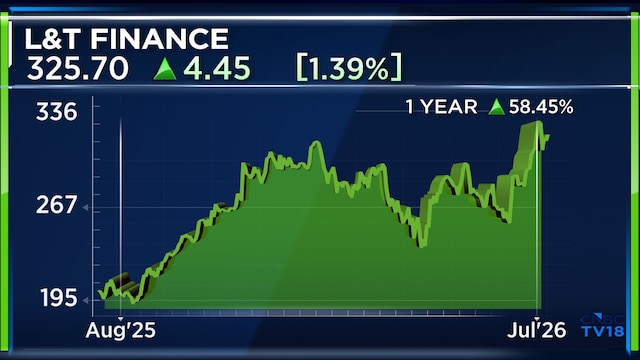
The company, which has a current market capitalisation of ₹81,534.18 crore, has seen its shares gain more than 58% over the last year.
Our cross-sell business, especially to our two-wheeler customers—and we are a pretty large originator of two-wheelers and have been originating a large amount of prime two-wheeler loans over the last 12 to 18 months as well—the cross-sell business of personal loans to two-wheeler customers has also increased.
So overall, between the increase in disbursements through the digital partners as well as the increase in cross-selling to our two-wheeler customers, our personal loans business has maintained strong growth.
However, the risk-calibrated outlook remains, and actually our credit performance on the personal loans business continues to improve with every passing quarter.
Q: And this is coming through two or three platforms, this growth?A: Primarily CRED, PhonePe, Google Pay, and Amazon. These are the large partners. However, there are a couple of other partners.
Q: And the rates of growth will continue to be turbocharged here, or will they moderate?A: I will say that probably as the balance sheet size grows a little larger, it will moderate towards the end of the year. However, for the next couple of quarters, the growth rates are going to remain strong.
For the full interview, watch the accompanying video

Catch all the latest updates from the stock market here