
Hey all, Jason here.
We’re closing in on the final days of summer. Utrecht is something of a university town, and students have already been back in force for a couple of weeks. The weather already feels distinctly fall-like, which, I suppose, is preferable to the heat waves earlier this summer.
Partner content: Fraud leaves breadcrumbs. But most detection misses them. Because fraud moves across accounts, channels, and organizations long before it hits your systems. It’s time for a new approach to detection.
In this report, produced in partnership with Plaid, Javelin explores the latest fraud trends and how earlier, connected data can help you get ahead of them.
Get the report to learn:
-
How new-account fraud, ATO, scams, and first-party fraud are evolving today
-
Why traditional, point-in-time fraud checks create gaps in your defenses
-
What fraud really costs you in terms of customer trust, operational strain, and your reputation

Second Federal Savings and Loan Association of Philadelphia Assumes All Deposits of Tioga-Franklin Savings Bank, Philadelphia (FDIC)
FDIC Launches Office of Supervisory Appeals (Consumer Finance Monitor)
California nonprofits sue to release CDFI Fund appropriations (ABA Banking Journal)
Illinois Enacts Disparate Impact Standard for Credit Decisions: What Lenders Need to Know (National Law Review)
Extra-Legal Bank Capital Regulation (University of Chicago Law Review Online)
Lawmakers counter World Liberty approval with anti-corruption bill (Banking Dive)
‘A rounding error’: why AML fines fail to change bank behaviour (The Banker)
We Went to Wall Street’s Exclusive Wilderness Camp. Everyone Was Spooked by AI. (Wall Street Journal)
An Ancient Sumerian Solution to Our $40 Trillion Deficit (New York Times)
Ring Ring, Kerching: Why Your Bank Wants to Be Your Mobile Provider (Fintech Under the Hood)
Five Reasons Stripe Might Have Bought OpenRouter (Fintech Takes)
Great Scott: Challenges Facing the Bond Trader in Chief (Net Interest)
The Coming Battle Between Personal AI Agents and Bank AI Agents (Ron Shevlin)
Personetics and Plaid Partner to Drive Account Primacy via AI-Powered Open Finance Intelligence (FF News)
Square and OpenTable Team on Restaurant Transaction Data (PYMNTS)
The deadline for banks to file their second quarter call reports was the end of July, meaning this newsletter is overdue in checking in on two institutions we’ve long been following: Varo and Evolve Bank & Trust.
Varo is widely credited with being the first fintech to win a de novo charter from the Office of the Comptroller of the Currency.
In sharp contrast to the current climate, winning a de novo charter was no easy feat for Varo. It has been widely reported that Varo spent “nearly $100 million” in its quest to obtain its bank charter.
The company initially applied in 2017 but didn’t secure all approvals necessary — OCC, FDIC for deposit insurance, and the Federal Reserve to form a bank holding company — until July 2020. Prior to obtaining its own charter, Varo operated via a partnership model, working with The Bancorp Bank.
But Varo’s story shows that obtaining a charter is far from a shortcut to a profitable or sustainable business model.
Since it filed its first call report for the period ending September 30, 2020, through the end of the second quarter of 2026, Varo Bank has posted a cumulative loss of over $875 million. Varo’s continued survival has depended on the willingness of its backers to continue to sink capital into the money-losing bank.
Despite a C-suite shake up, with founder and CEO Colin Walsh announcing his departure in February 2025, Varo’s performance doesn’t appear to have meaningfully improved since then, based on data points available in its call report.
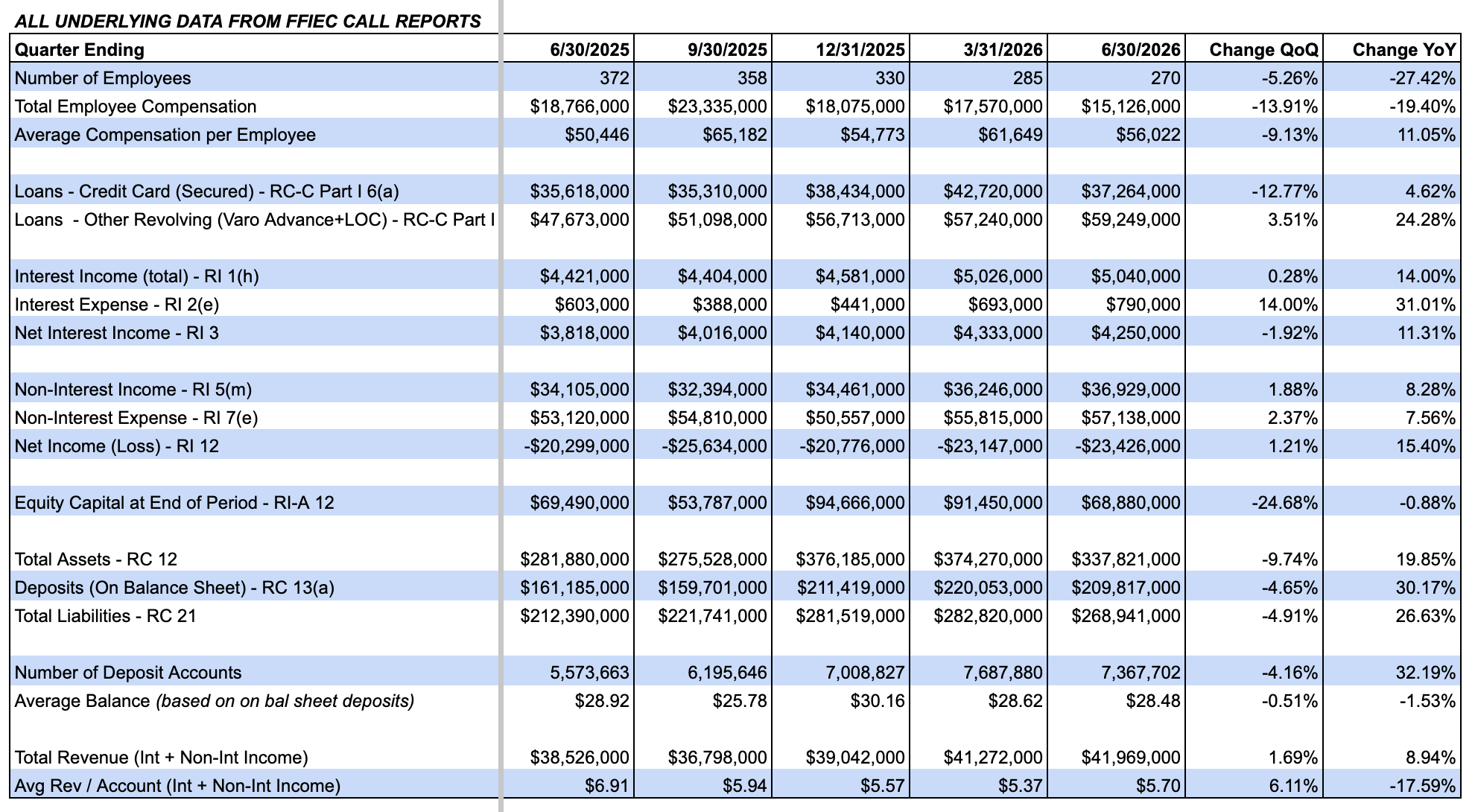
In Q1 2025, Walsh’s last quarter leading Varo, the bank posted a $25 million loss. Per Varo’s most recent call report, it hasn’t made much progress on improving its bottom line, posting a $23.4 million loss for Q2 2026 — despite aggressively slashing staff, from 375 employees when Walsh departed to just 270, as of the end of the second quarter.
There has been minimal progress at growing top line revenue, which has increased from $39 million, when Walsh stepped down, to nearly $42 million in Q2 2026. But, despite significant layoffs, the expense side of the equation hasn’t improved much. In Walsh’s last quarter, non-interest expenses ran $59.4 million; in the most recent quarter, despite a nearly 30% reduction in headcount, Varo still incurred $57.1 million in non-interest expenses.
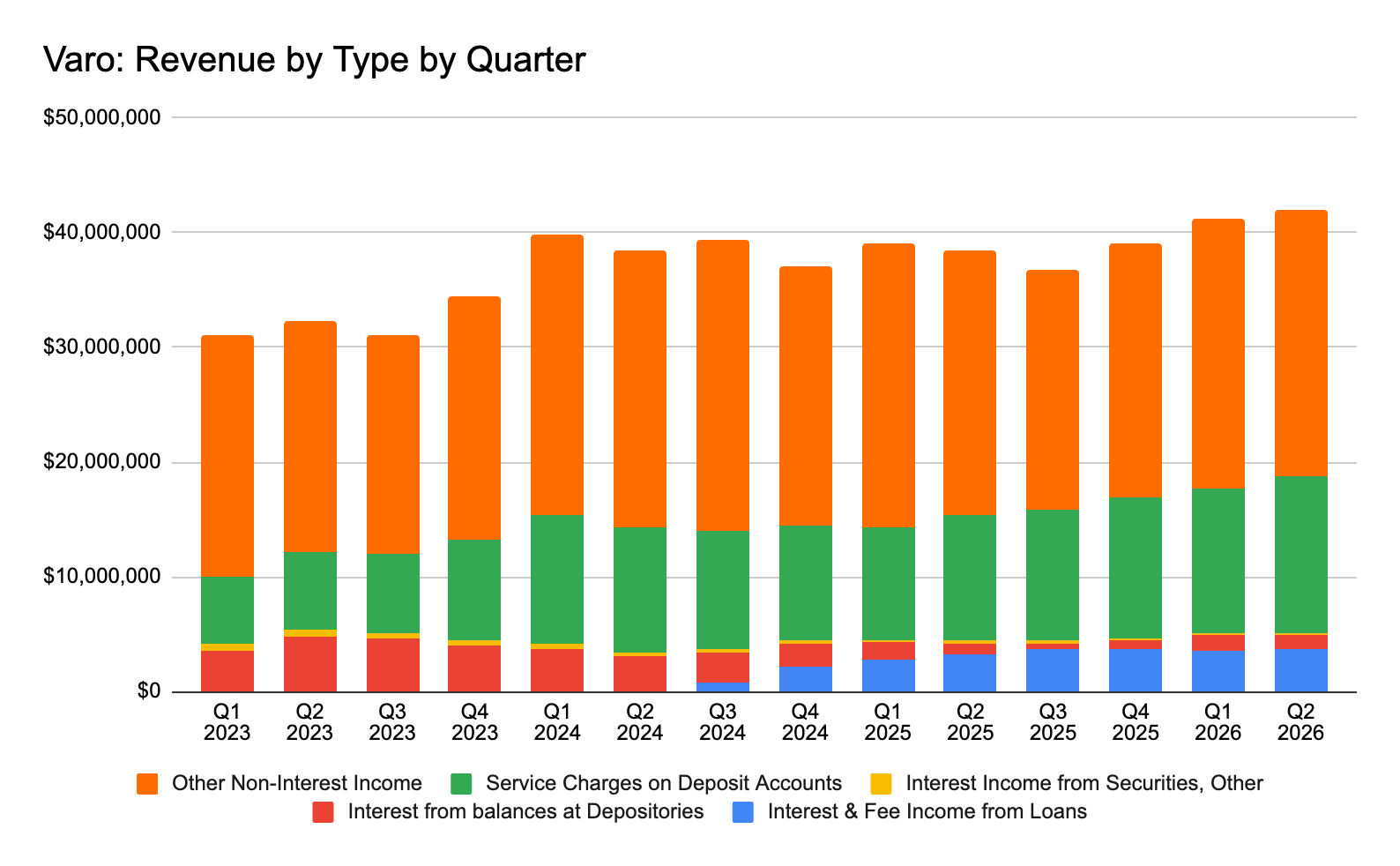
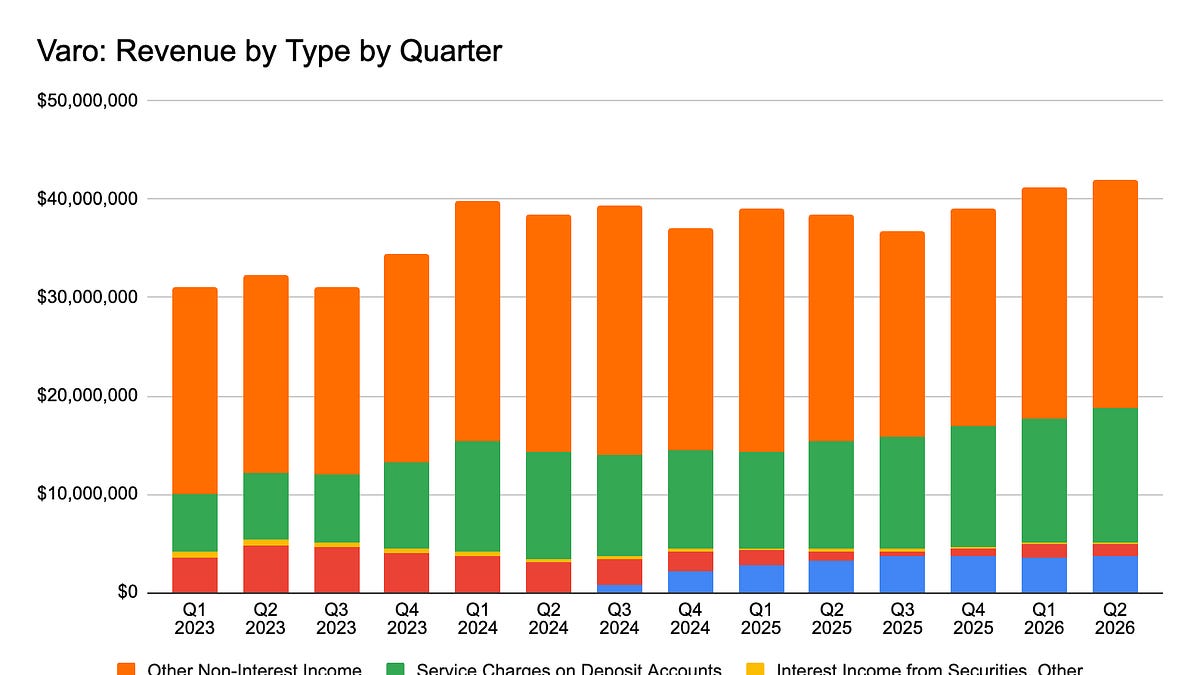
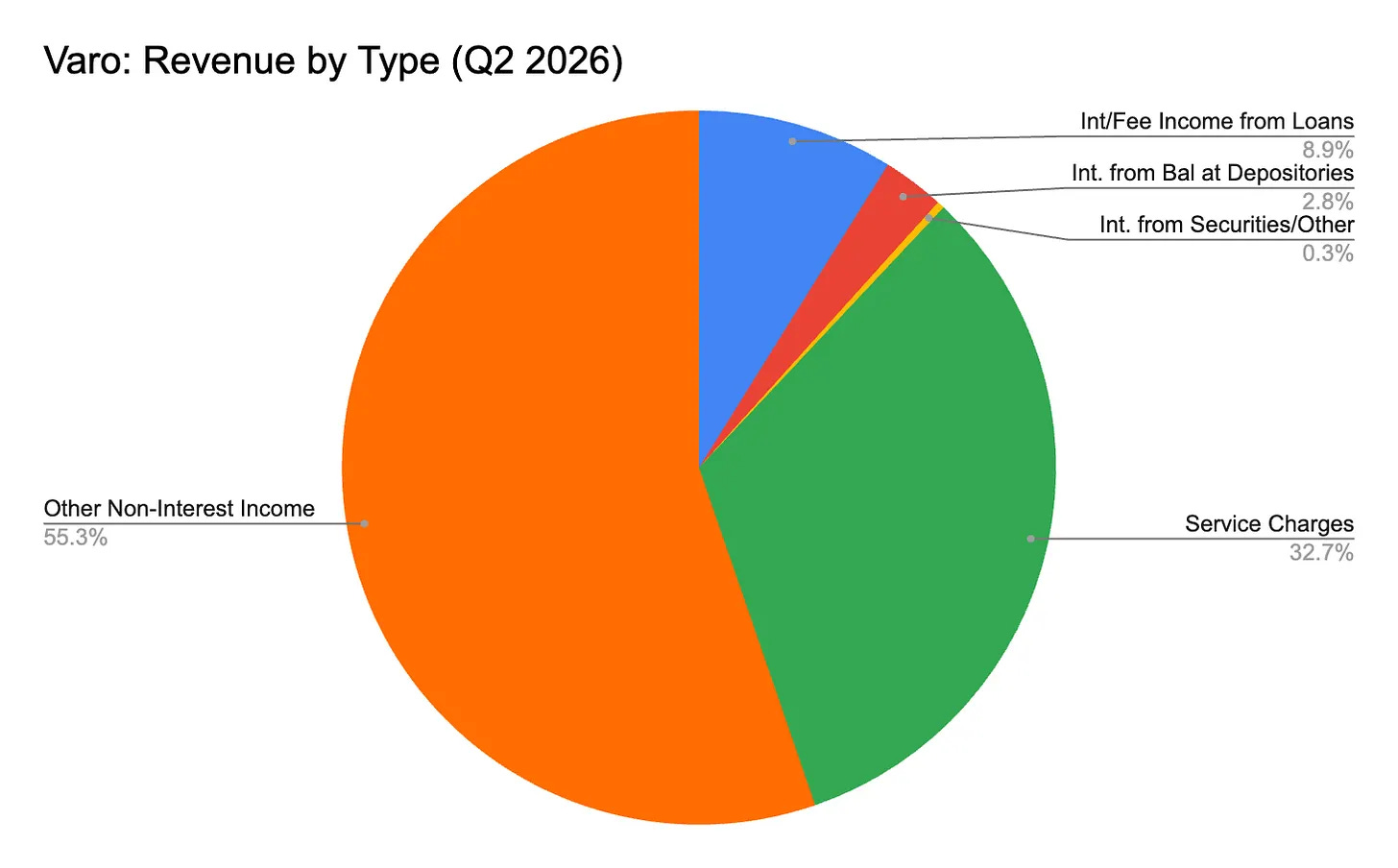
Based on its call report classifications, “Other non-interest income” accounted for more than 55% of Varo’s second quarter revenue. Deposit account service charges drove nearly a third of revenue (32.7%), interest and fees on loans drove just shy of 9%, and interest from balances held at other depositories and from securities accounted for about 3% of revenue.
It’s not entirely clear how revenue from specific products/features aligns with these call report classifications.
Varo’s major revenue drivers include interchange from its debit and secured credit cards, which appears to be classified under “Other Non-Interest Income,” fees on its payday loan-like Varo Advance product, which appear to be classified as “Service Charges on Deposit Accounts,” and fees on its Varo line of credit product, which appear to be classified as interest/fee income from loans. Out-of-network ATM fees are likely also bucketed under “Service Charges on Deposit Accounts.”
Since cofounder Walsh’s departure in early 2025, Varo has managed to resume growth in the number of deposit accounts it reports, closing out Q2 2026 up 43% from the end of Walsh’s tenure.
But despite the increase of more than 2.2 million accounts, revenue in Q2 2026 is up only $2.9 million vs. Q1 2025 — and the number of reported deposit accounts actually dipped Q2 vs. Q1 2026.
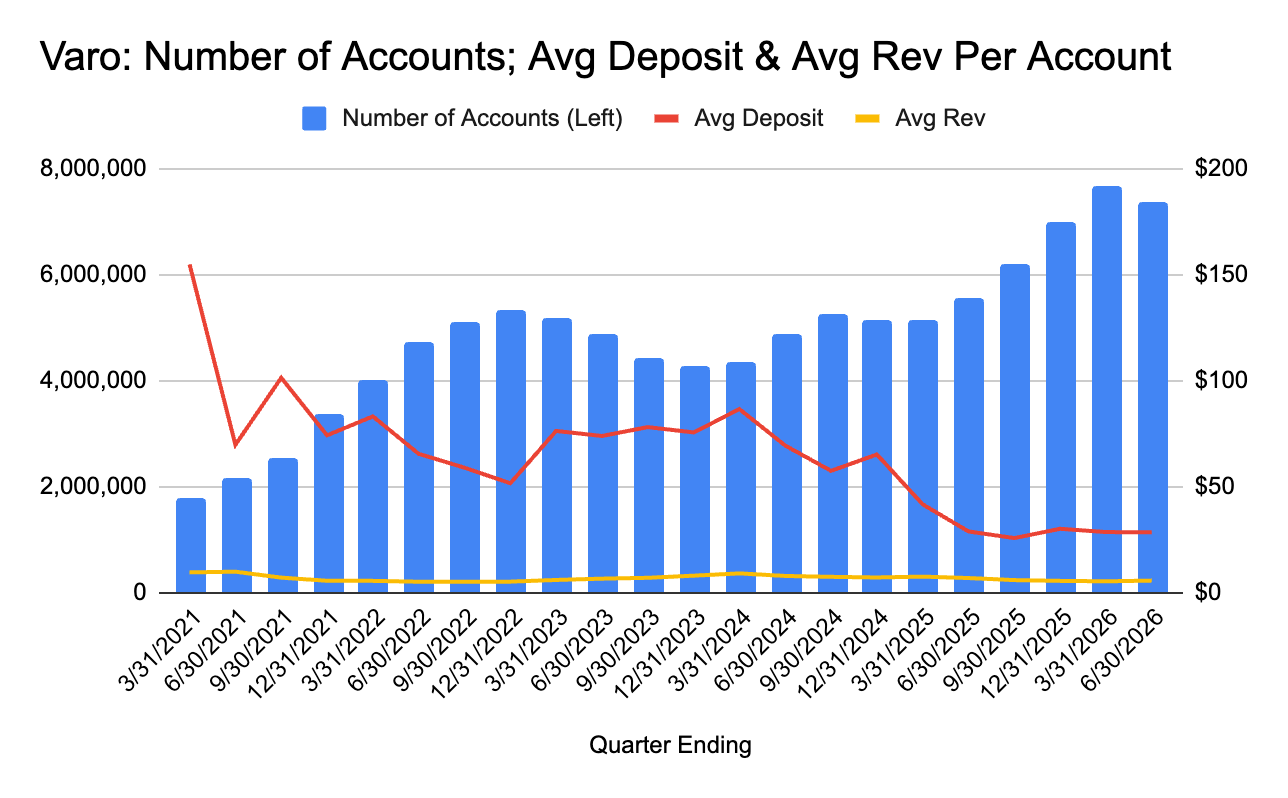
Account level metrics remain abysmal (though the average deposits per account understate the true numbers, as Varo sweeps deposits it is unable to profitably put to use itself off of its balance sheet.)
In Q2 2026, Varo earned on average just $5.70 of revenue per account, suggesting it continues to struggle to convince users to actually activate newly opened accounts, to move direct deposits to them, and to use them as their “primary” bank account.
Outstanding receivables tied to Varo’s secured credit builder card, dubbed Varo Believe, actually declined nearly 13% quarter over quarter, dropping from $42.7 million at the end of Q1 to $37.2 million at the end of Q2.
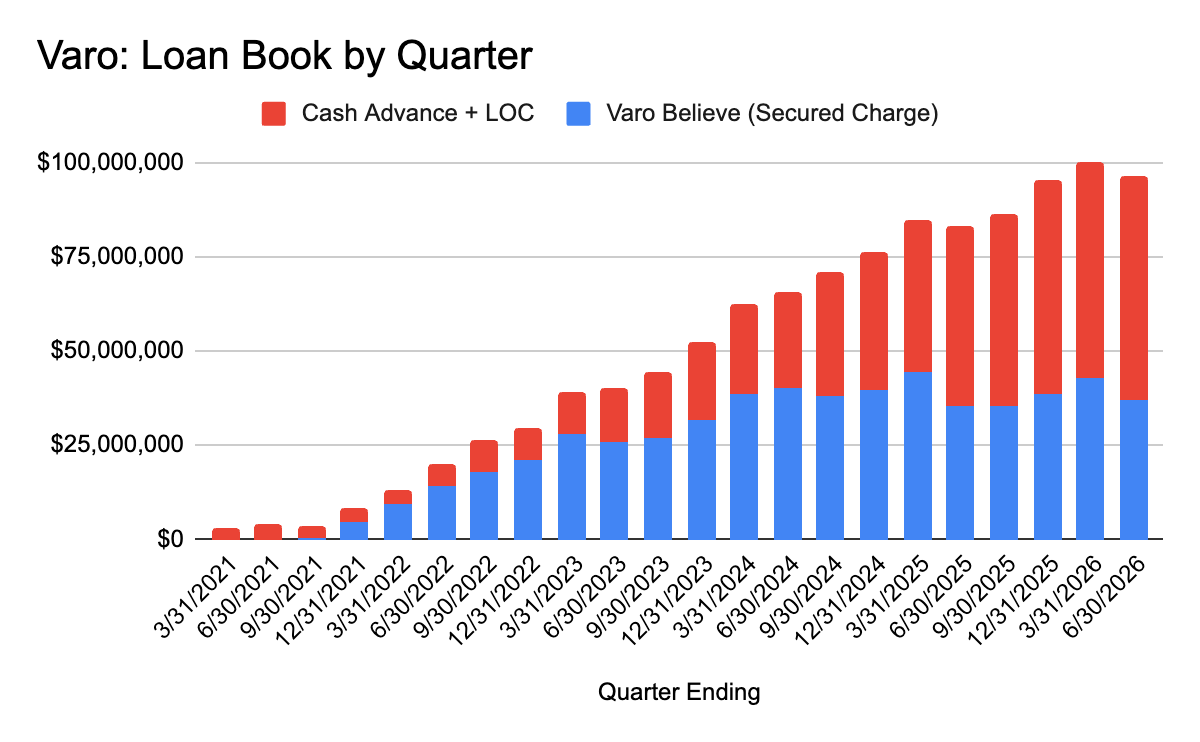
Varo did manage to grow its unsecured consumer loan book by 3.5% quarter over quarter, hitting just shy of $60 million as of the end of Q2.
Varo offers two unsecured products: a line of credit, which enables users to borrow as much as $2,000, repayable over up to 12 months, for a one-time flat fee of up to $400. A $400 fee on a $2,000 12-month line of credit is the equivalent of a 20% APR — high, but likely better than a typical Varo user could access elsewhere.
Varo also offers a payday loan-like product, Varo Advance. Users can apply to borrow up to $250 (up to $700 over time with direct deposit).
Users with less than $800 in direct deposits to their Varo account pay significantly higher fees than those with more substantial income direct deposited to their Varo accounts.
A user that doesn’t meet that $800 direct deposit minimum would pay a flat $20 fee to borrow $100, equivalent to an APR of 240%, if repaid a month later, or more than 1,000% APR if repaid within a week (because APRs represent the annualized cost of credit, small-dollar short-duration credit will nearly always have triple-digit or higher APRs.)
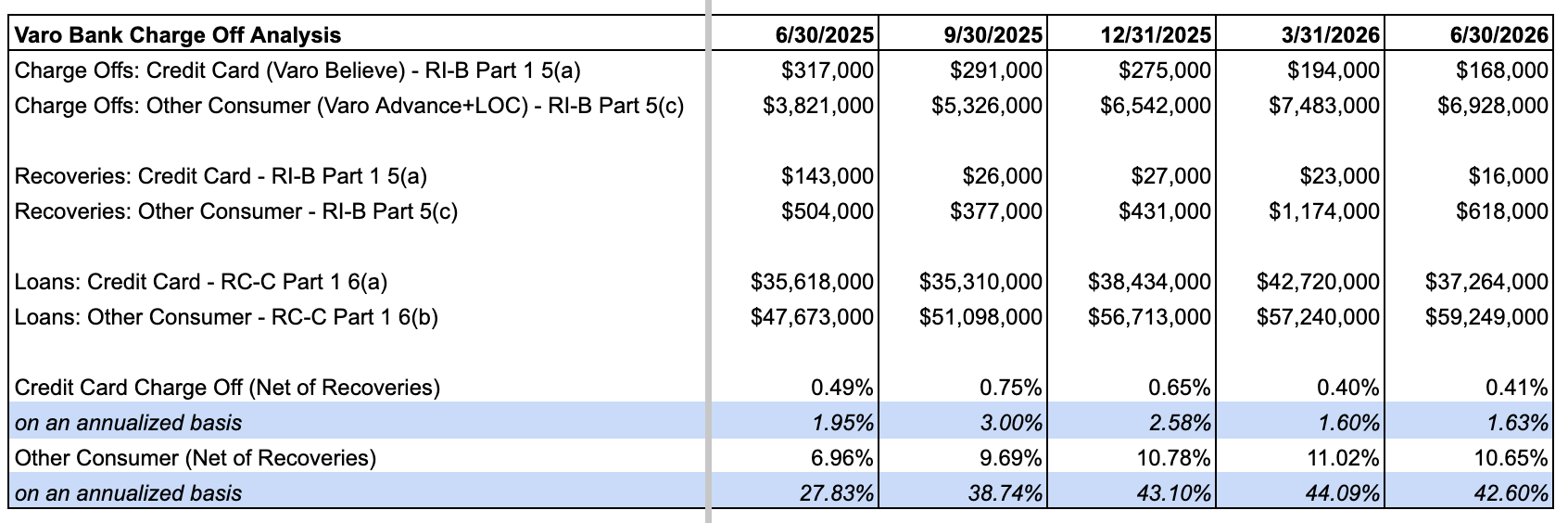
Although Varo launched its higher dollar amount (and, presumably, lower risk) line of credit offering in Q2 2024, its net charge offs, measured as charge offs (net of recoveries) as a percent of its outstanding book, haven’t improved.
Both Varo’s advance product and line of group are grouped as “Other” consumer credit in call report data, making it impossible to break out performance by loan type.
But looking at the last 12 months, for its advance and line of credit book, Varo had $23,679,000 of other consumer charge offs, net of recoveries, vs. an average book size of just over $56 million — making its charge off rate slightly over 42%. While not uncommon for deep subprime small-dollar loans, similar charge off rates from firms like Enova and OppFi have been cited by consumer advocates opposing those firms’ respective applications to acquire existing banks.
Advocacy groups like the Center for Responsible Lending and National Community Reinvestment Coalition and Democratic legislators like Sen. Elizabeth Warren have argued granting Enova and OppFi permission to acquire banks will allow them to take their high APR lending national.
Varo, whose products carry fee structures with APRs that can and do reach triple digits and with charge off rates not dissimilar to Enova and OppFi hasn’t received the same scrutiny of whether its lending practices are compatible with the safety and soundness requirements of operating as an OCC-chartered national bank.
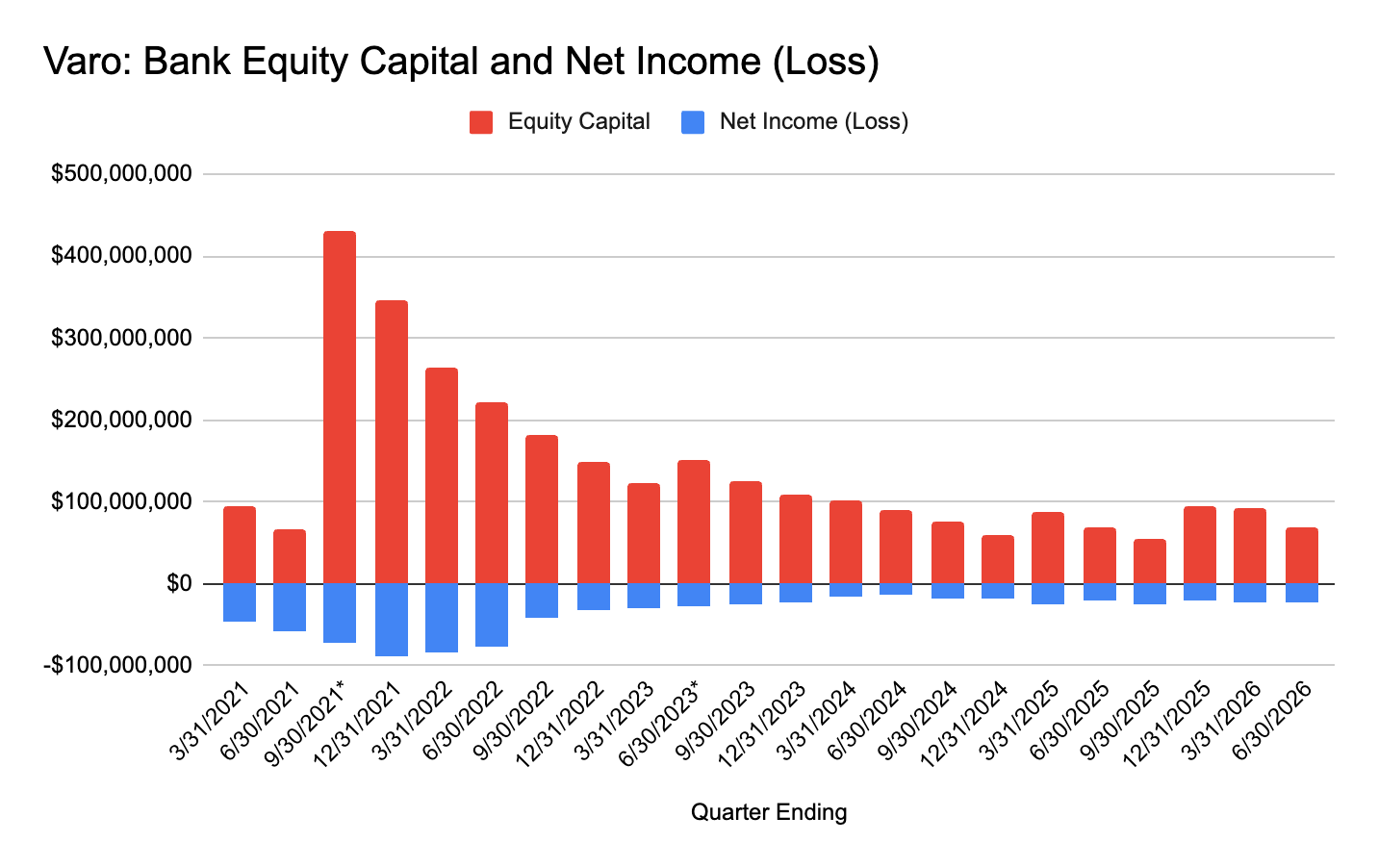
Varo ended Q2 2026 with just shy of $69 million in total bank equity capital and $61 million in Tier 1 capital. With a leverage ratio of 18.46%, Varo remains comfortably above the threshold to be considered “well capitalized.”
But, with no end to the red ink in sight, one has to wonder how patient (and generous) Varo’s investors — most notably Warburg Pincus — will be if there aren’t clear indicators the bank has turned a corner and has a plausible path to profitability soon.
Fintech Business Weekly is made possible by the generous support of paying subscribers — bringing you independent analysis of banking, fintech, and crypto without fear or favor.
You can support my work by becoming a paying subscriber if you aren’t already. Paying subscribers enjoy:
-
access to the entire archive of nearly six years of newsletters
-
extended versions of the weekly newsletter, with additional content and analysis
-
and (for founding member tier) quarterly personal 1:1 fintech Q&A / strategy calls with me, tapping into my unparalleled knowledge of the intersection of banking and fintech and experience working in the sector, including helping to launch Goldman Sachs’ retail bank Marcus
You can also support Fintech Business Weekly by sponsoring a newsletter or podcast, putting you in front of 93,000+ of the most influential decision makers in banking, fintech, and crypto. Learn more about sponsor opportunities or request a media kit by dropping me an email.
Evolve, the bank at the center of the Synapse disaster, has struggled to turn a profit as it has managed the fallout of its disastrous partnership with the bankrupt middleware company (Q4 2025, viewed in isolation, shows positive net income, but Evolve realized an approximately $3 million loss for full year 2025.)
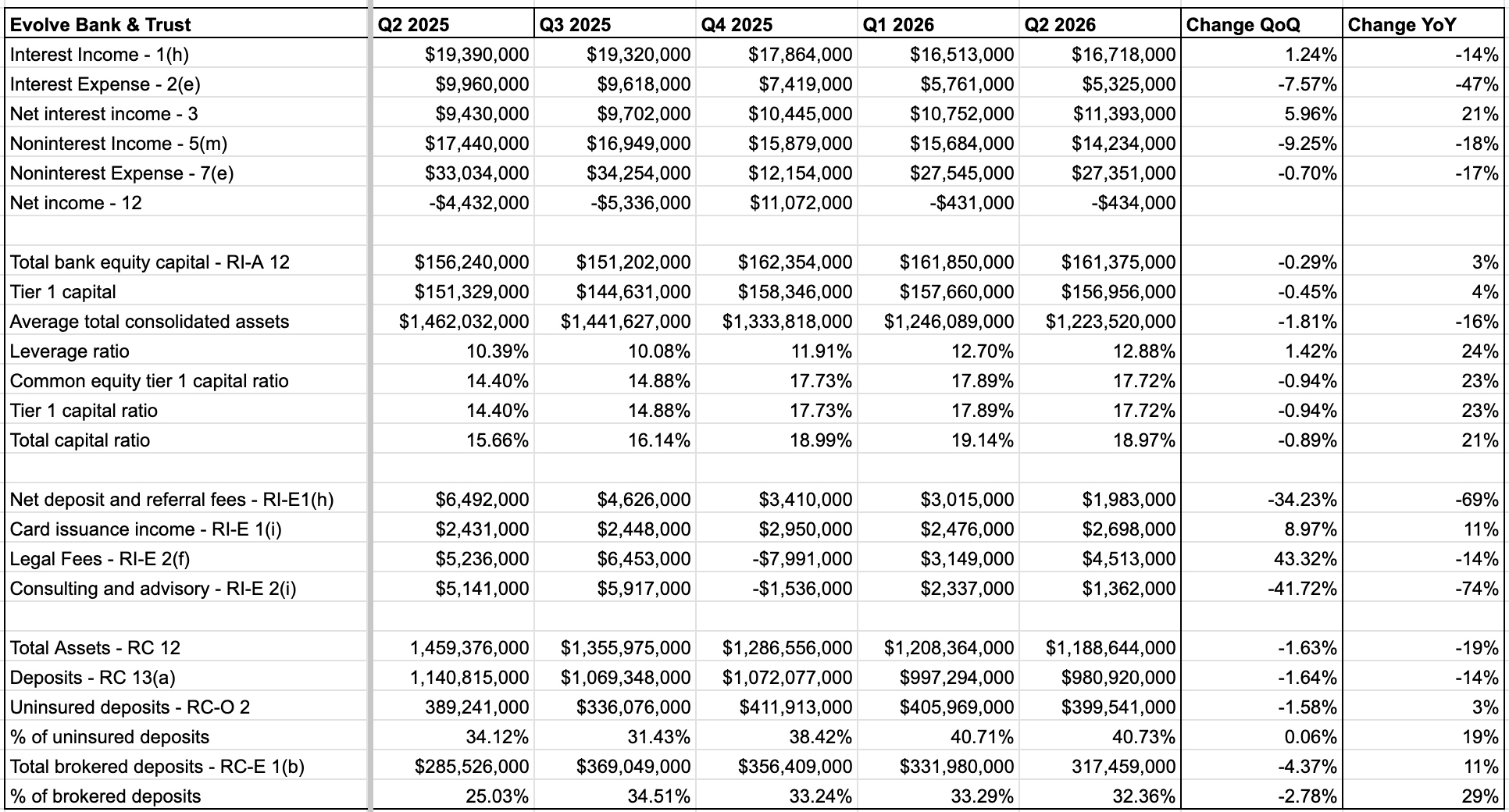
Evolve continues to rely heavily on brokered deposits, which account for nearly one-third of the bank’s on balance sheet deposits. Evolve also has an elevated rate of uninsured deposits, with over 40% of the bank’s deposits not covered by FDIC insurance.
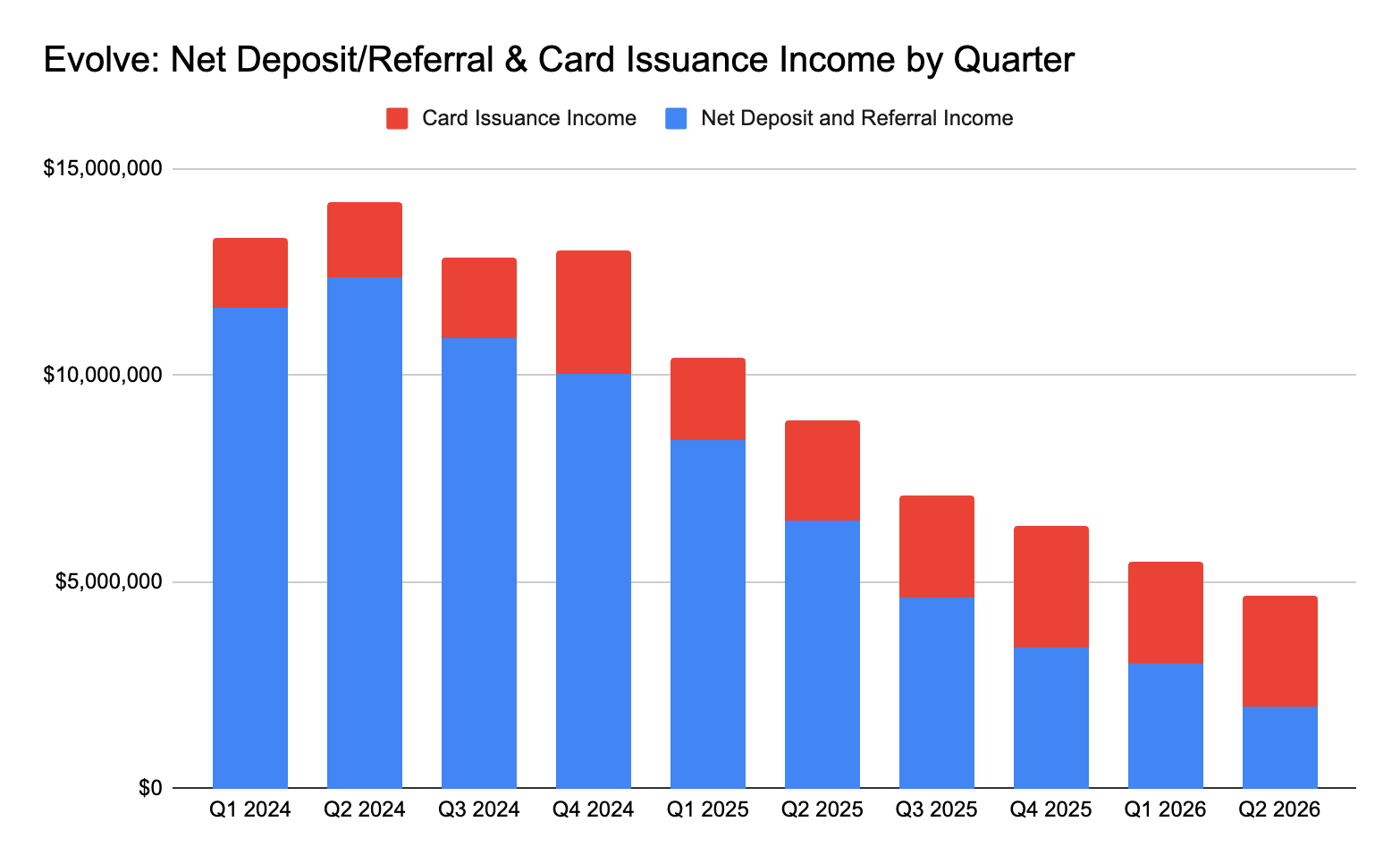
Evolve has seen its combined revenue from deposit referral fees and card issuance, both of which are driven by its fintech partnerships, continue to march lower. In Q2 2026, Evolve earned about $4.7 million from such activities, down by nearly 50% vs. Q2 2025’s $8.9 million.
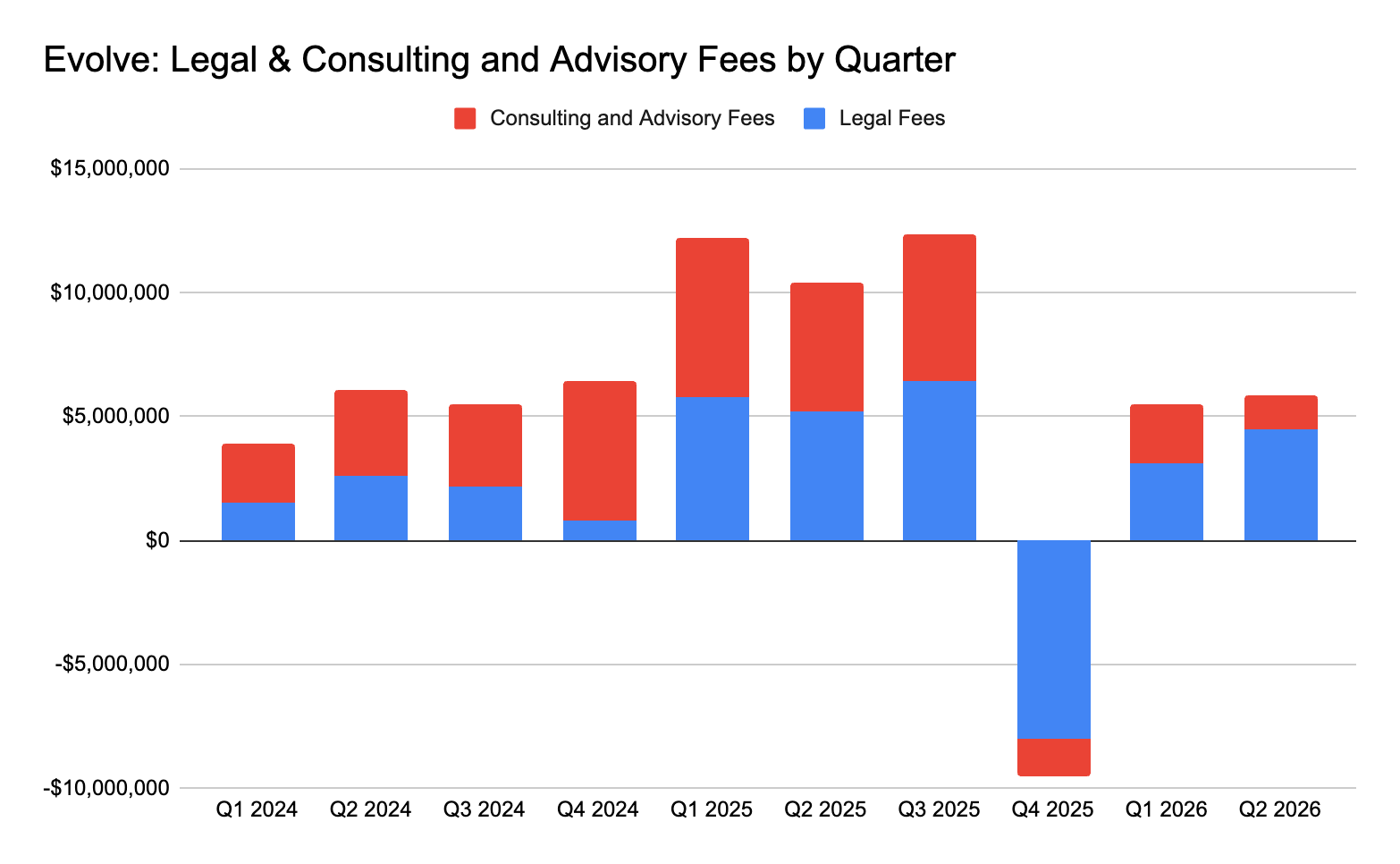
At the same time, Evolve has continued to face elevated legal and consulting expenses, owing in no small part to remediating the fallout from the Synapse disaster and the bank’s wide-reaching 2024 consent order.
Looking at Evolve’s legal and consulting expenses on a quarter-by-quarter basis is a bit confusing, as the year-to-date values reported in its call reports would imply negative spending for Q4 2025, presumably because it spent less than had been budgeted and accrued for 2025.
Looking at Evolve’s combined legal and consulting expenses since Q2 2024 (approximately the time of Synapse’s bankruptcy), the bank has spent nearly $55 million on such services, though the pace of expenditures has slowed in recent quarters.
Still, Evolve’s Synapse and wider fintech partnership headaches aren’t fully in the rearview mirror yet.
Coastal Community Bank, which had been conducting due diligence on certain Evolve fintech partner programs in advance of a potential deal to transfer them to the Washington bank, terminated the non-binding letter of intent it had entered into with Evolve. It’s not clear if Coastal’s recent earnings miss — driven by concerns over the financial stability of one of its fintech partners — drove the decision to back away from acquiring programs currently working with Evolve.
And despite Evolve’s apparent efforts to keep Synapse-related lawsuits out of the public eye, one victim successfully sued Evolve in small claims court.
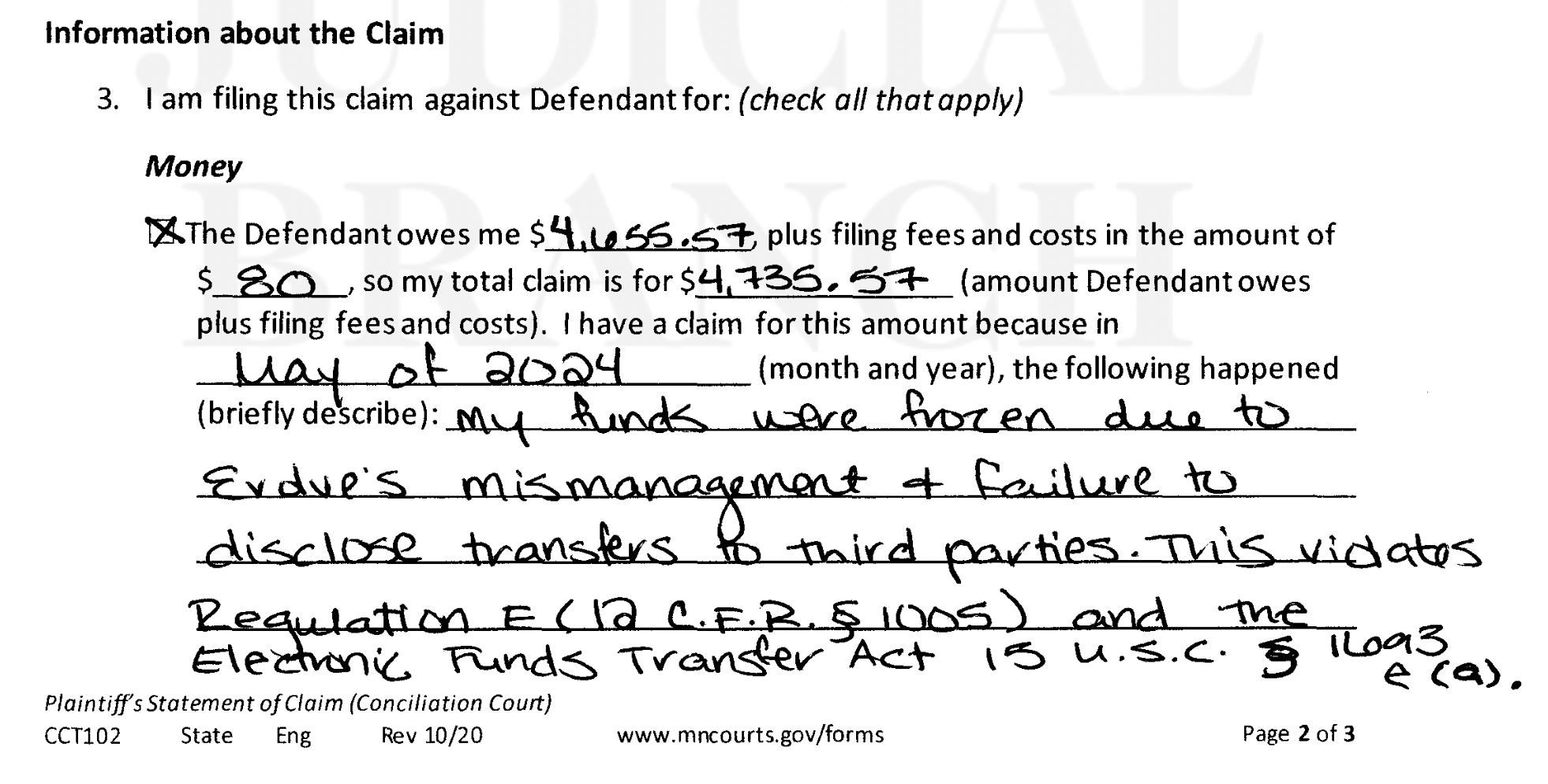
The court entered a default judgment in the victim’s favor, awarding $4,735.57, after Evolve failed to appear at the hearing to contest it.
According to Fight For Our Funds, an informal advocacy group setup by victims of the Synapse-Evolve situation, the bank sought to keep the matter out of court: “During negotiations, Evolve requested the vacation or dismissal of the judgment in exchange for a settlement amount lower than the full judgment. They stated that an appeal would complicate further recovery efforts. The bank proposed settlement offers containing various clauses that presented potential contractual difficulties. The bank expressed a preference to resolve the matter outside of civil/district court. The bank indicated that other claimants had been opting for settlements and noted the public nature of court records.”
Evolve did discuss a potential settlement with the user who filed the small claims case, but was offering a lower amount ($3,700) and would require the user to sign a non-disclosure agreement, file to vacate the court judgment, and formally retract complaints the user had filed with the FDIC, CFPB, and their Congressional representatives.
Last week, the Florida Attorney General filed lawsuits against two so-called “sweepstakes-casino” operators, Stake and VGW Games.
But the attorney general’s suits also named service providers the two firms use in payment processing: Worldpay, Praxis, Breeze Labs, Trustly, and Yodlee.