
Cameroon has launched a World Bank-backed programme to digitise government payments through bank accounts and mobile money platforms, as part of efforts to modernise public finance management.
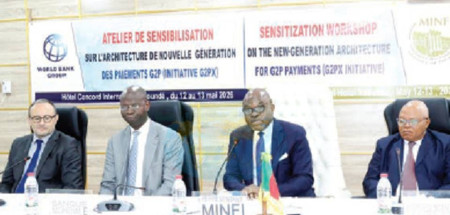
The initiative, known as Government-to-Person payments (G2Px), was presented during a two-day sensitisation workshop held in Yaounde by the Ministry of Finance and the World Bank. The programme focuses on digitising salaries, pensions and social transfers through bank accounts and mobile money systems in line with the government’s wider economic modernisation strategy.
Officials said the reform is intended to reduce the manipulation of cash payments and improve traceability in public financial flows. The workshop brought together government officials, payment sector stakeholders and development partners to examine the architecture of the new payment system and its implementation in Cameroon.
Presenting the initiative, World Bank economist Samba Ba said the reform responds to growing international demand for faster, more transparent and more efficient public services through digital tools.
“Everywhere in the world, States are reinventing the way they serve citizens, with greater speed, transparency and efficiency. The digitalisation of public services has become an essential condition for economic performance and trust between the State and its citizens,” Samba Ba said.
According to the World Bank, more than a quarter of the world’s adult population receives either salaries, pensions or social transfers from governments, while nearly 400 million additional people have joined that category in the past four years.
Officials at the workshop said the transition to digital transfers creates opportunities for Cameroon to improve public spending efficiency, reduce transaction costs and strengthen financial inclusion, particularly among women and young people.
The Director of Accounts at the Ministry of Finance, Dr Achille Nestor Basahag, said the reform seeks to align Cameroon’s payment system with international standards while ensuring that public funds reach final beneficiaries directly without intermediaries.
“The objective is to put an end to the manipulation of cash which, in the current system, is a source of significant losses and weak transparency in the payment of public expenditure. The reform aims to ensure that payments effectively reach the final recipients through secure digital channels,” Basahag said.
Officials also linked the initiative to the government’s broader digital transformation agenda under President Paul Biya’s economic modernisation policy. During the workshop, participants received technical presentations on institutional arrangements, legal implications and international benchmark experiences linked to implementing the G2Px architecture.
Experts from the World Bank, including Omar Ndiaye and Craig Patrick, delivered sessions on digital payment systems and governance structures, while representatives from Cameroon’s Social Safety Net Project and postal payment services shared operational experiences linked to electronic transfers.
“At the level of public administrations, this major reform is already being implemented through the deployment of the Tresopay platform dedicated to the collection and payment of public expenditure. The objective is to modernise payment procedures while improving accountability in the management of State funds,” Basahag said.
The G2Px initiative, implemented by the World Bank in partnership with the Bill & Melinda Gates Foundation, is designed to help governments digitise public transfers, improve payment reliability and support wider access to formal financial services for beneficiaries.
Mercy Fosoh