
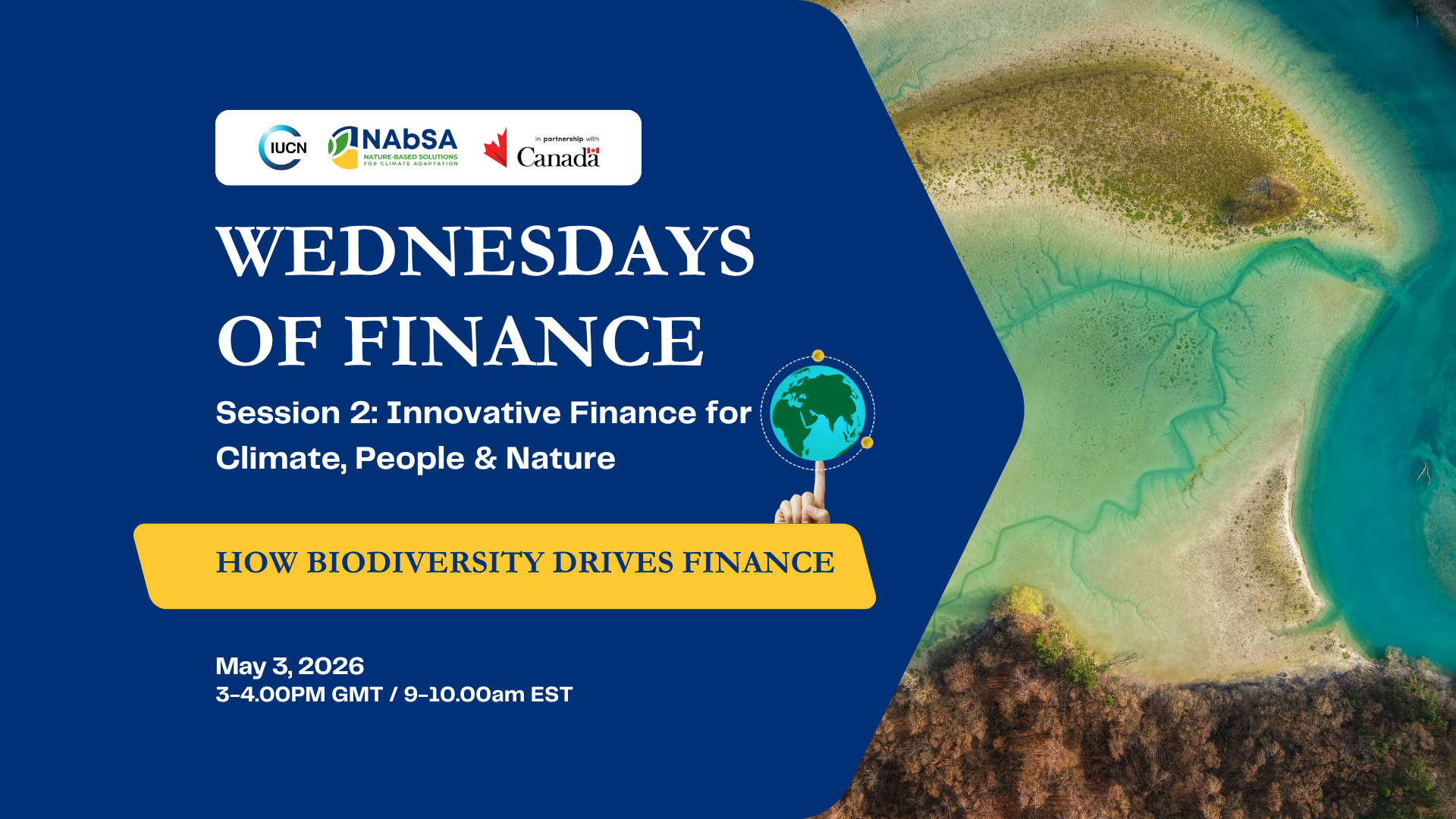
That question sat at the heart of the second session of the Wednesdays of Finance webinar series, “How Biodiversity Drives Finance,” convened by NAbSA and its Land & Natural Resource Management Task Force last week and moderated by Quilin Liu, IUCN Programme Officer.
Bringing together experts from academia, finance, and policy, the session explored the rapidly evolving landscape of biodiversity finance — from green bonds and debt-for-nature swaps to biodiversity credits and financial system reform. Throughout the discussion, speakers emphasized that while finance mechanisms are evolving quickly, the real challenge lies in ensuring that finance serves biodiversity — not the other way around.

The biodiversity finance gap: Big numbers, bigger questions
Opening the session, Dr. John Tobin-de la Puente, Professor of Practice at Cornell University, introduced participants to the fundamentals of biodiversity finance and the scale of the challenge ahead.
At the center of biodiversity finance, he explained, are two defining questions: How much are we currently spending on biodiversity conservation, and how much do we actually need to sustainably manage and restore nature?
The gap between these figures remains enormous.
While global investment in biodiversity has grown in recent years, nature-negative subsidies and environmentally harmful investments continue to vastly outweigh funding directed toward conservation and restoration efforts.
Yet despite the scale of the challenge, Dr. Tobin-de la Puente stressed that the global financial system also presents enormous opportunity.
“Capital markets represent many times the amount of money needed to address the biodiversity crisis,” he noted, highlighting the growing interest in mobilizing private capital for nature-positive outcomes.
Understanding the biodiversity finance landscape
To help participants navigate this rapidly changing space, Dr. Tobin-de la Puente organized biodiversity finance mechanisms into three broad categories:
- Non-market mechanisms: Traditional public finance approaches such as official development assistance (ODA); tax revenues; and public biodiversity funds.
- Structured mechanisms: Innovative finance tools that use market structures without necessarily generating commercial investor returns, including debt-for-nature swaps, agricultural lending incentives and regenerative agriculture financing models.
- Market mechanisms: Investment-oriented approaches where investors seek risk-adjusted financial returns, including green bonds, sustainability-linked loans, environmental impact bonds, green private equity funds, biodiversity credit markets.
Among these, green bonds have seen the most dramatic growth over the last two decades, reaching approximately USD 6 trillion globally by mid-2025.
However, speakers noted that biodiversity finance still faces a fundamental challenge that climate finance does not: Biodiversity is difficult to standardize.
Unlike carbon credits — where one tonne of CO₂ provides a universal metric — biodiversity is highly context-specific, making it far harder to create globally comparable units or credits.
This complexity explains why biodiversity credit markets remain at a much earlier stage of development.
Learning from carbon markets — without repeating mistakes
One of the central themes throughout the webinar was the need to learn from both the successes and shortcomings of carbon markets.
Speakers emphasized that biodiversity finance mechanisms must prioritize transparency, scientific credibility, third-party verification, respect for Indigenous Peoples’ rights, Free, Prior and Informed Consent (FPIC), and strong social and environmental safeguards.
Reflecting on the evolution of carbon markets, Alonso Martinez, Environmental Finance Analyst for LAC region at BIOFIN, UNDP, warned against replicating problematic approaches.
“We have already seen ‘cowboy carbon markets’ emerge in some places,” he noted, stressing the importance of building integrity into biodiversity finance systems from the outset.
Rather than rushing to scale markets quickly, speakers argued that trust, governance, and community participation must form the foundation of any biodiversity finance mechanism.
Participants also explored whether biodiversity credit systems should operate globally or remain locally grounded.
While some speakers pointed to the advantages of larger global markets — including liquidity and standardized rules — others emphasized that biodiversity is inherently local, requiring place-based approaches rooted in specific ecosystems and communities.

Beyond new money: Reforming financial systems
Another major theme emerging from the discussion was that closing the biodiversity finance gap is not simply about finding “new money.”
Instead, it requires transforming the systems that already shape financial flows.
Drawing on experiences from Latin America, Ana Lucía Orozco Rubio shared examples of how BIOFIN is working with governments and financial institutions to integrate biodiversity into mainstream finance systems.
Examples included:
- Reforming agricultural credit systems in Colombia
- Integrating environmental and social safeguards into Ecuador’s microfinance sector
- Aligning biodiversity goals with national development and finance policies
These examples illustrated how biodiversity finance can move beyond isolated pilot projects toward systemic transformation.
As Ana emphasized, enabling conditions matter as much as individual finance instruments.
Strong policy frameworks, institutional coordination, transparent tracking systems, and engagement with ministries of finance are all critical to ensuring biodiversity finance delivers long-term impact.
Putting people at the centre of biodiversity finance
A recurring message throughout the session was that biodiversity finance cannot succeed without local communities.
Speakers repeatedly highlighted the importance of:
- Community participation
- Capacity-building
- Rights-based approaches
- Inclusive governance
- Equitable benefit-sharing
The discussion reinforced that Indigenous Peoples and local communities are not simply beneficiaries of biodiversity finance — they are central actors in protecting and stewarding ecosystems globally.
Participants also explored how local communities can play active roles in monitoring biodiversity outcomes and shaping nature-positive finance systems.
Looking ahead
The second session of Wednesdays of Finance demonstrated that biodiversity finance is no longer a niche conversation.
As governments, investors, and institutions increasingly recognize the economic importance of healthy ecosystems, new finance mechanisms are emerging rapidly. Yet the discussion also made clear that finance alone will not solve the biodiversity crisis.
Integrity, governance, science, participation, and equity remain essential.
Ultimately, the session highlighted that biodiversity finance is not simply about creating markets — it is about reshaping how economies value nature, support communities, and invest in long-term resilience.
Watch the recording from Session 2 here and access the slides in English and in French.
The webinar series concludes on the 27 May 2026 with Session 3: Actionable Finance: Turning Investments into Inclusive Outcomes’ exploring innovative finance pathways and what they mean for practitioners working at the intersection of climate, biodiversity, and development. Register here.
Additional resources shared during the session
Participants were also encouraged to explore several resources shared by speakers during the webinar:
Dr. Tobin-de la Puente’s books on nature finance:
BIOFIN examples and case studies:
Additional references discussed: