
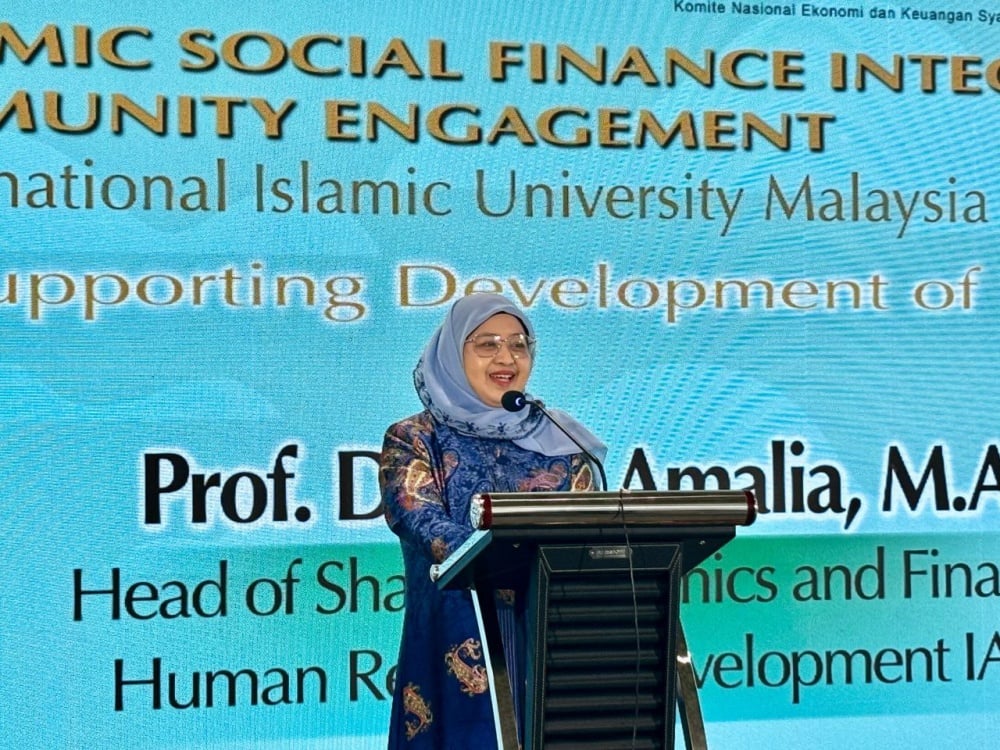
ASEAN cooperation needs to be stepped up to reinforce an integrated halal industry.
JAKARTA — Euis Amalia, Head of Sharia Economics and Finance Human Resource Development at the Indonesian Islamic Economists Association (IAEI), has stressed the importance of regional cooperation within ASEAN to strengthen an integrated halal industry ecosystem linked to Islamic social finance.
She made the remarks at a joint seminar organised by Menara Syariah and the International Islamic University Malaysia, themed Bilateral and Regional Islamic Social Finance Integration for Halal Community Engagement, which also involved IAEI and the National Committee for Islamic Economics and Finance (KNEKS), held at Menara Syariah, PIK2, Banten, on Tuesday (16/12).
Euis said the global halal economy is experiencing rapid growth. Its value is estimated to reach USD 2.99–3.30 trillion in 2025 and could rise to USD 5.2–9.45 trillion by 2034, with annual growth of 9–12.8%.
However, this substantial potential has yet to be fully realised due to policy fragmentation and weak cross-border coordination. In the global Islamic finance landscape, Indonesia currently ranks third, behind Malaysia and Saudi Arabia.
Despite having the world’s largest Muslim population, Indonesia is still seen as lagging in the integration of the halal industry, Islamic finance and Islamic social finance.
Euis highlighted the low level of zakat collection in Indonesia. Of an estimated zakat potential of around IDR 327 trillion, actual collection has reached only 15.3%.
Productive waqf is also considered underutilised, with less than 10% of approximately 41,000 hectares of waqf land being put to productive use. This situation is seen as constraining the role of Islamic social finance in supporting economic development and the halal industry.
She emphasised the need to redefine the concept of halal. According to Euis, halal should not be understood merely as legal compliance and certification, but must be integrated with the principle of tauhid, which emphasises quality, ethics, sustainability and holistic welfare.
With such an approach, halal can serve as an instrument of socio-economic development, rather than simply a product label.
Euis also criticised national halal regulations for failing to clearly regulate the linkage between halal products and sharia-based financing. (DK/ZH)
as a preferred source on Google