
“What can physicists do? ” is an interview series that profiles physicists who opted for careers outside of academia.
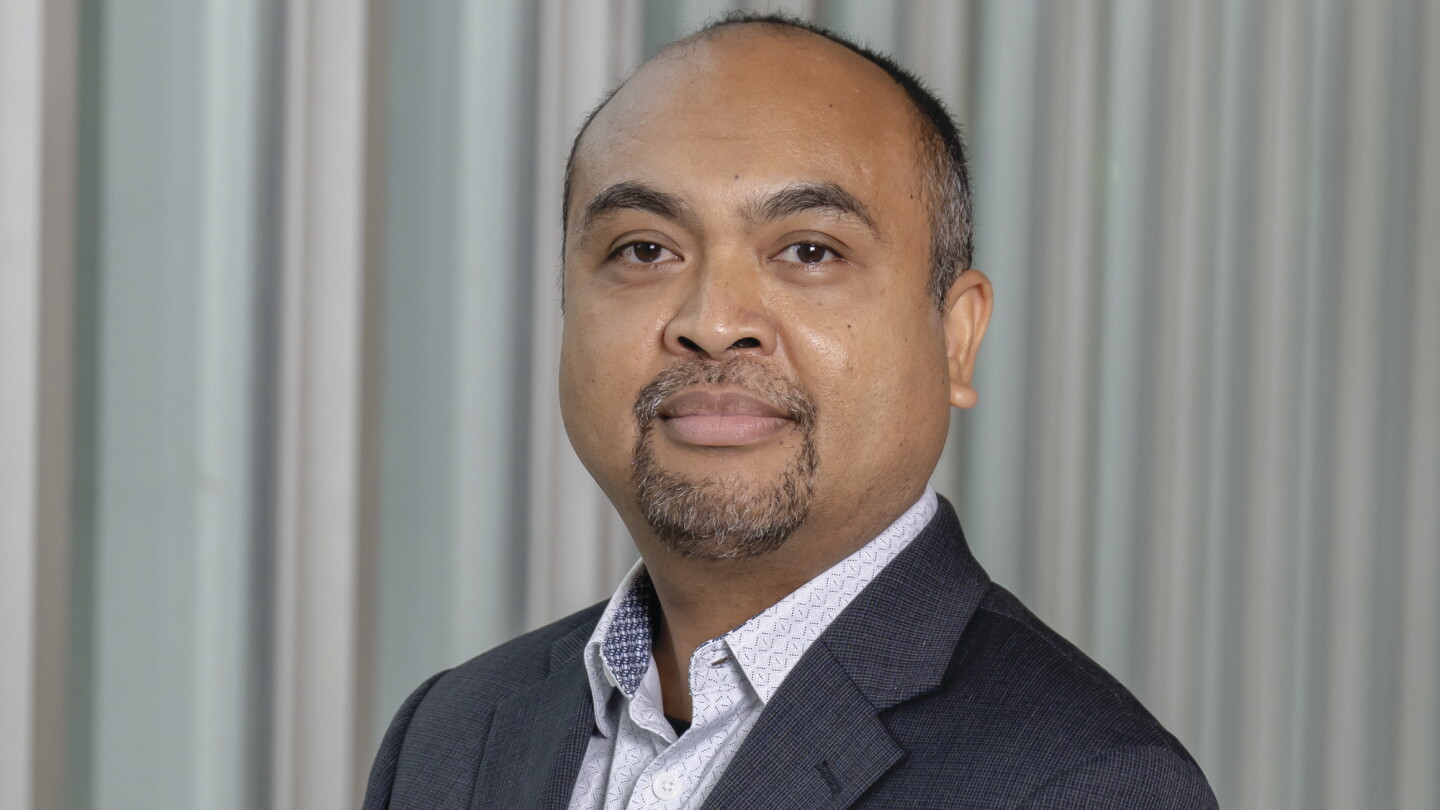
Koloina Randrianarivony
Senior financial officer, World Bank
BS, physics, University of Antananarivo, 2000
Diploma, physics, Abdus Salam International Centre for Theoretical Physics, 2002
PhD, physics, Syracuse University, 2008

(Photo courtesy of Koloina Randrianarivony.)
What was your research focus?
Experimental particle physics. As a postdoc, I was involved in the ATLAS collaboration at CERN.
What were you looking for in a job?
I was thinking of becoming a professor—like my father, who is a professor of nuclear physics in Madagascar. I realized that staying in academia would mean going wherever a university position happened to open, with little say over geography. I broadened my net beyond physics. My goal was finance. Emanuel Derman’s book My Life as a Quant: Reflections on Physics and Finance became my bible.
How did you get to the World Bank?
I started working for a small hedge fund in New York City. Then, my wife got a job in operations at the World Bank in Washington, DC. I commuted, spending weekends in DC and weekdays in New York.
The World Bank provides loans and other resources to countries in need. I contacted people at the World Bank who worked in the finance and risk department. One of the directors saw that my résumé mentioned boson research and called me in. He gave me a job. That was 2013.
How do you spend your time?
I work in financial risk management. We collect a huge amount of data and perform stress tests, calculations, and simulations. The aim is to prevent financial loss for the World Bank.
I also prepare reports for board members, and I led the creation of a dashboard for slicing and dicing data into different displays and of technological innovation tools such as for implementation of AI.
How do you use your physics in your job?
In physics, I monitored particles and did simulations. Here, I monitor financial markets data. The principles and the mathematics are the same, but the terminology is different.
What new skills did you need to pick up?
In finance, you need to be extra careful about translating complex quantitative findings into clear, actionable language for nontechnical decision-makers.
What do you like most about your job?
The impact. Every dollar the World Bank has implies an approximately $5 loan to a country. I am from Madagascar; $5 means a lot. Connecting rigorous quantitative work to real development outcomes makes my role meaningful to me.