
Bell, BDC, EDC, and InBC back BC quantum firm’s continued push towards commercialization.
Vancouver-based Photonic has completed the final close of its latest funding round, securing another $70 million USD ($95 million CAD) that will fuel the development of its quantum computers as the company advances towards commercialization.
This brings the total size of this equity financing to more than $200 million USD ($275 million CAD). Photonic shared the news this morning, noting that the round gives it a $2-billion USD ($2.7-billion CAD) post-money valuation.
“Imagine, in 2018, you could have predicted with accuracy the ChatGPT moment. That’s what’s happening inside the [quantum] space.”
Stephanie Simmons,
Photonic
Photonic previously announced an initial close of $180 million CAD in January. That portion came from a group that included first-time backers Planet First Partners, the Royal Bank of Canada, and Telus, as well as existing investors like the British Columbia Investment Management Corporation and strategic partner Microsoft.
New investors—which included the Business Development Bank of Canada’s defence-focused StrongNorth Fund, Export Development Canada, Bell Ventures, Firgun Ventures, and InBC Investment Corp.—participated in this final close, which also saw follow-on support from Mubadala Capital.
In a news release, Photonic CEO Don Mattrick said this financing unites government, strategic partners, and international investors from across Canada, Europe, the United Kingdom, and the Middle East “around a shared conviction: that commercial-scale quantum computing is within reach—and that its economic impact will be transformative.”
“We achieved and exceeded what we set out to do with this fundraise,” Mattrick told BetaKit in an interview following the announcement. “We’re particularly pleased that we were able to aggregate [this group of investors] and have such a strong showing of support from Canada.”
Mattrick said Canadian investors accounted for more than half of this round and own more than half of Photonic’s equity.
Mattrick, who took over for Paul Terry as CEO in March, said that the company plans to use this capital to hit key milestones, grow its team, and deepen its partnerships. He said Photonic will invest the funding in building out its labs and 170-person team to north of 200 employees by next year.
“We’ve got the capital, we’ve got the partners, we’ve got the go-to-market mechanism to build a great business,” Mattrick said.
The CEO also anticipates increased interest and support from governments and strategic players this year. “It really seems our space is heating up,” he said.
Commercializing a “new branch of physics”
Photonic, which was founded in 2016, has now raised more than $350 million USD ($475 million CAD) to develop a useful quantum computer and sell its services at scale.
As Terry, now chief product officer, told BetaKit in January, the company is “commercializing a new branch of physics” by using a property of quantum physics called entanglement to network quantum computers together. Entanglement is when two particles become linked together, even when they are far apart, allowing quantum information to essentially teleport from one place to another.
Photonic aims to harness entanglement to perform increasingly powerful computation, and sell that capability to corporations and, eventually, governments. The company’s architecture leverages light and a networked approach to achieve entanglement, and co-founder and chief quantum officer Stephanie Simmons said it is designed to work at scale.
“Many other teams are box-constrained because that’s where they came from, and they’ve been very successful at getting these early demonstrations,” she told BetaKit in an interview. “But we’re playing the bigger commercial game.”
Terry said in January that Photonic was gearing up to commercialize its tech and that he expected this round to be the last financing the firm required to become cash-flow positive.
RELATED: Xanadu makes solid debut as it begins trading on TSX and Nasdaq
Photonic is one of three Canadian quantum computing companies participating in both the new Canadian Quantum Champions Program (CQCP) and the second phase of the US DARPA Quantum Benchmarking Initiative (QBI), which aim to support companies in the quest to develop a functional, fault-tolerant quantum computer.
QBI aims to determine whether it is possible to build an industrially useful quantum computer by 2033. “I personally believe our company will be able to execute on achieving that earlier than those dates,” Mattrick said. He noted that some industry roadmaps put the timeframe closer to 2029, adding, “That doesn’t seem unreasonable to me.”
Simmons, who has been working in quantum since 2001, said, “We now see the path very clearly, and we’re tracking down it.”
Are we in a quantum bubble?
One of Photonic’s Canadian competitors, Toronto-based Xanadu, recently had a strong debut on the Nasdaq and Toronto Stock Exchange. While its shares have whipsawed since then, at the time of publication, it boasts a market cap of nearly $5 billion USD ($6.8 billion CAD).
For her part, Simmons said this round gives Photonic the runway to, for now, remain a private company, but she did not rule out the possibility that it could eventually go public.
Recent excitement around quantum has left Xanadu and its public peers trading at particularly high multiples relative to their current earnings and near-term potential. That’s fuelled questions about whether this hype and these valuations are justified, given industrially useful quantum computers are likely still years away.
As to whether we are in a quantum bubble, Simmons pointed to the Canadian and US quantum computing research programs as external validation that the sector is not, calling both “substantial investments that would not be made if they didn’t believe that there is a viable path” to commercial value.
“We know, inside, what’s coming in three years,” Simmons said. “Imagine, in 2018, you could have predicted with accuracy the ChatGPT moment. That’s what’s happening inside the space here. That’s what the investors are seeing. That’s what these Five Eyes contracts are seeing. All the information isn’t available publicly, necessarily, but the people that have been doing the diligence are voting with their wallets.”
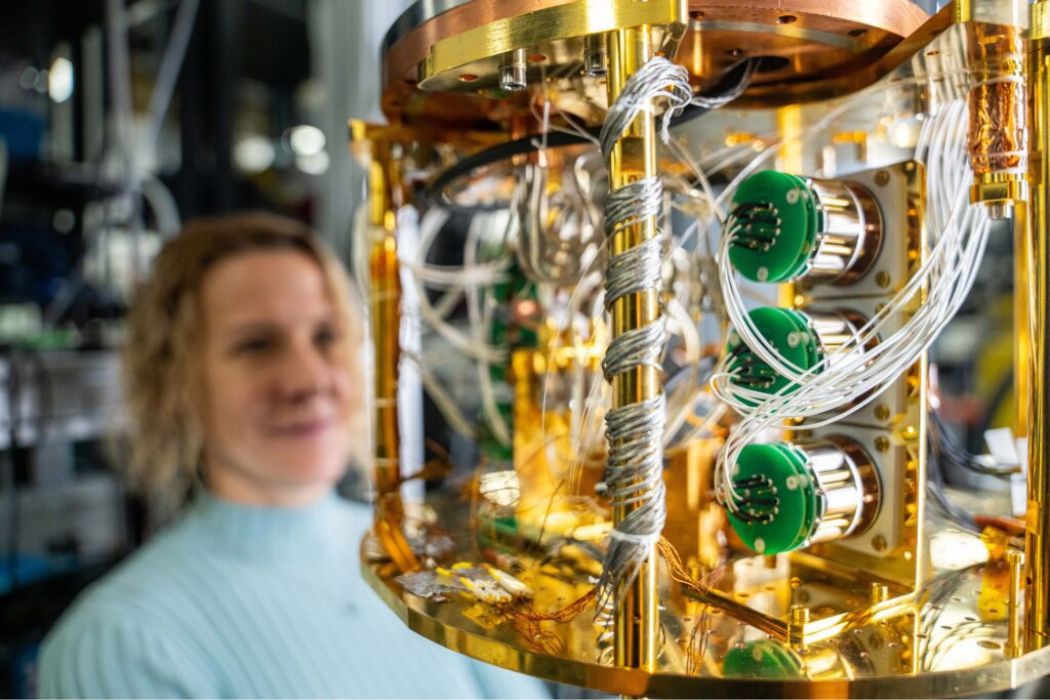
Feature image courtesy Photonic.